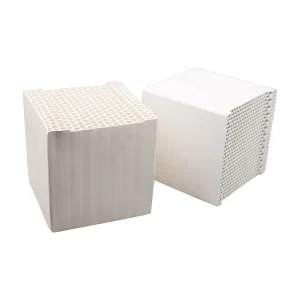
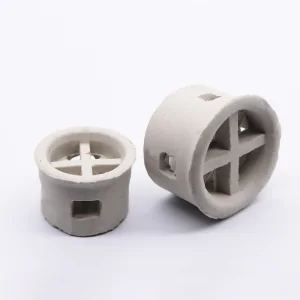
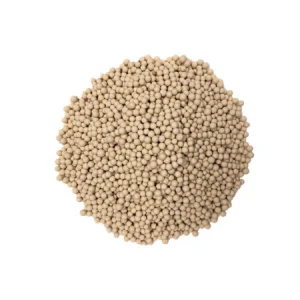
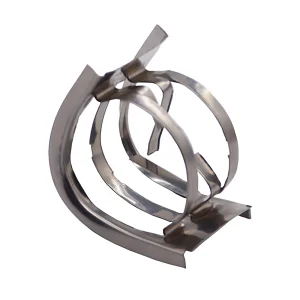
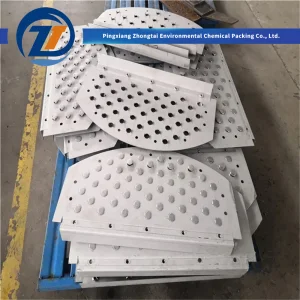
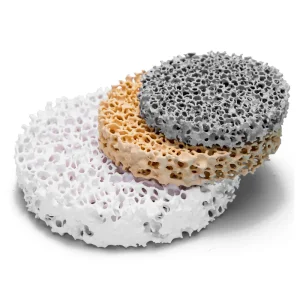
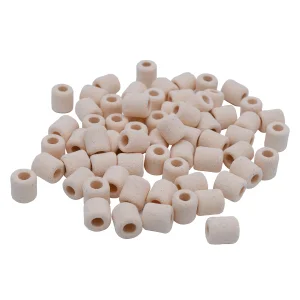
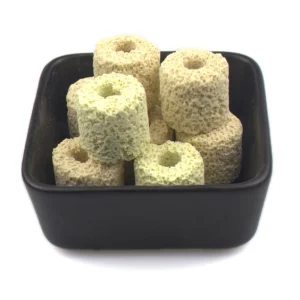
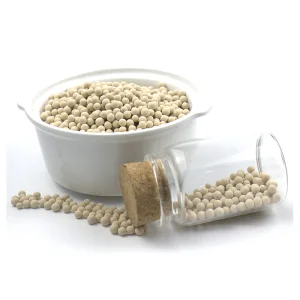
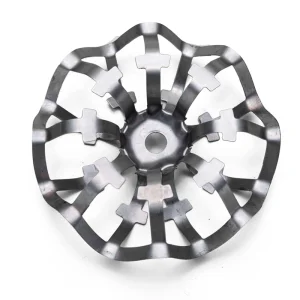
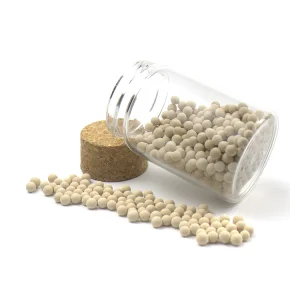
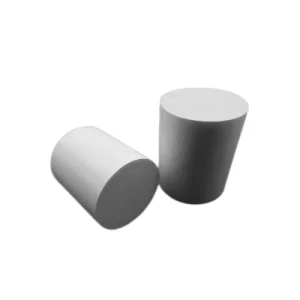
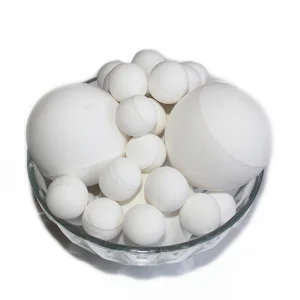
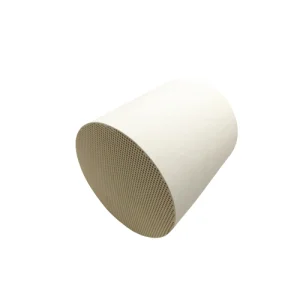
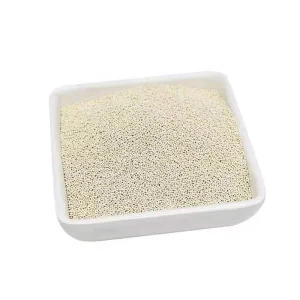
Explore our core product portfolio manufactured in Pingxiang, China for chemical processing, refinery operations, and gas purification.
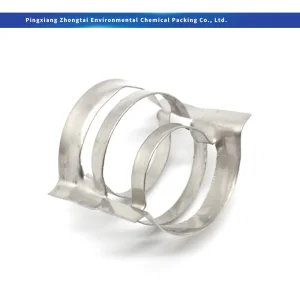
A comprehensive technical evaluation of potassium-exchanged alkali metal aluminosilicate for critical industrial moisture separation.
Zeolite 3A (Type A Molecular Sieve) belongs to the Linde Type A (LTA) synthetic crystalline aluminosilicate family. The primary structural framework consists of silicon-oxygen ($\text{SiO}_4$) and aluminum-oxygen ($\text{AlO}_4$) tetrahedra cross-linked to form a three-dimensional network of sodalite cages connected by 8-ring windows. In its native sodium form (Zeolite 4A), the nominal effective pore aperture measures approximately 4 Ångströms ($0.4\text{ nm}$).
To produce Zeolite 3A, a precise ion-exchange process replaces a substantial portion of the native sodium cations ($\text{Na}^+$) with larger potassium cations ($\text{K}^+$). Chemical stoichiometry yields the formula:
$\text{K}_{m} \text{Na}_{12-m} [(\text{AlO}_2)_{12} (\text{SiO}_2)_{12}] \cdot x\text{H}_2\text{O}$ (where $m$ represents the potassium exchange degree, typically resulting in an effective pore size of $\sim 3\text{ \AA}$ or $0.3\text{ nm}$).
Because the ionic radius of $\text{K}^+$ ($1.38\text{ \AA}$) is significantly larger than that of $\text{Na}^+$ ($1.02\text{ \AA}$), the potassium ions occupy strategic sites within the 8-ring pore openings. This physically constricts the free aperture diameter from $4\text{ \AA}$ down to approximately $3\text{ \AA}$.
The defining operational advantage of Zeolite 3A is its strict kinetic diameter selectivity. Molecules with kinetic diameters smaller than $3.0\text{ \AA}$ readily diffuse into the internal adsorption cavities (alpha-cages), whereas larger organic molecules are completely excluded, eliminating co-adsorption risks.
| Molecule Species | Formula | Kinetic Diameter (Å) | 3A Adsorption Status |
|---|---|---|---|
| Water | $\text{H}_2\text{O}$ | 2.65 Å | Rapid Adsorption |
| Ammonia | $\text{NH}_3$ | 2.60 Å | Rapid Adsorption |
| Hydrogen | $\text{H}_2$ | 2.89 Å | Adsorbed (Trace) |
| Carbon Dioxide | $\text{CO}_2$ | 3.30 Å | Excluded / Restricted |
| Methane | $\text{CH}_4$ | 3.80 Å | Completely Excluded |
| Ethylene | $\text{C}_2\text{H}_4$ | 3.90 Å | Completely Excluded |
| Ethanol | $\text{C}_2\text{H}_5\text{OH}$ | 4.50 Å | Completely Excluded |
By excluding unsaturated hydrocarbons such as ethylene, propylene, and butadiene, Zeolite 3A prevents catalytic polymerization (coking) within the internal pores, avoiding bed fouling and thermal runaways during thermal regeneration cycles.
How rigorous ion-exchange stoichiometry, binder formulation, and thermal calcination guarantee physical integrity and maximum dynamic capacity.
Synthesis begins with high-purity sodium silicate and sodium aluminate raw materials under precise stoichiometric ratios ($\text{SiO}_2/\text{Al}_2\text{O}_3 \approx 2.0$). Hydrothermal crystallization in automated stainless-steel reactors forms uniform Na-A zeolite powder under controlled temperature profiles ($95^\circ\text{C}-105^\circ\text{C}$).
The wet Na-A slurry undergoes multi-stage counter-current potassium ion exchange using refined $\text{KCl}$ solution. Zhongtai precisely controls potassium replacement levels ($\ge40\%$ cation exchange) to achieve strict $3.0\text{ \AA}$ aperture cutoff without sacrificing structural crystallinity.
Purified zeolite powder is compounded with fibrous attapulgite or kaolin clay binders ($10\%-20\%$) and spherical nodulizers. Spheroidized beads undergo multi-zone rotary calcination at $550^\circ\text{C}-600^\circ\text{C}$ to remove structural moisture and induce high mechanical crush strength.
| Physical & Chemical Parameter | Standard Bead (1.6-2.5 mm / 8x12 mesh) | Large Bead (3.0-5.0 mm / 4x8 mesh) | Pellet / Extrudate (1.6mm / 3.2mm) |
|---|---|---|---|
| Bulk Density ($\text{g/mL}$) | 0.70 – 0.74 | 0.68 – 0.72 | 0.66 – 0.70 |
| Crush Strength (N/granule) | ≥ 38 N | ≥ 85 N | ≥ 35 N (Radial) |
| Static Water Adsorption (RH 60%, 25°C) | ≥ 21.5 wt% | ≥ 21.5 wt% | ≥ 21.0 wt% |
| Attrition Rate (wt%) | ≤ 0.05% | ≤ 0.05% | ≤ 0.08% |
| Package Dew Point Capability | < -80°C (-112°F) | < -80°C (-112°F) | < -80°C (-112°F) |
| Residual Moisture Content (Exit Factory) | ≤ 1.0 wt% | ≤ 1.0 wt% | ≤ 1.0 wt% |
Market expansion drivers across Petrochemical Cracking, Renewable Energy Transition, and Energy-Efficient Building Envelope Technologies.
The global molecular sieve market is projected to exceed USD 2.1 Billion by 2030, with Zeolite 3A maintaining the dominant volume share among synthetic adsorbents. Primary macro growth drivers include:
Pingxiang City in Jiangxi Province, China, represents the premier industrial chemical packing and ceramic manufacturing hub worldwide. Sourcing wholesale Zeolite 3A directly from established Pingxiang manufacturers such as Pingxiang Zhongtai Environmental Chemical Packing Co., Ltd. yields substantial supply chain advantages:
Integrated Raw Material Access: Localized clay deposits and synthesized sodium aluminate supply reduce raw material transport overhead by up to 18%.
Quality-Controlled Batch Production: Automated rotary kilns ensure batch-to-batch crush strength uniformity ($\pm 5\%$).
Factory Direct Engineering Quotes: Direct procurement bypasses trading intermediaries, reducing capital expenditure (CAPEX) for plant turnarounds.
Detailed process design integration across five core industrial dehydration duties.
Deploying 3A Zeolite in Temperature-Swing Adsorption (TSA) beds dehydrates crude ethanol vapors ($92-95\%$) up to anhydrous grade ($\ge99.9\%$). Zero co-adsorption of ethanol ensures maximum thermal efficiency without alcohol breakdown or yield loss.
Cracked gas dryers operating ahead of cryogenic fractionation columns require deep dew point suppression ($<-100^\circ\text{C}$). 3A sieve selectively extracts moisture without co-adsorbing light olefins ($\text{C}_2\text{H}_4, \text{C}_3\text{H}_6$), eliminating polymer formation on the adsorbent bed.
Filled into aluminum or warm-edge spacer bars of double-glazed windows, ultra-fine 3A granules (0.5-0.9mm) continuously adsorb trace moisture and solvent vapor without co-adsorbing nitrogen or argon, preventing glass bowing under barometric pressure shifts.
In closed-loop HFC, HFO, and hydrocarbon refrigeration circuits, 3A molecular sieves remove acid-forming water. The controlled $3\text{ \AA}$ pore excludes complex refrigerant molecules (R-134a, R-1234yf) and polyolester lubricants.
Positioned upstream of LNG liquefaction heat exchangers, dual-bed 3A TSA units lower gas moisture content to $<0.1\text{ ppmv}$, preventing ice clogging inside main cryogenic heat exchangers (MCHE).
Continuous liquid-phase drying of hexanes, cyclohexane, and benzene used in polyolefin polymerization catalysts, maintaining organometallic catalyst (Ziegler-Natta) activity by removing ppm-level water.
Engineering adaptations of Zeolite 3A desiccant systems tailored to distinct climatic and regulatory environments.
Operating Environment: US Gulf Coast petrochemical plant operating an 800,000 MT/year naphtha steam cracker.
Challenge: Premature coking and rapid pressure drop in drying vessels caused by historic co-adsorption of ethylene on non-uniform molecular sieve beads.
Zhongtai Solution: Retrofitted bed loading with Zhongtai High-Crush 3A Spherical Beads (1.6-2.5 mm) featuring strict $\ge42\%$ potassium exchange. Dynamic break-through capacity increased by $14\%$, eliminating ethylene co-adsorption and extending thermal regeneration intervals from 24 to 36 hours.
Operating Environment: High-efficiency triple-pane window manufacturing in Central & Northern Europe.
Challenge: Strict adherence to European Standard EN 1279-2/3 requires zero nitrogen desorptive glass deflection down to $-40^\circ\text{C}$ ambient temperatures.
Zhongtai Solution: Supplied specialized low-dust 3A micro-beads ($0.5-0.9\text{ mm}$) with dust index $<15\text{ ppm}$. Verified air-desorption volumes below $0.05\text{ mL/g}$, preventing unit collapse and seal degradation over 25-year service lifetimes.
Next-generation adsorbent formulations, low-carbon synthesis pathways, and AI-assisted bed optimization.
Conventional beads contain 15-20% inert clay binder. Next-gen hydrothermal synthesis converts inert binder phases directly into active LTA zeolite framework, boosting volumetric water capacity by 18-22% and shrinking vessel sizes.
Surface modification using nano-scale hydrophobic shells lowers desorption activation energy, allowing complete bed regeneration at $170^\circ\text{C}-190^\circ\text{C}$ (down from $250^\circ\text{C}-280^\circ\text{C}$), saving up to 30% thermal energy in industrial TSA systems.
Zhongtai is pioneering electric calcination kilns coupled with 100% mother-liquor hydrothermal recycling, eliminating wastewater discharge and lowering carbon intensity ($kg\text{ CO}_2/kg\text{ product}$) by over 40%.
Complete mass transfer components supplied directly from Pingxiang Zhongtai Environmental Chemical Packing Co., Ltd.
Expert engineering clarity regarding molecular sieve selection, regeneration curves, pressure drop limits, and operational lifespans.
All three belong to the Linde Type A (LTA) crystal framework. Zeolite 4A is the unexchanged sodium form ($\text{Na-A}$) with an effective pore diameter of approximately $4.0\text{ \AA}$. Zeolite 3A is produced via potassium ion exchange ($\text{K-A}$), reducing the active pore opening to $3.0\text{ \AA}$ to adsorb only water and polar molecules while excluding hydrocarbons. Zeolite 5A undergoes calcium ion exchange ($\text{Ca-A}$), expanding the effective pore size to $5.0\text{ \AA}$, allowing it to co-adsorb normal alkanes while excluding iso-paraffins and cyclic hydrocarbons.
In Temperature Swing Adsorption (TSA) systems, regeneration is accomplished by passing a dry purge gas (nitrogen, natural gas, or process gas) through the bed at elevated temperatures ($200^\circ\text{C}-250^\circ\text{C}$ or $390^\circ\text{F}-480^\circ\text{F}$). The bed must be heated slowly to avoid thermal shock, held at peak temperature until outlet dew point stabilizes below $-60^\circ\text{C}$, and then cooled down to operating temperature before being reintroduced to the process stream.
Zeolite 3A excludes molecules with kinetic diameters larger than $3.0\text{ \AA}$. Ethylene ($3.9\text{ \AA}$), propylene ($4.5\text{ \AA}$), and ethanol ($4.5\text{ \AA}$) cannot physically penetrate the 3A sodalite cages. If 4A zeolite were used, unsaturated hydrocarbons would enter the pores and undergo catalytic coking during high-temperature thermal regeneration, rapidly deactivating the adsorbent and creating extreme hot spots in the vessel.
Smaller beads (1.6-2.5 mm) offer higher mass transfer rates and sharper breakthrough curves due to shorter internal diffusion paths, making them ideal for high-purity liquid phase drying or compact vessels. Larger beads (3.0-5.0 mm) create lower pressure drops across tall, high-velocity gas drying columns. Use the Ergun equation to balance allowed pressure drop ($\Delta P$) against required dynamic adsorption efficiency.
Under recommended operating conditions with clean feed gas (free of free water droplets, heavy pyrolytic oil, or strong mineral acids), Zhongtai Zeolite 3A maintains high adsorption capacity for 3 to 5 years (typically 2,000 to 4,000 thermal regeneration cycles). Gradual capacity loss occurs primarily through hydrothermal aging and pore contraction over time.
Standard export packaging includes 25 kg multi-wall air-tight paper bags with PE liners, 25 kg steel drums with outer seals, or 500 kg / 1000 kg UV-stabilized super-sacks (jumbo bags) on fumigated wooden or plastic pallets. Custom moisture-proof packaging is tailored for long-distance maritime container shipments.
To receive a technical proposal and quotation, please provide: 1) Target application (ethanol, olefin, insulating glass, natural gas), 2) Required particle shape and size (beads or extrudates), 3) Total metric tonnage or bed volume ($\text{m}^3$), 4) Port of destination, and 5) Any specific crush strength or dynamic adsorption standards required by your plant design.
Partner with Pingxiang Zhongtai Environmental Chemical Packing Co., Ltd. for factory-direct molecular sieve supply, comprehensive data sheets, and custom bed loading calculations.