1 / 1
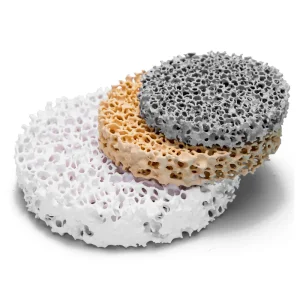
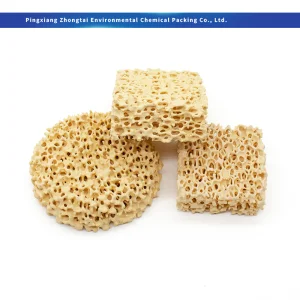
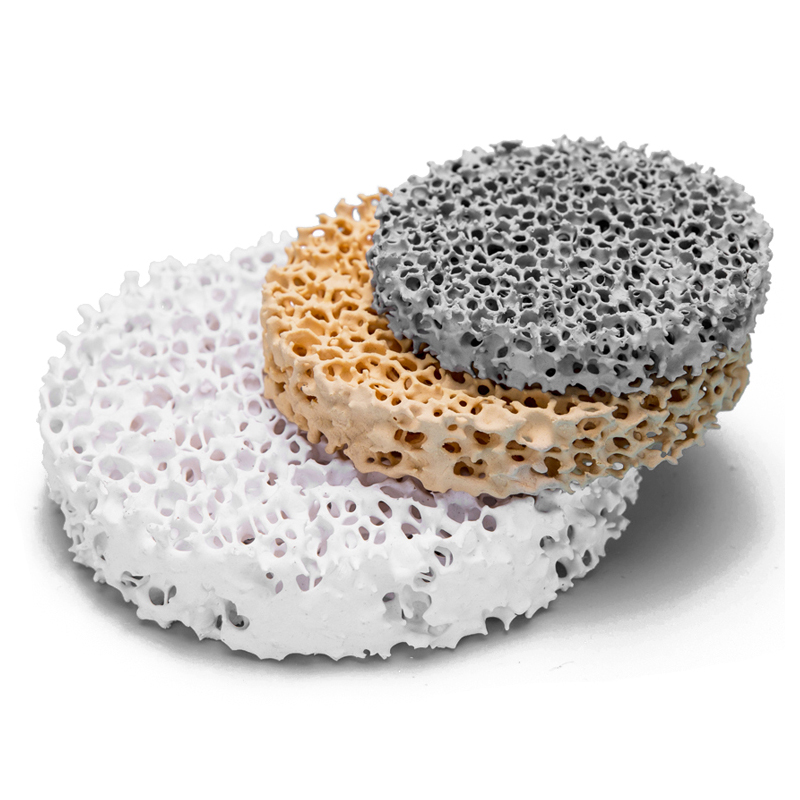
Ceramic foam filters feature high porosity, low thermal shock loss, superior mechanical strength at both ambient and elevated temperatures, a large specific surface area, and exceptional chemical stability. Engineered with an advanced 3D open-cell matrix, they deliver outstanding screening, residue collection, and adsorption performance—capturing tiny impurities down to 1~10 µm.
By converting turbulent molten metal flow into stable, laminar flow, this three-dimensional structure degassing the melt, significantly reducing non-metallic inclusions and elevating overall casting quality. In addition to high-temperature molten metal filtration, ceramic foam filters are widely adopted for hot gas treatment, catalyst carriers, solid heat exchange systems, and specialized packing in the chemical industry.
High-efficiency mechanical screening and deep-bed adsorption for fine inclusions as small as 1~10 µm.
Low thermal shock loss with thermal endurance capable of withstanding up to 1600°C extreme operating temperatures.
Transforms molten turbulence into smooth laminar flow, effectively eliminating gas porosity and casting defects.
Ideal for non-ferrous, iron, and steel casting, hot gas purification, catalyst substrates, and chemical tower packing.
| Ceramic Foam Filter | Material Specifications | |||
|---|---|---|---|---|
| Property | Unit | Alumina (Al₂O₃) | Silicon Carbide (SiC) | Zirconia (ZrO₂) |
| Composition | Al₂O₃ | ≥ 85% | ≤ 30% | ≤ 30% |
| SiO₂ | ≤ 1% | ≤ 10% | ≤ 4% | |
| Others | -- | SiC ≥ 60% | ZrO₂ ≥ 66% | |
| Channels Density | 10 ~ 60 ppi | 10 ~ 60 ppi | 10 ~ 60 ppi | |
| Porosity | 80 ~ 90 % | 80 ~ 90 % | 80 ~ 90 % | |
| Bending Strength | 0.6 MPa | 0.8 MPa | 0.8 ~ 1.0 MPa | |
| Heat Conductivity | 0.8 MPa | 0.9 MPa | 1.0 ~ 1.2 MPa | |
| Max Operation Temperature | 1100 °C | 1500 °C | 1600 °C | |
| Heat Resistance (1100–20°C) | 6 Times/1100°C | 6 Times/1100°C | 6 Times/1100°C | |
| Primary Application | Non-ferrous, Alumina making | Iron smelting | Steel making | |
Ceramic foam filters are manufactured in square, round, and tailored geometric profiles. Dimensions span from 10 mm up to 600 mm, with standard thicknesses ranging between 10 mm and 50 mm. Standard pore densities include 10 ppi, 15 ppi, 20 ppi, and 25 ppi, with custom cut-to-size specifications and higher porosities available upon request.
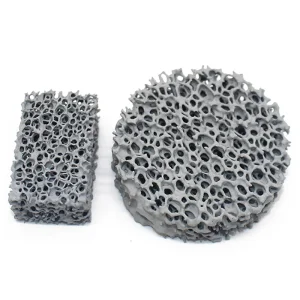
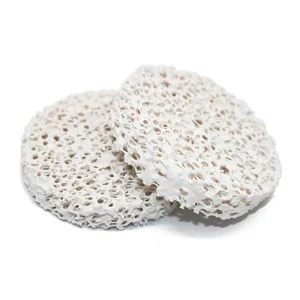
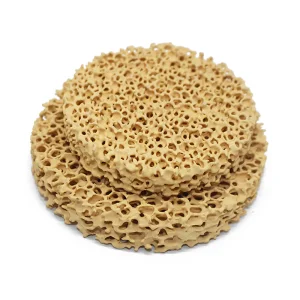
Ceramic foam filters are primarily manufactured using three standard refractory materials: Alumina (Al₂O₃ ≥ 85%), Silicon Carbide (SiC ≥ 60%), and Zirconia (ZrO₂ ≥ 66%), each formulated for specific metallurgy and temperature environments.
Alumina filters withstand continuous operating temperatures up to 1100°C; Silicon Carbide filters operate safely up to 1500°C; and Zirconia filters provide extreme heat resistance up to 1600°C.
The three-dimensional open-pore network alters liquid metal movement from turbulent flow to steady lamellar (laminar) flow. This minimizes air entrainment, removes trapped gases, traps tiny impurities (1~10 µm), and significantly smooths the cast surface.
Standard pore channel densities range from 10 to 60 ppi (with 10, 15, 20, and 25 ppi most common) and total porosity between 80% and 90%. Geometries encompass round, square, and custom cut-to-size formats from 10 mm up to 600 mm across, with thicknesses between 10 mm and 50 mm.
Yes. Beyond molten non-ferrous, iron, and steel casting, their thermal and structural stability allows deployment in industrial high-temperature gas filtering, catalyst carriers, solid heat exchange systems, and chemical reaction filling media.