Wholesale Catalyst carrier cordierite honeycomb ceramics for DOC Factories, Quotes

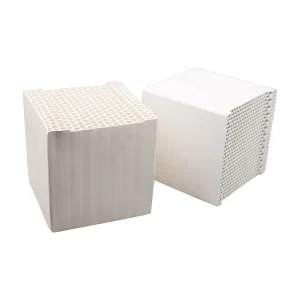
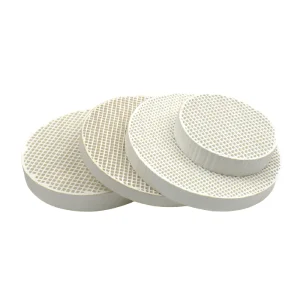
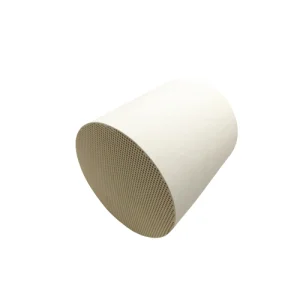
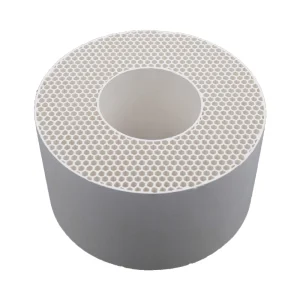
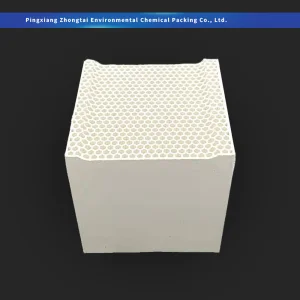
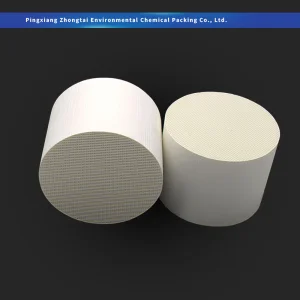
Ceramic honeycomb substrate (catalyst monolith) is a new kind of industrial ceramic product, as a catalyst carrier which are widely used in automobile emissions purifying system and industrial exhaust gas treatment system.

Product Description

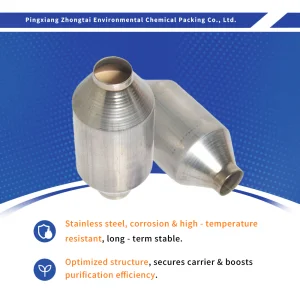
Catalytic Converter Substrate for Vehicle

Material Composition: Its major material is composed of cordierite and stainless steel of iron. The material for catalytic converter substrate is cordierite.

The natural cordierite exists very rare in nature, so most of cordierites are man-made substances.

Key Thermal Properties

Low thermal expansion coefficient and good thermal shock resistance.

High Resistance

High anti-acid, anti-alkali, anti-erosion function, and good mechanical strength.

Standard CPSI

The usual CPSI for catalytic converter substrate is 400.

Versatile Shapes

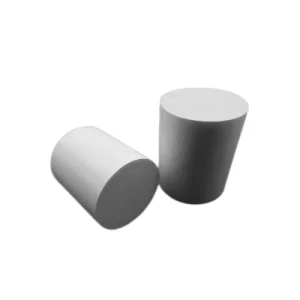
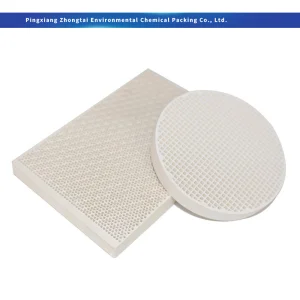
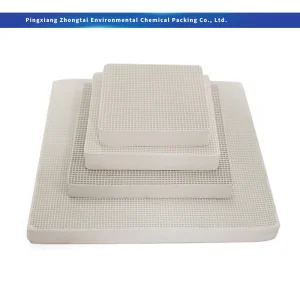
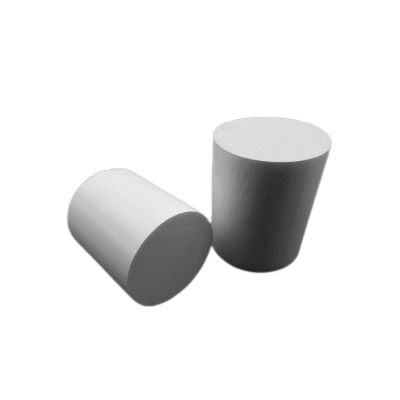
Round, racetrack, ellipse, and custom shapes tailored to different car models.

Properties of Honeycomb Ceramics

Item Unit Alumina Ceramic Dense Cordierite Cordierite Mullite
Density g/cm³ 2.68 2.42 2.16 2.31
Bulk Density kg/m³ 965 871 778 832
Thermal Expansion Coefficient 10⁻⁶/K 6.2 3.5 3.4 6.2
Specific Heat Capacity J/kg·K 992 942 1016 998
Thermal Conductivity W/m·K 2.79 1.89 1.63 2.42
Thermal Shock Resistance Max K 500 500 600 550
Softening Temperature ℃ 1500 1320 1400 1580
Maximum Service Temperature ℃ 1400 1200 1300 1480
Average Heat Capacity W/m·K/m³·K 0.266 0.228 0.219 0.231
Water Absorption % ≤20 ≤5 15-20 15-20
Acid Resistance % 0.2 5.0 16.7 2.5

Frequently Asked Questions (FAQ)

What are the primary materials used in catalytic converter substrates?
The major material is composed of cordierite and stainless steel of iron, with cordierite being the core ceramic substrate material.
Why is synthetic cordierite predominantly used instead of natural cordierite?
Natural cordierite is extremely rare in nature; therefore, almost all cordierites used in industrial and automotive applications are man-made synthetic substances.
What key features make cordierite suitable for vehicle catalytic converters?
Cordierite features a low thermal expansion coefficient, excellent thermal shock resistance, robust mechanical strength, and superior resistance to acids, alkalis, and erosion.
What is the standard CPSI for vehicle catalytic converter substrates?
The typical cell density specification (CPSI - cells per square inch) for vehicle catalytic converter substrates is 400.
What geometric shapes are available for honeycomb ceramics?
Honeycomb ceramic substrates are offered in round, racetrack, ellipse, and other customized configurations to accommodate diverse automotive models and exhaust system designs.
How does cordierite compare to other honeycomb ceramics in thermal shock resistance?
Standard cordierite delivers a thermal shock resistance rating of Max 600 K, outperforming alumina ceramics (500 K), dense cordierite (500 K), and mullite (550 K).

Related Products