Engineered random and structured mass transfer media, ceramic filters, and molecular sieves for industrial gas processing and chemical absorption.

In modern chemical separation, gas scrubbing, and absorption processes, mass transfer columns demand optimal interfacial surface contact combined with absolute minimum pressure drop. For decades, standard Pall Rings dominated random packing bed designs. However, the operational limitations of 1:1 aspect ratio cylinders became apparent in high-throughput chemical towers.
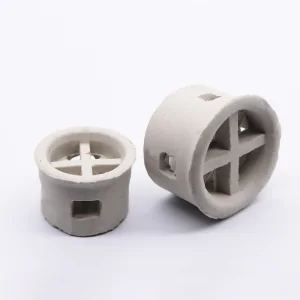
The Plastic Cascade Mini Ring (CMR) represents a revolutionary structural departure. Featuring a reduced aspect ratio—typically 1:3 (height to diameter ratio)—the CMR design alters the spatial orientation of packing elements within a randomly dumped bed. When dumped into a packed column, the lower height forces a higher percentage of rings to align horizontally rather than vertically. This preferential orientation creates a streamlined passage for vapor phase flow while presenting a continuous, highly accessible liquid film surface.
The engineered internal flanges and flared edges of the Plastic Cascade Mini Ring significantly enhance mass transfer efficiency through three primary fluid dynamics phenomena:
Selecting the correct thermoplastic matrix is essential to guarantee mechanical creep resistance, thermal integrity, and chemical inertness over a 15+ year operational lifespan.
| Polymer Variant | Abbr. | Max Temp (°C) | Chemical Resistance Highlights | Primary Industrial Applications |
|---|---|---|---|---|
| Polypropylene | PP | 90°C – 100°C | Excellent resistance to aqueous acids, bases, and inorganic salts. Susceptible to strong oxidizers. | Water treatment, municipal scrubbers, ambient gas absorption. |
| Reinforced Polypropylene | RPP | 110°C – 125°C | Glass-fiber enriched matrix offering high mechanical rigidity and resistance to thermal creep. | Hot acid gas absorption, ammonium nitrate scrubbers, deep packed beds. |
| High-Density Polyethylene | HDPE | 80°C – 90°C | Exceptional low-temperature impact strength, excellent resistance to environmental stress cracking. | Cold water degasification, low-temperature petrochemical stripping. |
| Polyvinyl Chloride | PVC | 60°C – 70°C | High resistance to chlorine gas, strong oxidizing agents, and strong mineral acids. | Chlor-alkali wet scrubbers, chlorine dioxide generation units. |
| Chlorinated PVC | CPVC | 95°C – 105°C | Elevated temperature limits with robust chemical resistance to aggressive halogen compounds. | High-temperature wet chlorine scrubbers, hot bleach recovery towers. |
| Polyvinylidene Fluoride | PVDF | 140°C – 150°C | Fluoropolymer engineered for extreme acid/solvent exposure, ozone resistance, and low outgassing. | Semiconductor ultrapure chemical towers, nitric/sulfuric acid strippers. |
Across the Gulf Coast chemical processing hubs (Texas and Louisiana), demand for Wholesale Plastic Cascade Mini Rings is driven by NGL fractionators and sour gas sweetening units. Amine scrubbing systems (MDEA/MEA) utilize PP and RPP CMR packings to maximize acid gas removal ($H_2S$ / $CO_2$) while minimizing reboiler heat energy consumption due to low pressure drop overheads. Furthermore, emerging Carbon Capture, Utilization, and Storage (CCUS) pilot and commercial facilities are standardizing on specialized CMR geometries to handle massive gas volumetric throughputs.
Under stringent EU Industrial Emissions Directives (IED) and REACH regulations, chemical plants in Germany, the Netherlands, and Antwerp are revamping existing packed columns. Replacing standard packing with high-efficiency PVDF and CPVC Cascade Mini Rings allows facilities to meet sub-10 ppm VOC emission thresholds without expanding physical tower footprints. Additionally, European procurement specifications increasingly demand certified post-industrial recycled (PIR) polymer blends to align with corporate ESG guidelines.
China, India, and Southeast Asian industrial zones (such as Rayong, Thailand and Johor, Malaysia) account for over 55% of global wholesale volume demand. Mega-scale refinery integration projects require cost-effective, high-capacity plastic packing for sea-water desulfurization, cooling tower water treatment, and fertilizer manufacturing (ammonia scrubbers). China-based manufacturers lead global supply chains by leveraging automated injection molding centers in Jiangxi and Zhejiang to provide factory-direct pricing.
Rigorous hydrodynamic characterization allows process engineers to size towers accurately and prevent catastrophic bed flooding under high turndown conditions.
The hydraulic capacity of Plastic Cascade Mini Ring beds is modeled using modified Sherwood-Leva-Eckert correlations. The capacity parameter ($Y$) is expressed as a function of gas velocity ($U_G$), packing factor ($F_p$), liquid viscosity ($\mu_L$), and phase densities ($\rho_G, \rho_L$):
Due to its low aspect ratio, the packing factor ($F_p$) of a #2 Plastic CMR is approximately 28 ft⁻¹, compared to 40 ft⁻¹ for an equivalent 1.5-inch plastic Pall Ring. This physical drop in packing factor directly translates to a 30% wider hydrodynamic operating window before reaching the loading point.
Manufacturer tolerances must adhere to strict dimensional consistency to maintain calculated bed voidage values ($\epsilon$):
In natural gas sweetening plants, columns scrub $H_2S$ and $CO_2$ using aqueous amine solvents (such as MDEA). High gas throughputs in conventional beds lead to liquid entrainment and severe pressure drop spikes. Replacing internal packing with Polypropylene Cascade Mini Rings reduces overhead pressure losses, cuts foam generation tendencies, and lowers reboiler energy duty by up to 18%.
Wet chlorine gas handling requires total resistance to oxidative degradation and chemical cracking. Utilizing PVDF or CPVC Plastic Cascade Mini Rings in primary chlorine tail-gas scrubbers ensures complete structural integrity under exposure to wet $Cl_2$ gas and concentrated sodium hypochlorite ($NaOCl$) solutions, avoiding ring softening or structural bed collapses common with lower-tier polymers.
Industrial wastewater streams contaminated with benzene, toluene, or chlorinated hydrocarbons undergo air stripping. High void fraction Plastic CMR packings maximize gas-liquid mass transfer contact area per unit volume. The improved liquid distribution prevents channeling down column shell walls, yielding higher mass transfer rate coefficients ($K_L a$) at low liquid-to-gas ($L/G$) operating ratios.
Marine scrubbers and coastal power station FGD units treat massive exhaust volumes. Lightweight Polypropylene CMR packing elements deliver high mechanical resilience against wave motion-induced bed shifting while remaining immune to seawater bio-fouling and mineral scaling over extended continuous duty cycles.
Understanding the key cost drivers of Plastic Cascade Mini Ring manufacturing helps procurement managers optimize bulk contracts and evaluate factory quotes accurately.
Polymer resin market prices (ICIS / Platts indices) represent 60%–70% of total wholesale product cost. Virgin Polypropylene (PP) provides the baseline economy, whereas RPP carries a 15%–20% premium due to glass fiber compounding. Speciality fluoropolymers like PVDF can cost 8x to 12x baseline virgin PP per metric ton.
High-volume orders ($>50 \text{ m}^3$) benefit from multi-cavity hot-runner injection mold tools running on high-speed robotic presses. Larger ring sizes (CMR #3) require lower piece-counts per cubic meter, reducing unit production cycle times, whereas micro sizes (CMR #0.5) require extended molding runs per unit volume.
Wholesale quotes are calculated on a volumetric basis ($\text{USD/m}^3$) rather than weight due to the low bulk density of plastic random packing ($45–95 \text{ kg/m}^3$). Utilizing high-compression jumbo woven bags ($1 \text{ m}^3$ to $1.5 \text{ m}^3$) maximizes 40HQ container loadability, accommodating up to $65–70 \text{ m}^3$ of product per shipment.
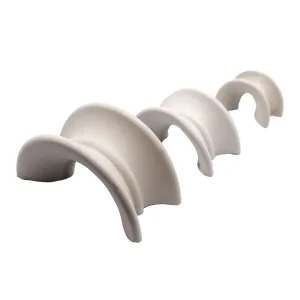
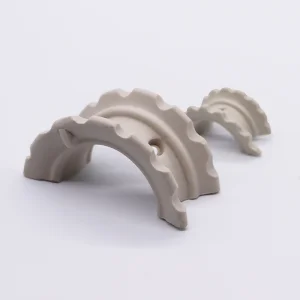
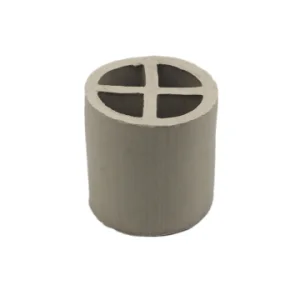
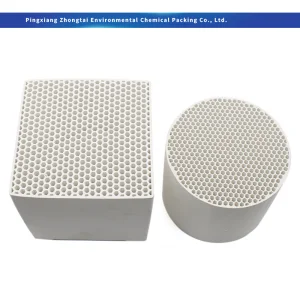
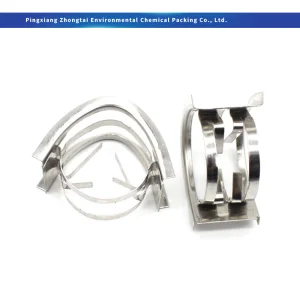
Explore factory-direct ceramic saddles, metal random packings, honeycomb monoliths, and conjugated rings for high-temperature and high-pressure tower designs.
The chemical process industry is shifting rapidly toward carbon neutrality, digital design validation, and circular material loops.
Leading manufacturers are introducing bio-polypropylene derived from tall oil and bio-waste feedstocks. These circular polymers deliver identical thermal resistance and mechanical tensile strength as fossil-derived resins, helping EPC contractors meet strict Scope 3 embedded carbon targets during plant construction.
Advanced computational fluid dynamics (CFD) and machine learning algorithms are optimizing the micro-grooves along CMR ring walls. By molding sub-millimeter laser-etched textures onto the plastic surface, liquid film spreading velocities increase by up to 22%, significantly lowering minimum wetting rates ($L_{min}$) without increasing pressure drop.
Integration of 3D non-destructive CT scanning allows process engineers to model exact dumped packing orientations inside digital twin simulation platforms. This enables predictive modeling of hydraulic maldistribution and wall flow effects prior to physical tower installation, eliminating on-site commissioning delays.