Global Industrial Engineering Whitepaper: Advanced Zeolite Crystallography, Mass Transfer Mechanics, and High-Performance Adsorption Technologies for Petrochemical, Gas Processing, and Clean Energy Transition
Precision-engineered synthetic zeolites, monolith substrates, and chemical tower packings designed for extreme thermal and chemical process environments.
A comprehensive examination of global supply chains, material synthesis breakthroughs, and China's strategic role in modern adsorption technology.
The global inorganic molecular sieve market is expanding rapidly, projected to reach over USD 6.5 Billion by 2030. Key growth drivers include stringent environmental emissions standards, decarbonization initiatives (Carbon Capture, Utilization, and Storage - CCUS), and the expanding footprint of Liquefied Natural Gas (LNG) processing plants across North America, the Middle East, and Asia-Pacific.
Centered in established industrial hubs such as Pingxiang, Jiangxi, Chinese molecular sieve manufacturers have evolved from low-cost suppliers to global technological pioneers. By integrating kaolin clay raw material processing, precision hydrothermal synthesis kilns, and advanced automated extrusion/spheronization lines, China delivers world-class zeolites with uncompromised batch stability.
Industrial demand is shifting toward energy-efficient separation media. High-performance Pressure Swing Adsorption (PSA) and Vacuum Pressure Swing Adsorption (VPSA) molecular sieves reduce cycle times and lower regeneration thermal energy requirements by up to 22%, directly contributing to operational Scope 1 and Scope 2 carbon footprint reductions.
Inorganic molecular sieves (crystalline aluminosilicates) operate on molecular sieving mechanisms governed by angstrom-level pore diameters (3Å, 4Å, 5Å, 10Å/13X). A deviation of merely 0.1Å in channel geometry can dramatically alter kinetic selectivity, leading to co-adsorption losses or premature desiccant breakthrough in high-pressure gas dehydrators.
Understanding the molecular pore architectures, cation-exchange mechanics, and dynamic mass transfer dynamics that govern industrial gas separation.
Synthetic inorganic molecular sieves are crystalline, hydrated alkali metal aluminosilicates possessing three-dimensional interconnecting networks of $SiO_4$ and $AlO_4$ tetrahedra. The primary building blocks form secondary structural units (SBR), resulting in defined cages and channels. The replacement of silicon ($Si^{4+}$) by aluminum ($Al^{3+}$) within the framework creates a negative charge imbalance, which is neutralized by exchangeable cations such as $Na^+$, $K^+$, $Ca^{2+}$, or $Li^+$.
| Zeolite Type | Framework Code | Nominal Pore Diameter (Å) | Primary Balancing Cation | Kinetic Diameter Cutoff (Å) | Primary Industrial Application |
|---|---|---|---|---|---|
| Molecular Sieve 3A | LTA (Linde Type A) | 3.0 Å | Potassium ($K^+$) | < 3.0 Å | Cracked gas, ethanol, liquid olefin & LNG dehydration. Prevents co-adsorption of hydrocarbons. |
| Molecular Sieve 4A | LTA (Linde Type A) | 4.0 Å | Sodium ($Na^+$) | < 4.0 Å | Static dehydration in closed systems, refrigerant drying, closed-loop air brake systems. |
| Molecular Sieve 5A | LTA (Linde Type A) | 5.0 Å | Calcium ($Ca^{2+}$) | < 5.0 Å | PSA normal/iso-paraffin separation, $H_2$ purification, transformation of natural gas sweetening beds. |
| Molecular Sieve 13X | FAU (Faujasite) | 10.0 Å (Faujasite cage) | Sodium ($Na^+$) | < 9.0 Å | Cryogenic air separation unit (ASU) prep, $H_2S$/Mercaptan removal, oxygen concentrators. |
| 13X-HP / Li-X | FAU (Faujasite) | 9.0–10.0 Å | Lithium ($Li^+$) | < 9.0 Å | High-efficiency VPSA medical and industrial oxygen generation plants. |
In fixed-bed adsorption columns, the efficiency of an inorganic molecular sieve is evaluated by the length of its Mass Transfer Zone (MTZ). A sharp, short MTZ indicates fast intragranular diffusion kinetics, high dynamic adsorption capacity, and minimal unutilized bed height during operations. China’s advanced binderless molecular sieves reduce inert clay content from 20% down to <5%, maximizing active crystalline zeolite content per unit volume.
Industrial desiccant beds experience cyclic pressure shocks and thermal spikes during regeneration (Thermal Swing Adsorption - TSA at 200°C–315°C). High crush strength (>85 N/particle for 3-5mm spheres) and resistance to hydrothermal structural degradation are critical to prevent particle attrition, bed compaction, dust carryover, and subsequent downstream compressor damage.
Custom-engineered adsorbent solutions tailored for extreme operational parameters across global processing facilities.
Challenge: Ethylene and propylene feedstocks require deep dehydration down to <1 ppmv water content to prevent catalyst poisoning in downstream polymerization reactors while avoiding hydrocarbon co-adsorption.
Solution: Specialized 3A molecular sieve beads engineered with constrained 3Å pore apertures, high attrition resistance, and optimized pore volume distribution.
Challenge: Air feed streams containing trace moisture, carbon dioxide ($CO_2$), and hydrocarbons must be thoroughly prepurified to prevent explosive freeze-outs in cryogenic main heat exchangers.
Solution: High-capacity 13X-APG and specialized APG-II molecular sieve beds designed for low $CO_2$ mass transfer zone length, operating efficiently under ambient and elevated inlet temperatures.
Challenge: Green hydrogen production via electrolysis or steam methane reforming (SMR), along with biogas upgrading, requires high-purity gas drying and carbon dioxide/siloxane removal.
Solution: VPSA Lithium-X and 5A/13X molecular sieve configurations providing high dynamic separation selectivity at optimized operating pressures.
Demonstrating technical authority, operational experience, and rigorous quality assurance across the full synthesis lifecycle.
Leading Chinese inorganic molecular sieve manufacturers execute comprehensive quality control procedures adhering strictly to international standards, including ASTM, HG/T, and ISO protocols. Every production batch undergoes rigorous laboratory evaluation prior to factory clearance:
Next-generation adsorbent innovations driving decarbonization, energy efficiency, and material longevity.
Traditional molecular sieves incorporate 15-20% inert clay binders (kaolin, bentonite) to form mechanically stable extrudates or beads. The breakthrough toward 100% active binderless zeolites via post-synthesis chemical conversion increases adsorption capacities by 15-25% while decreasing vessel footprint requirements.
Current TSA systems require regeneration temperatures reaching up to 300°C. Advanced surface chemistry modification enables desiccant regeneration at sub-150°C temperatures, opening pathways for direct integration with industrial waste heat recovery networks.
Combining micropores (<2 nm) for molecular selectivity with engineered mesopores (2-50 nm) for fast mass transport solves severe intra-crystalline diffusion limitations, significantly improving dynamic processing speeds in heavy hydrocarbon separation.
Combining adsorption media with high-efficiency tower packings, catalyst bed supports, and monolithic substrates for complete mass transfer operational excellence.
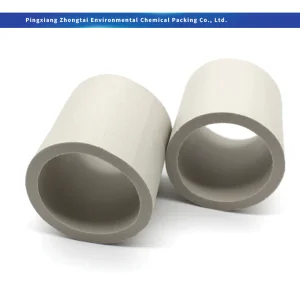
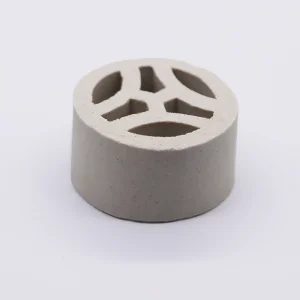
A modern chemical refining or natural gas purification facility relies on a holistic mass transfer ecosystem. Molecular sieves act as final-stage polishing adsorbents, but their operating efficiency is heavily dependent on upstream separation equipment, including random tower packings, structured packings, and ceramic bed supports.
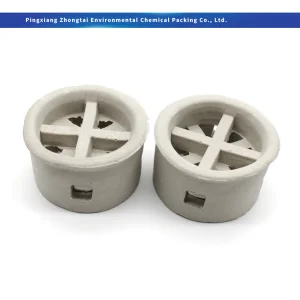
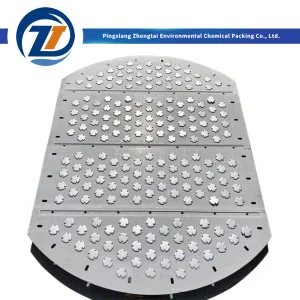
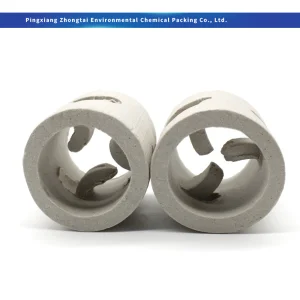
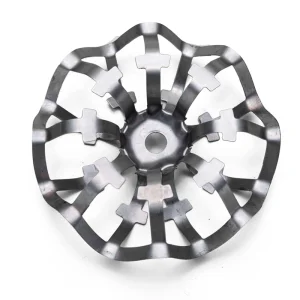
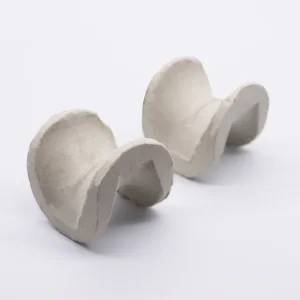
Before raw natural gas reaches molecular sieve dehydration beds, acid gas scrubbing towers utilizing ceramic Pall Rings, Raschig Rings, or metal floating valve trays remove bulk $H_2S$ and $CO_2$. Efficient upstream phase separation prevents liquid carryover, acid droplets, and heavy hydrocarbons from blinding the zeolite pores down-stream.
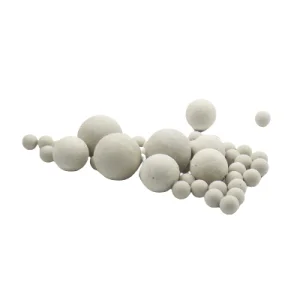
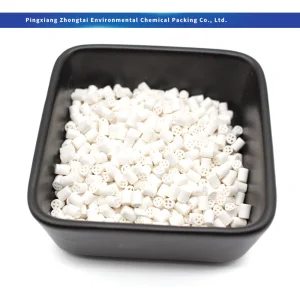
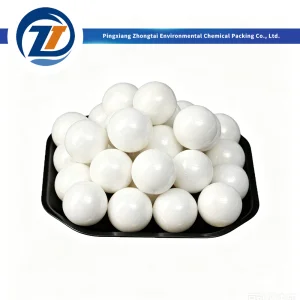
Inside the fixed-bed adsorbent vessel, inert alumina ceramic balls (17%-99% $Al_2O_3$) are installed at the top and bottom of the bed. They function as flow distributors to prevent gas channeling, hold down molecular sieve particles to eliminate bed fluidization, and cushion shock waves during cyclic valve switching in high-pressure PSA units.
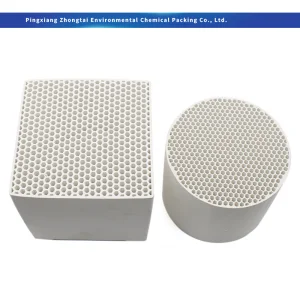
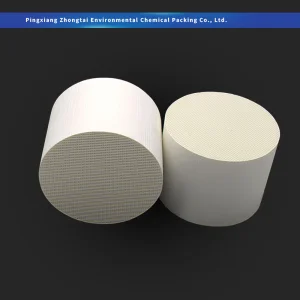
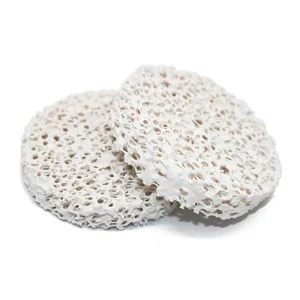
Regenerative Thermal Oxidizers (RTO) and catalytic oxidizers utilizing honeycomb cordierite ceramic monoliths process waste gases regenerated from molecular sieve concentration wheels, delivering continuous zero-VOC industrial gas abatement with up to 95% thermal heat recovery efficiency.
Expert answers to critical procurement, chemical compatibility, bed sizing, and operation questions posed by process design engineers.
Selection depends entirely on the kinetic diameter of the carrier gas and target adsorbate. Molecular Sieve 3A (pore diameter ~3Å) adsorbs water while excluding unsaturated hydrocarbons like ethylene, propylene, and ethanol, preventing co-adsorption and side reactions. Molecular Sieve 4A is standard for static desiccant duty in closed air or gas loops. Molecular Sieve 5A adsorbs molecules up to 5Å (such as n-paraffins), while 13X (pore diameter ~10Å) is selected when co-removal of water, carbon dioxide, $H_2S$, and trace mercaptans is required (e.g., in cryogenic air separation pre-treatment).
Under recommended process parameters (adequate feed filtration, controlled regeneration ramp rates, and avoidance of liquid water or heavy hydrocarbon fouling), high-grade synthetic molecular sieves operate reliably for 3 to 5 years (typically 2,000 to 4,000 regeneration cycles in TSA duty). Performance monitoring involves tracking the dew point at the bed outlet; when breakthrough occurs prematurely, it indicates thermal aging or bed contamination.
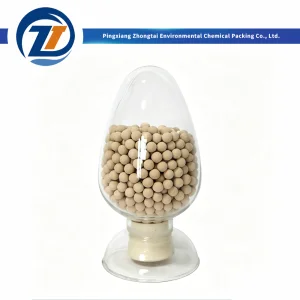
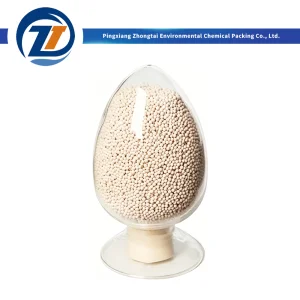
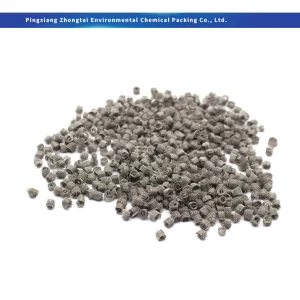
Spherical molecular sieve beads offer superior packing density, higher bulk crush strength, and uniform hydraulic flow distribution compared to extrudate pellets. Beads experience less attrition friction against vessel walls during pressure cycling, significantly reducing dust generation and pressure drop across the adsorbent column.
Hydrocarbon coking occurs when heavy hydrocarbons ($C_6+$) condense inside the zeolite pores during thermal regeneration. To prevent coking, plants should utilize upstream mechanical coalescing filters to remove liquid aerosol droplets, implement a dry purge gas cycle prior to heating, and ensure regeneration gas temperatures increase gradually to sweep volatile hydrocarbons out before high temperatures induce cracking.
Liquid water exposure causes severe thermal hydro-shocks and structural collapse of the crystalline zeolite framework (particularly in LTA types), leading to substantial loss of crush strength and active surface area. If a bed is flooded, immediate laboratory testing of core samples is mandatory. In most cases, flooded portions must be replaced to prevent total bed collapse.
Complementary ceramic support balls, structured metal packings, and specialty filtration media for industrial processing plants.
Need assistance selecting molecular sieve adsorbents, bed sizing, or custom tower packing configurations? Our team of senior chemical engineers provides factory-direct quotes and comprehensive technical data sheets.
