Premium grade catalyst bed support spheres, random packing, and molecular sieves produced under strict ASTM/HG standards.
A rigorous examination of microstructural integrity, chemical inertness, and thermal-mechanical dynamics in continuous process systems.
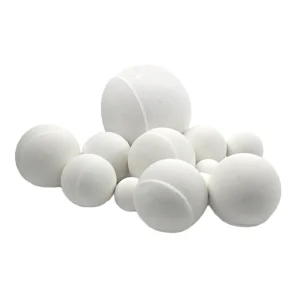
Operating as critical fluid distributors and physical retention barriers inside fixed-bed reactors, our inert alumina ceramic balls are formulated with refined microcrystalline kaolin, feldspar, and calcined alpha-alumina ($\alpha\text{-Al}_2\text{O}_3$). Engineered to resist thermal shock cycles up to 1350°C and compressive shock loads up to 35 kN/particle, they prevent active catalyst fluidization and reactor bed plugging.
HG/T 3683.1-2014 & ASTM C515 StandardFormulated from ultra-fine, spray-dried calcined alumina powder ($92\%\text{–}95\%\ \text{Al}_2\text{O}_3$), our grinding spheres exhibit a dense isometric crystal matrix free of internal micro-voids. With Vickers hardness exceeding HV 1100 and low wear loss values ($\le 0.01\%$), they ensure zero silica contamination in high-purity zirconia, titanium dioxide, and advanced glaze milling operations.
Density: 3.65 - 3.85 g/cm³Beyond traditional smooth spheres, Chinese ceramic balls encompass specialized perforated, multi-hole, and grooved convex architectures. These geometric modifications reduce reactor bed pressure drops by 18% to 26% while substantially multiplying the effective interstitial void fraction, optimizing two-phase vapor-liquid distribution across deep multi-stage catalytic hydrocrackers.
High Void Fraction & Low ΔPHow the world's most concentrated chemical packing hub delivers unmatched material quality, rapid lead times, and economies of scale.
Situated in Pingxiang, Jiangxi Province, our manufacturing base leverages hyper-localized raw material logistics. High-grade sedimentary kaolin, high-whiteness quartz, and synthetic calcined aluminas are secured within a 60-kilometer radius, protecting procurement schedules from global raw material shocks.
Firing takes place in computer-controlled, 120-meter continuous natural gas tunnel kilns monitored by SCADA and DCS feedback loops. Multi-zone optical pyrometers regulate thermal ramps within a tight ±3°C variance, eliminating thermal internal micro-fissuring across millions of sphere batches.
Precision sphere sizing utilizes synchronized 3D rolling pans and high-tonnage dry cold isostatic pressing (CIP). This dual-line capability ensures absolute sphericity (≥ 98.5%) and high volumetric packing densities that streamline catalyst bed volume calculation during plant loading.
From raw slurry viscosity and laser particle size distribution analysis to dry particle crush strength testing and ultrasonic integrity checks, every metric ton is digitally cataloged with non-destructive acoustic and mechanical crushing records.
How global refineries, petrochemical complexes, and green-tech plants protect billion-dollar catalyst beds using Pingxiang media.
In severe Hydrodesulfurization (HDS), Hydrocracking, and Continuous Catalytic Reforming (CCR) units, bed support ceramic balls are subjected to partial pressures of hydrogen exceeding 150 bar and temperatures above 450°C. Our high-alumina media prevents catalytic poisoning, resists hydrogen embrittlement, and maintains mechanical support integrity across multi-year operating runs.
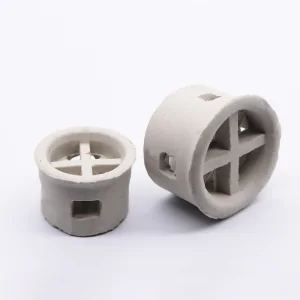
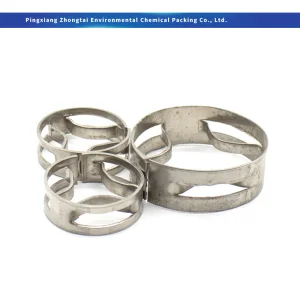
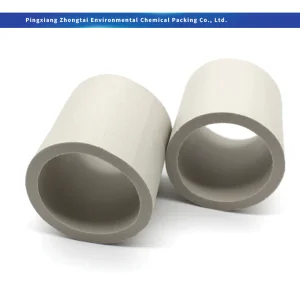
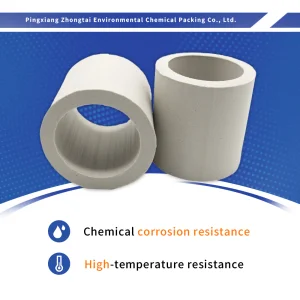
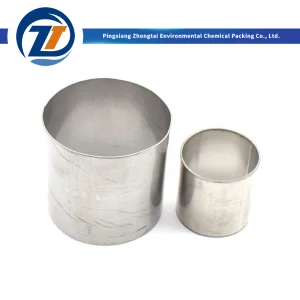
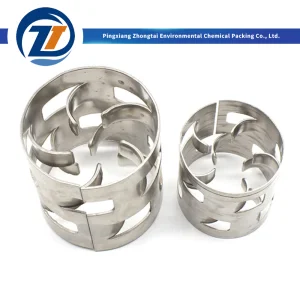
Modern double-contact double-absorption (DCDA) sulfuric acid plants subject packing media to 98% to 99% hot concentrated acid. Our chemical-porcelain inert ceramic balls and acid-resistant Raschig/saddle rings possess acid solubility loss values below 0.5%, withstanding harsh liquid-gas contact without leaching iron or alumina into end-product battery-grade acid.
In secondary steam-methane reformers, shift converters, and methanators, high steam partial pressure can leach trace amorphous silica ($\text{SiO}_2$), carrying it downstream to foul cooler condenser tubes and heat exchangers. Pingxiang Zhongtai's low-silica (≤0.1% $\text{SiO}_2$) 99% alumina balls completely mitigate downstream silicification risks.
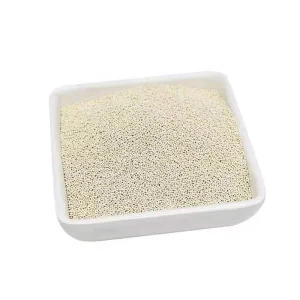
High-tech electronics, lithium iron phosphate (LFP) battery cathode production, and advanced dielectric ceramics require zero-iron contamination during micronization. Our isostatically pressed 92% and 95% $\text{Al}_2\text{O}_3$ grinding balls deliver low wear loss, maximizing kinetic energy transfer in high-speed stirred and horizontal ball mills.
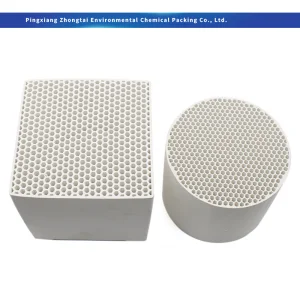
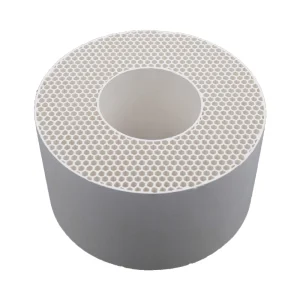
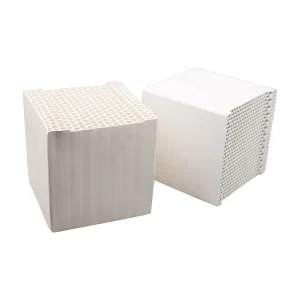
Collaborating directly with our honeycomb ceramic monolithic blocks, high-thermal-capacity ceramic spheres serve as primary heat buffer layers at the inlet face of volatile organic compound (VOC) abatement beds. They absorb high-velocity acoustic and thermal shocks, preventing premature crack propagation in delicate monolithic matrixes.
Engineered with tailored interconnected microporosity, specialized dechlorination and bio-ceramic media provide high specific surface area ($>450\ \text{m}^2/\text{m}^3$) for nitrifying and denitrifying biofilm cultivation. They neutralize active halogen ions without hazardous byproduct formation.
Comprehensive technical specifications guiding process EPCs, refinery maintenance engineers, and plant turnaround managers.
| Property Parameter | Standard Inert (17–23%) | Medium Alumina (23–30%) | High Alumina (65–75%) | High-Purity Corundum (90–92%) | Super-Pure (99.5% Al₂O₃) |
|---|---|---|---|---|---|
| Al₂O₃ Content (%) | 17.0 – 23.0 | 23.0 – 30.0 | 65.0 – 75.0 | 90.0 – 92.5 | ≥ 99.5 |
| SiO₂ Content (%) | 70.0 – 75.0 | 65.0 – 70.0 | 20.0 – 28.0 | 5.5 – 7.0 | ≤ 0.10 (Zero Silica Leaching) |
| Fe₂O₃ Content (%) | ≤ 1.0 | ≤ 0.8 | ≤ 0.5 | ≤ 0.2 | ≤ 0.05 |
| Bulk Density (g/cm³) | 1.35 – 1.45 | 1.40 – 1.50 | 1.85 – 1.95 | 2.10 – 2.25 | 2.35 – 2.50 |
| Specific Gravity (g/cm³) | 2.30 – 2.40 | 2.40 – 2.50 | 2.90 – 3.10 | 3.60 – 3.70 | 3.85 – 3.92 |
| Water Absorption (%) | ≤ 2.0 | ≤ 1.5 | ≤ 0.5 | ≤ 0.05 | ≤ 0.02 |
| Crush Strength (3/4" - 19mm) | ≥ 4.5 kN/particle | ≥ 6.0 kN/particle | ≥ 12.0 kN/particle | ≥ 22.0 kN/particle | ≥ 30.0 kN/particle |
| Max Operating Temp (°C) | 1100 °C | 1200 °C | 1450 °C | 1600 °C | 1800 °C |
| Acid Resistance (%) | ≥ 99.6 (HG/T 3683.1) | ≥ 99.7 | ≥ 99.8 | ≥ 99.8 | ≥ 99.9 |
Standard reactor bottoms utilize a reverse-graded stacking architecture: beginning with 2-inch (50mm) or 1.5-inch (38mm) balls on top of grid screens, transitioning through 1" (25mm), 1/2" (13mm), 1/4" (6mm), to 1/8" (3mm) immediately supporting the catalyst pellets. This guarantees an even flow distribution while avoiding catalyst migration into downstream piping.
Under hydrotreating steam operating temperatures above 380°C, acidic environments dissolve amorphous silicate phases, creating gaseous silicic acids that crystallize on downstream heat exchanger tubes. Our low-silica corundum media keeps free active silica extraction below 5 ppm across standard steam-methane test sequences.
Dynamic crush resistance is verified by dumping batches into a test container from a 6-meter vertical height drop without shattering. High thermal shock resilience is certified through repeated cycles consisting of heating specimens to 850°C for 45 minutes followed by instantaneous cold-water quenching without cracking.
Strategic R&D pathways addressing decarbonization, advanced hydrogen economy infrastructures, and nano-engineered catalyst carriers.
By adopting sub-micron seeded gel precursor synthesis, our advanced materials lab is engineering next-generation alpha-alumina ceramic balls with average crystal grain sizes under 1.2 micrometers. This grain refinement elevates single-particle crushing resistance beyond 45 kN while significantly dampening micro-crack propagation under extreme thermal cyclic shocks.
Near-Zero Intergranular PorosityAs the clean energy transition drives large-scale ammonia cracking and liquid organic hydrogen carrier (LOHC) dehydrogenation reactors, Pingxiang Zhongtai is commercializing high-porosity yet mechanically resilient ceramic supports doped with rare-earth oxides (Lanthanum, Cerium) to maximize surface active metal dispersity while avoiding high-temperature sintering deactivation.
Targeted Active Metal DispersionOur factory modernization roadmap integrates green oxy-fuel combustion and electric heating elements into continuous kilns, cutting Scope 1 carbon emission intensity by over 40%. Concurrently, we are qualifying closed-loop recycling loops for spent non-toxic ceramic packing into low-shrinkage thermal insulation monoliths.
40% Decarbonized Kiln OperationsEnsuring compliance with international standards, transparent third-party auditing, and damage-proof transit to over 80 nations.
Strict adherence to ISO 9001:2015 Quality Management Systems, ISO 14001 Environmental Management, and ISO 45001 Occupational Health & Safety. Full conformity to EU REACH regulations and RoHS directives.
Configured for maritime transit: multi-layer woven FIBC jumbo bags (1,000 kg capacity) with moisture-proof polyethylene inner liners, or sealed 200L steel/polyethylene drums mounted on ISPM 15 fumigation-free composite or heat-treated solid timber pallets.
Factory inspection access for international testing agencies including SGS, BV, and TÜV. Batch inspection reports covering chemical XRF elemental analysis, crushing test curves, and true density parameters accompany every commercial shipping manifest.
Bilingual process engineering support available 24/7. Tower packing volume calculations, dynamic hydraulic modeling, and emergency replacement turnaround services for refinery unplanned shutdowns worldwide.
In-depth engineering answers addressing selection criteria, performance limits, and logistics protocols.
Advanced structured and random packing media, heat exchangers, and zeolite molecular sieves manufactured in Pingxiang.