Factory-direct chemical mass transfer components engineered for extreme durability, low pressure drop, and precise pore distribution.
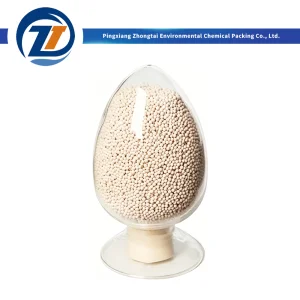
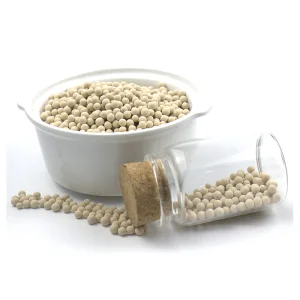
In the contemporary chemical process industries (CPI), **molecular sieve adsorbents** represent the core technology for selective gas separation, deep dehydration, and liquid hydrocarbon purification. As synthetic crystalline aluminosilicates possessing uniform 3D pore networks at the angstrom scale (3Å to 10Å), molecular sieves outperform conventional desiccants—such as silica gel and activated alumina—in dynamic water capacity, thermal resistance, and extreme selectivity.
Global demand for wholesale molecular sieves is driven by the rapid expansion of liquefied natural gas (LNG) trains, green hydrogen purification plants, olefin cracked gas drying towers, and oxygen/nitrogen pressure swing adsorption (PSA) generators. EPC contractors and process engineers face stringent operational parameters: moisture levels in cryogenically processed natural gas must consistently stay below **0.1 ppmv** to prevent hydrate formation and heat exchanger freeze-ups. Attaining these metrics requires sourcing adsorbents with guaranteed hydrothermal stability, minimal point-crush attrition, and optimized mass transfer zones (MTZ).
As a specialized enterprise based in Pingxiang, Jiangxi Province—China's recognized capital for industrial ceramics and chemical tower packing—Pingxiang Zhongtai Environmental Chemical Packing Co., Ltd. (Zhongtai Packing) has established an integrated manufacturing ecosystem since 2003. By integrating raw kaolin clay processing, automated sphere pelletization, high-temperature tunnel kilns, and real-time point-crush strength testing, Zhongtai offers world-class adsorbents directly to international refineries, air separation plant operators, and EPC engineering firms.
Molecular sieves are structured around tetrahedral building blocks of [SiO4]4- and [AlO4]5- linked by shared oxygen atoms. The presence of trivalent aluminum imparts a negative framework charge, balanced by exchangeable alkali or alkaline earth metal cations (K+, Na+, Ca2+). The size of these cation species directly governs the effective crystallographic aperture size, creating precise size-exclusion boundaries:
| Molecular Sieve Grade | Cation / Structure | Nominal Pore Aperture | Bulk Density (g/ml) | Equilibrium Water Adsorption (25°C) | Primary Industrial Application |
|---|---|---|---|---|---|
| Zeolite 3A | Potassium (K-LTA) | ~3.0 Å | 0.68 - 0.74 | ≥ 21.0 % | Cracked gas drying, ethanol dehydration, insulated glass units. Excludes hydrocarbons >3Å. |
| Zeolite 4A | Sodium (Na-LTA) | ~4.0 Å | 0.68 - 0.73 | ≥ 22.0 % | Natural gas dehydration, air compressor desiccant beds, refrigerant drying. |
| Zeolite 5A | Calcium (Ca-LTA) | ~5.0 Å | 0.69 - 0.75 | ≥ 21.5 % | n-Paraffin / iso-paraffin separation, PSA hydrogen purification, CO2 removal. |
| Zeolite 13X | Sodium (Na-FAU) | ~10.0 Å (Supercage) | 0.62 - 0.69 | ≥ 24.5 % | Air separation unit (ASU) pre-purification (H2O & CO2 removal), mercaptan removal. |
| 13X-HP / APG | Modified Faujasite | ~10.0 Å | 0.64 - 0.70 | ≥ 25.5 % | PSA medical oxygen generators, cryogenic air separation feedgas prep. |
A successful adsorption bed design involves more than just selecting high-purity zeolite beads. It requires a total reactor engineering solution to guarantee uniform fluid distribution, prevent bed fluidization during pressure swing cycles, and eliminate liquid carryover. Zhongtai Packing provides a complete end-to-end material architecture:
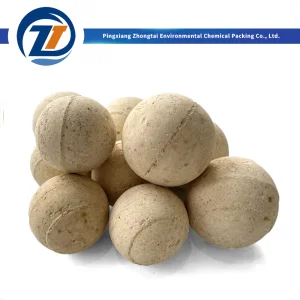
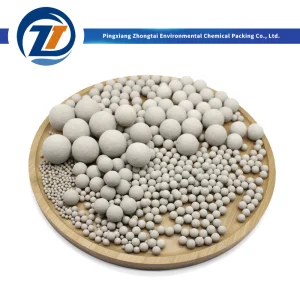
Positioned at the top and bottom of zeolite beds. High-purity alumina balls (17% to 99% Al2O3) hold down the molecular sieve layer, absorb mechanical hydraulic shock, and distribute feed gas evenly.
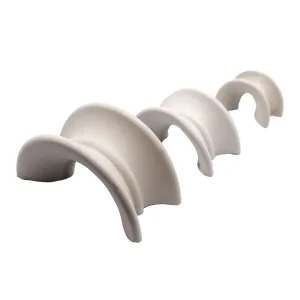
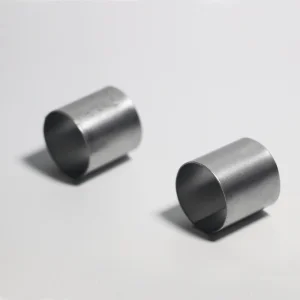
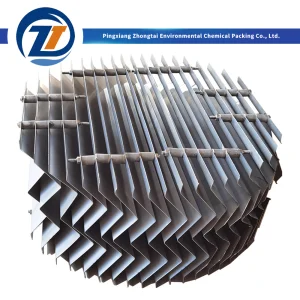
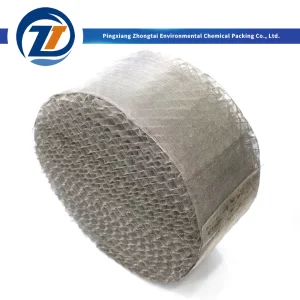
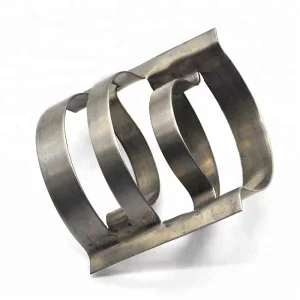
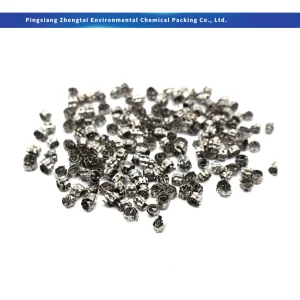
In upstream scrubbers and acid gas removal units, Metal Pall Rings, Intalox Saddles, and Corrugated Structured Packings optimize gas-liquid contact prior to molecular sieve desiccant entry.
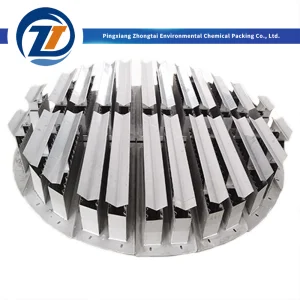
304 / 316L Stainless Steel Trough Liquid Distributors ensure that feed solvents or liquid hydrocarbon streams are evenly dispersed over molecular sieve beds, eliminating channeling.
As global decarbonization mandates intensify, molecular sieve manufacturing is undergoing radical technological changes. Next-generation industrial units require reduced energy consumption during Temperature Swing Adsorption (TSA) regeneration cycles, lower pressure drop across packed beds, and higher resistance to acid-gas degradation.
Traditional molecular sieve beads contain 15% to 20% inert clay binder (attapulgite or bentonite), which provides mechanical crush strength but contributes zero adsorption capacity. Zhongtai's advanced technological roadmap focuses on converting clay binders into active zeolite framework structures. Binderless 13X and 3A sieves increase static water and N2/O2 adsorption capacities by up to 20%, enabling smaller vessel sizing and reduced capital expenditure (CAPEX).
Customized faujasite (FAU) and chabazite (CHA) synthetic zeolites are being engineered with specific cation density ratios to selectively capture CO2 from ultra-dilute atmospheric streams and flue gases. These adsorbents feature optimized heats of adsorption, reducing thermal energy requirements during vacuum-temperature swing adsorption (VTSA) cycles.
Proton Exchange Membrane (PEM) fuel cells require hydrogen purity levels exceeding 99.97% (ISO 14687 Grade D), with strict limits on trace moisture, CO, CO2, and sulfur compounds. Tailored 5A and 13X molecular sieve formulations play a vital role in multi-bed PSA systems designed for green hydrogen production plants worldwide.
Pingxiang City in Jiangxi Province, China, represents the premier industrial cluster for environmental chemical packing, industrial ceramics, and synthetic zeolites. This geographical concentrating of raw material deposits, specialized kiln engineering expertise, and dedicated chemical research laboratories yields a highly integrated supply chain:
Established in 2003, Zhongtai operates extensive production facilities in the West Section Hi-Tech Industry Park, Pingxiang City. Our core competency lies in producing chemically consistent, high-density adsorbents and tower packing media tailored to precise engineering specifications.
Because raw materials, molding machines, calcination kilns, and export packaging units sit within a unified manufacturing perimeter, Zhongtai guarantees short lead times and consistent product quality. Overseas buyers benefit from rigorous batch testing—covering static water adsorption, bulk density, attrition rates, and point-crush strength—recorded per batch and verifiable prior to ocean dispatch.
Deploying chemical adsorbents into international process facilities requires strict adherence to international quality management and environmental compliance standards. Zhongtai Packing operates an end-to-end quality assurance program designed to meet the demands of global EPC contractors:
Bulk density is verified under ASTM D2854; particle size distribution is controlled via ASTM D2862; point crush strength and attrition indices are executed per standard industrial lab methodologies.
Adsorbents are sealed in airtight 25 kg multi-wall paper bags, 150 kg airtight steel drums, or 1000 kg super sacks with desiccant liners to prevent premature ambient hydration during transit.
We welcome third-party inspection agencies (SGS, BV, TUV) for on-site auditing. Korean enterprise auditors and South American engineering teams have successfully evaluated our manufacturing lines.
Practical answers to key questions asked by process engineers and procurement specialists.
Complementary chemical mass transfer packing, heat storage ceramics, and laboratory-grade distillation internals.