Direct factory supply from Pingxiang chemical packing manufacturing hub for global engineering projects.
An authoritative technical analysis of open-ring fluid dynamics, mass transfer coefficients, and polymer matrix selection for chemical separation processes.
In chemical reaction engineering and separation towers, random packing media serve as the fundamental catalyst for liquid-gas interfacial contact. The historical transition from the solid-wall Raschig ring to the open-wall Polypropylene (PP) Pall Ring represents one of the most critical paradigm shifts in tower internal engineering.
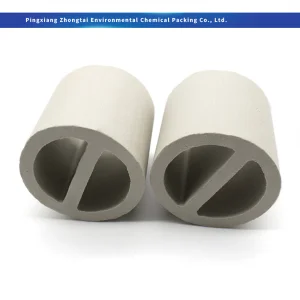
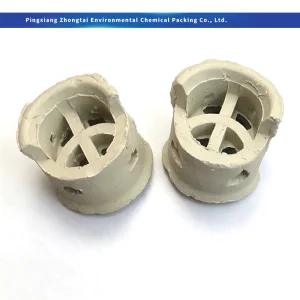
Standard Raschig rings suffer from severe internal stagnation zones, where the inner surface receives minimal fluid wetting and contributes negligible mass transfer while creating significant drag force. Polypropylene Pall Rings solve this hydrodynamic limitation by introducing punched internal window tabs (or fingers) bent inward toward the ring axis.
This structural modification achieves three major fluid dynamic goals:
As a leading Chinese supplier and manufacturer, industrial supply efficiency requires selecting the precise polyolefin formulation matching specific process conditions. Polypropylene Pall Rings are engineered across several distinct resin formulations:
1. Homopolymer Virgin Polypropylene (PP): Standard grade offering outstanding resistance to aqueous acids, inorganic bases, and salts at temperatures up to 100°C–110°C.
2. Reinforced Polypropylene (RPP): Blended with 10%–20% glass fibers or mineral fillers, doubling tensile modulus, preventing creep deformation under high liquid heads, and expanding operating thermal windows up to 130°C.
3. Fluorinated Polyolefins (PVDF / PFA alternatives): For severe oxidative environments (e.g., concentrated wet chlorine gas or hot nitric acid streams), advanced polymer options provide long-term structural survival where standard PP degrades.
Comprehensive engineering physical properties per standard size dimension across industrial packed towers:
| Nominal Size (mm / inch) | Dimensions D × H × T (mm) | Specific Surface Area ($m^2/m^3$) | Void Fraction ($\epsilon$) | Bulk Density ($kg/m^3$) | Packing Factor $F_p$ ($1/m$) |
|---|---|---|---|---|---|
| 16 mm (5/8") | 16 × 16 × 1.0 | 341 | 87% | 115 | 320 |
| 25 mm (1") | 25 × 25 × 1.2 | 228 | 90% | 88 | 175 |
| 38 mm (1.5") | 38 × 38 × 1.4 | 148 | 91% | 72 | 110 |
| 50 mm (2") | 50 × 50 × 1.5 | 112 | 92% | 60 | 80 |
| 76 mm (3") | 76 × 76 × 2.2 | 74 | 93% | 48 | 52 |
From municipal scrubbers to complex petrochemical absorption columns, exploring real-world deployments across diverse industrial ecosystems.
In chemical processing plants across North America and Europe, Polypropylene Pall Rings are the primary standard for packed bed wet scrubbers removing Hydrochloric Acid ($HCl$), Hydrofluoric Acid ($HF$), and Sulfur Dioxide ($SO_2$). PP material remains completely immune to chloride stress corrosion cracking that destroys stainless steel packings.
Wastewater treatment facilities and industrial effluent plants in Southeast Asia and South America utilize 50mm and 76mm PP Pall Rings in packed towers to strip dissolved Volatile Organic Compounds (VOCs) and free ammonia gas from water streams prior to bio-basin discharge.
Middle Eastern offshore oil platforms and thermal desalination facilities deploy large-diameter Polypropylene Pall Rings in vacuum deaeration columns to strip dissolved oxygen from seawater, safeguarding subsea pipelines against internal pitting corrosion.
In chlorine gas production plants, sodium hypochlorite generation units require packing materials capable of handling continuous caustic soda ($NaOH$) circulation. PP Pall Rings provide exceptional chemical stability under alkaline conditions up to pH 14.
Coal-fired power utilities and waste incineration units deploy cost-effective polypropylene random packing in emergency quench towers where high liquid flow rates demand minimal pressure drops to avoid back-pressuring upstream boilers.
Granular urea and phosphate production plants operate absorption towers to recapture fugitive Fluoride and Nitrogen gases. High-strength RPP Pall Rings withstand physical impaction from slurry carryover while retaining high mass transfer efficiency.
Advancing mass transfer efficiency through computational fluid dynamics (CFD), nano-structured surface modification, and circular economy polymers.
Traditional Pall ring designs relied on empirical laboratory trial-and-error. Next-generation Polypropylene Pall Ring manufacturing integrates 3D transient multiphase CFD modeling. By simulating gas-liquid droplet interactions at a sub-millimeter level, Chinese design engineers have optimized internal finger angle geometries.
Recent micro-geometry refinements reduce localized vortex turbulence behind the ring struts, lowering gas pressure drop by an additional 8% to 12% while elevating the overall volumetric mass transfer coefficient ($K_La$).
With global chemical supply chains aligning with Net-Zero 2050 targets, leading Chinese factories are pioneering the integration of ISCC PLUS-certified bio-based Polypropylene and high-density post-industrial recycled (PIR) polymer blends.
These sustainable PP variants retain identical mechanical tensile strength, melt flow indices, and chemical resistance parameters as standard fossil-fuel derived PP, allowing major ESG-conscious chemical conglomerates to decarbonize their physical supply chain without compromising operational reliability.
How the concentrated chemical packing industrial cluster in Pingxiang delivers unprecedented lead time efficiency, quality consistency, and scale economies.
Chinese factories utilize state-of-the-art multi-cavity automated injection molding machinery. Single-tool setups capable of outputting dozens of 25mm or 50mm PP Pall Rings per cycle operate 24/7 under robotic de-gating, achieving volume outputs exceeding millions of units per week.
Direct integration with domestic petrochemical refining giants ensures uninterrupted access to top-tier virgin polypropylene resins with tight Melt Flow Index (MFI) tolerances. Raw material batch purity is verified prior to mold loading via differential scanning calorimetry (DSC).
Optimized jumbo-bag and reinforced container packaging designs maximize ocean freight cubic utilization. Direct freight corridors connecting factories via rail and express highway to Ningbo, Shanghai, and Shenzhen ports guarantee swift worldwide dispatch.
Our technical sales engineers provide precise hydraulic sizing recommendations, pressure drop estimation models, and liquid holdup calculations customized for your tower diameter and chemical system.
Every manufacturing run undergoes rigorous physical and chemical batch testing according to international standards.
Our quality management system is fully certified under ISO 9001:2015 standards. Polypropylene raw materials and finished Pall Rings are tested against stringent physical benchmark metrics:
For international EPC firms and process equipment buyers, regulatory compliance documentation is delivered with every export shipment:
In-depth answers to common questions asked by process engineers, procurement leads, and plant managers.
Discover additional high-performance internal equipment, structured packings, and ceramic support media.