Direct factory supply of high-performance tower packings, catalysts, and molecular sieve structures engineered in Pingxiang, China.
A rigorous examination of kinetic selectivity, crystalline structure optimization, and commercial economics for PSA/VPSA oxygen plants.
The industrial separation of oxygen from ambient air relies heavily on pressure swing adsorption (PSA) and vacuum pressure swing adsorption (VPSA). Historically, standard 13X (Sodium Faujasite) molecular sieves served as the workhorse for mid-scale oxygen production, offering reasonable separation ratios derived from the quadrupole moment difference between Nitrogen ($1.52 \times 10^{-26} \text{ esu cm}^2$) and Oxygen ($0.4 \times 10^{-26} \text{ esu cm}^2$).
However, Chinese material science advances have revolutionized the global supply chain through high-exchange Li-X Molecular Sieves (Lithium Faujasite). By exchanging charge-balancing sodium cations with lithium cations at rates exceeding 98%, the local electric field gradient inside the zeolite supercage increases dramatically. This yields an exceptional $N_2/O_2$ separation factor ($\alpha \ge 6.0$), reducing required adsorbent bed mass by up to 50% and cutting compressor power consumption per ton of oxygen by 30%.
Modern non-cryogenic air separation requires molecular sieves that demonstrate both high equilibrium adsorption capacity and ultra-fast intra-crystalline diffusion rates. Modern Chinese oxygen molecular sieves are manufactured with engineered macro-micro pore structures that minimize intra-particle mass transfer resistance.
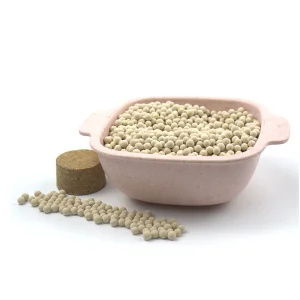
By controlling spherical bead diameter tolerance ($0.4\text{mm} - 0.8\text{mm}$ for micro-PSA medical concentrators, and $1.6\text{mm} - 2.5\text{mm}$ for large-scale VPSA industrial plants), factory engineers suppress bed fluidization while maximizing bed void utilization. The result is an adsorbent capable of maintaining continuous 93%–95% purity oxygen output under high-frequency cycle switches (10 to 60 seconds cycle times).
Quantifiable performance metrics verified through ISO 9001 and batch-level volumetric adsorption testing.
Optimized for low-pressure VPSA systems. Delivers unprecedented nitrogen adsorption volume ($N_2 \ge 20 \text{ Nml/g}$ at ambient pressure) with high thermal stability and zero phase degradation over millions of pressure swing cycles.
Engineered for small-to-medium PSA medical oxygen concentrators and industrial enrichment systems. Designed to tolerate minor feed gas humidity shifts without catastrophic loss of working capacity.
Incorporates advanced attapulgite and kaolin clay matrix binders that provide superior mechanical strength under high hydrodynamic force, eliminating downstream dust contamination of valves and compressors.
Why Tier-1 global EPC contractors and gas equipment builders source synthetic adsorbents from Pingxiang, Jiangxi.
Pingxiang in Jiangxi Province represents China's most robust industrial ceramic and chemical packing cluster. Raw materials—including high-purity kaolin clay, silica sol, and specialty aluminates—are sourced within a 50-kilometer radius. This geographic proximity drastically reduces raw material transit emissions, stabilizes production supply lines, and provides unmatched cost competitiveness for global procurement teams.
Synthesis of FAU-type zeolites requires exact stoichiometric balance of $SiO_2 / Al_2O_3$ ratios during high-temperature hydrothermal crystallization. Advanced Chinese plants utilize automated closed-loop reactors with real-time particle size monitoring. This guarantees consistent pore diameter windows ($10 \text{ \AA}$ for 13X, $9 \text{ \AA}$ for Li-X), avoiding crystal phase impurities such as Zeolite A or hydroxysodalite that reduce separation selectivity.
Final activation of molecular sieve beads demands precise thermal profiles to remove structural hydration without collapsing the crystalline skeleton. Chinese state-of-the-art factories employ multi-zone rotary calcination kilns with continuous moisture monitoring. This yields an exceptionally low Residual Water Content ($< 0.5 \text{ wt\%}$), maximizing immediate working capacity out of the packaging.
A data-driven breakdown of Chinese Oxygen Molecular Sieve grades for process engineering selection.
| Property Parameter | 13X Standard Grade | 13X-HP Oxygen Grade | Li-X High-Purity Grade | Test Standard / Method |
|---|---|---|---|---|
| Cation Exchange Type | Na⁺ (Sodium) | Na⁺ / Ca²⁺ (Sodium-Calcium) | Li⁺ (Lithium ≥ 98%) | ICP-AES Spectroscopy |
| Bead Diameter Range | 1.6 – 2.5 mm / 3.0 – 5.0 mm | 0.4 – 0.8 mm / 1.6 – 2.5 mm | 0.4 – 0.8 mm / 1.6 – 2.5 mm | Particle Size Analyzer |
| N₂ Adsorption Capacity | 8 – 10 Nml/g (at 25°C, 1 bar) | 12 – 15 Nml/g (at 25°C, 1 bar) | ≥ 20 Nml/g (at 25°C, 1 bar) | Static Volumetric Adsorption |
| N₂/O₂ Separation Factor ($\alpha$) | 2.8 – 3.2 | 4.0 – 4.5 | ≥ 6.0 | Chromatographic Break-through |
| Single-Beard Crush Strength | ≥ 35 N (for 1.6-2.5mm) | ≥ 45 N (for 1.6-2.5mm) | ≥ 85 N (for 1.6-2.5mm) | DL/T 515 Standard Tester |
| Bulk Density | 0.62 – 0.68 g/ml | 0.64 – 0.70 g/ml | 0.61 – 0.66 g/ml | ASTM D4180 |
| Attrition Rate | ≤ 0.20 wt% | ≤ 0.15 wt% | ≤ 0.10 wt% | Rotating Drum Abrasion |
| Residual Moisture (Pkg) | ≤ 1.0 wt% | ≤ 0.8 wt% | ≤ 0.5 wt% | Karl Fischer Titration |
| Primary System Application | Industrial Air Drying & Pre-purification | PSA Medical Concentrators (1-5L/min) | Large VPSA Industrial O₂ Plants / Medical Central | Engineering System Audit |
Deploying specialized molecular sieve formulations across medical, metallurgical, chemical, and aquaculture sectors.
Medical-grade PSA systems require compact adsorbent beds that deliver 93% $\pm$ 3% oxygen purity instantly upon startup. Micro-bead 13X-HP and Li-X ($0.4\text{mm} - 0.8\text{mm}$) enable portable oxygen concentrators (POCs) to reduce sieve bed mass by 40%, lowering device weight for home healthcare patients while extending battery runtime.
Electric arc furnace (EAF) steelmaking, copper smelting, and glass manufacturing demand high-volume oxygen (500 to 10,000 $Nm^3/h$). Replacing standard molecular sieves with Lithium-X in Vacuum Pressure Swing Adsorption units dramatically minimizes blower power consumption ($kW/Nm^3 O_2$).
High-concentration ozone generation for municipal water treatment and chemical oxidation relies on pure, ultra-dry oxygen feed gas. Oxygen sieves generate dry $O_2$ with a dew point below $-60^\circ\text{C}$, preventing dielectric tube degradation and nitric acid formation inside ozone generators.
Intensive fish farming and land-based RAS facilities require continuous oxygen injection to maintain dissolved oxygen (DO) saturation levels above 100%. On-site PSA oxygen generators using Chinese 13X-HP sieves reduce bulk liquid oxygen logistics costs by up to 70%.
Dissolved oxygen is the critical reagent in gold slurry cyanidation (Elsner Equation). Supplying oxygen-enriched air ($>90\% O_2$) via VPSA plants speeds up gold dissolution rates, reduces sodium cyanide consumption, and increases overall metal recovery rates in remote mine sites.
In environmental abatement systems where VOC concentrations are variable, auxiliary enrichment with high-purity oxygen allows complete thermal oxidation at lower overall gas volumes, reducing exhaust fan size and operating energy footprint.
How international engineering firms evaluate and verify Chinese adsorbent manufacturing quality.
When procuring bulk molecular sieves (25kg metal drums or 650kg super sacks), engineering teams should enforce strict acceptance thresholds:
Because synthetic zeolites exhibit extreme hydrophilic affinity, moisture ingress during ocean transport will permanently degrade performance prior to installation.
In-depth engineering answers addressing molecular sieve selection, operation, and troubleshooting.
The core difference lies in cation substitution and the resulting electric field gradient within the zeolite cage. Standard 13X-HP uses Sodium (or Sodium-Calcium) cations, offering an $N_2/O_2$ separation factor between 4.0 and 4.5. Lithium-X replaces sodium cations with Lithium ions ($Li^+$ exchange rate $> 98\%$).
Because $Li^+$ has an exceptionally small ionic radius and high charge density, it creates an intense local electrostatic field that interacts strongly with Nitrogen’s quadrupole moment. Consequently, Li-X exhibits nearly double the nitrogen adsorption capacity of 13X-HP, allowing VPSA systems to operate at lower pressures, drastically reducing power consumption and required sieve volume.
Molecular sieves are aggressive adsorbents for polar molecules, with water ($H_2O$) possessing a higher adsorption affinity than Nitrogen ($N_2$). If wet compressed air enters the sieve bed, water molecules permanently occupy the active crystalline cages, causing irreversible loss of nitrogen capacity (hydrothermal poisoning).
Similarly, aerosolized compressor oil coats the external micro-pores of the beads, blocking gas diffusion pathways (oil fouling). Proper pre-treatment—utilizing refrigerated dryers, activated alumina guard beds, and micro-coalescing filters—is mandatory to achieve a 5-to-10-year sieve operational lifespan.
Particle size represents a direct trade-off between mass transfer kinetics and pressure drop (Ergun Equation):
If performance degradation is caused purely by atmospheric water absorption (without oil contamination or thermal lattice damage), the molecular sieve can be reactivated. Thermal regeneration requires heating the material to $250^\circ\text{C} - 300^\circ\text{C}$ while purging the bed with dry, oil-free air or nitrogen gas for 4 to 8 hours.
Caution: Heating must be controlled gradually to prevent hydrothermal degradation caused by rapid steam release within the micro-pores. Oil-fouled adsorbents cannot be restored through thermal purging and must be replaced.
Adsorbent dusting occurs when beads grind against one another under rapid pressure changes, pneumatic vibration, or fluidization. Dusting leads to gas channeling, increased pressure drop, and eventual valve seizure.
Leading Chinese factories prevent attrition by adding synthetic clay binders (such as attapulgite and high-purity kaolin) combined with precise calcination temperatures. This yields single-bead crush strength ratings exceeding 85 N for Li-X sieves and keeps rotational drum attrition rates below 0.10 wt%.
Standard export documentation includes batch-specific Certificates of Analysis (COA) listing crush strength, bulk density, residual moisture, and static adsorption capacity. Additionally, products are accompanied by REACH-compliant Safety Data Sheets (SDS), Technical Data Sheets (TDS), Certificates of Origin (CO) for tariff optimization, and non-hazardous chemical transport certifications for smooth ocean freight clearance.
Complete chemical processing equipment and high-efficiency tower internals engineered for global exports.