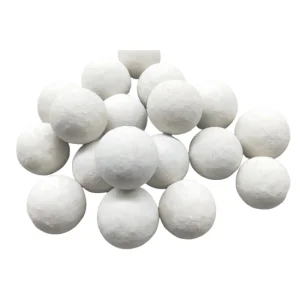
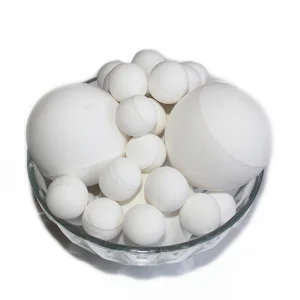
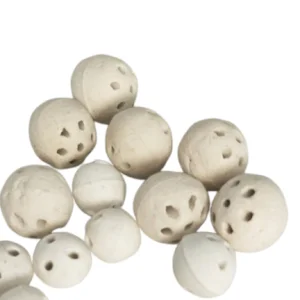
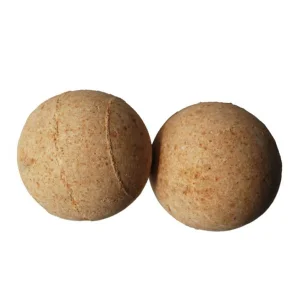
Wholesale Mid-Alumina Ceramic Ball Tower Packing Manufacturer, Quotes

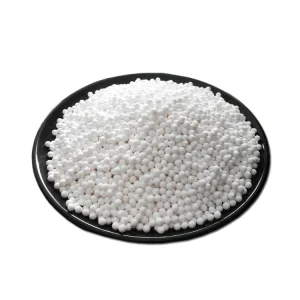
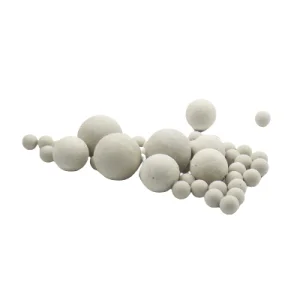
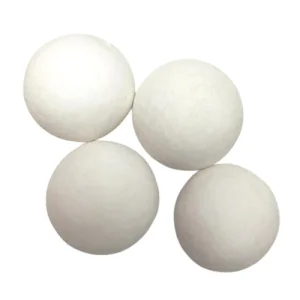
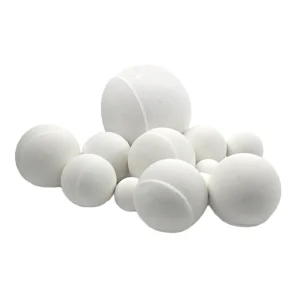
Mid -Alumina Inert ceramic balls are widely used in many fields, including petroleum, chemical engineering, fertilizer production, natural gas and environmental protection. They are used as covering and supporting materials of catalysts in reaction vessels and as packing in towers. They have stable chemical features and a low rate of water absorption, resist high temperatures and high pressure, and also resist the corrosion of acid, alkali and some other organic solvents. They can stand the change in temperature during the manufacturing process. The main role of inert ceramic balls is to increase the distribution spots of gas or liquid, and to support and protect the activating catalyst with low strength.

Product Description

Chemical Composition of Mid-Alumina Ceramic Ball

Al2O3+SiO2 Al2O3 Fe2O3 MgO K2O+Na2O+CaO Others
> 93% 45-50% < 1% < 0.5% < 4% < 1%

Physical Properties of Mid-Alumina Ceramic Ball

Item Value
Water absorption (%) < 2
Bulk density (g/cm3) 1.4-1.5
Specific gravity (g/cm3) 2.4-2.6
Free volume (%) 40
Operation temp.(max) (℃) 1200
Moh's hardness (scale) > 7
Acid resistance (%) > 99.6
Alkali resistance (%) > 85

Crush Strength of Mid-Alumina Ceramic Ball

Size Crush strength
Kg/particle KN/particle
1/8''(3mm) > 35 > 0.35
1/4''(6mm) > 60 > 0.60
3/8''(10mm) > 85 > 0.85
1/2''(13mm) > 185 > 1.85
3/4''(19mm) > 487 > 4.87
1''(25mm) > 850 > 8.5
1-1/2''(38mm) > 1200 > 12
2''(50mm) > 5600 > 56

Size and Tolerance of Mid-Alumina Ceramic Ball

Size and tolerance (mm)
Size 3/6/9 9/13 19/25/38 50
Tolerance ± 1.0 ± 1.5 ± 2 ± 2.5

Frequently Asked Questions

What is the alumina content of mid-alumina ceramic balls?
Mid-alumina ceramic balls feature an Al2O3 content of 45% to 50%, with a combined Al2O3 + SiO2 content exceeding 93%, providing an optimal balance of strength and cost efficiency.
What is the maximum operating temperature for these ceramic balls?
The maximum continuous operation temperature for mid-alumina ceramic balls is 1200℃, making them suitable for most thermal and chemical processing environments.
How resistant are mid-alumina ceramic balls to acids and alkalis?
They offer high chemical stability with an acid resistance exceeding 99.6% and an alkali resistance greater than 85%.
What is the crush strength range across different sizes?
Crush strength increases significantly with diameter, ranging from >35 kg/particle (>0.35 KN) for 3mm balls up to >5600 kg/particle (>56 KN) for large 50mm balls.
What are the manufacturing tolerances for different ball dimensions?
Dimensional tolerances depend on size: ±1.0 mm for 3/6/9 mm balls, ±1.5 mm for 9/13 mm, ±2.0 mm for 19/25/38 mm, and ±2.5 mm for 50 mm balls.

Related Products