Manufactured to strict petrochemical, metallurgical, and environmental engineering tolerances. Direct export supply certified by Pingxiang Zhongtai Environmental Chemical Packing Co., Ltd.
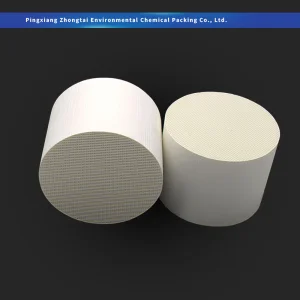
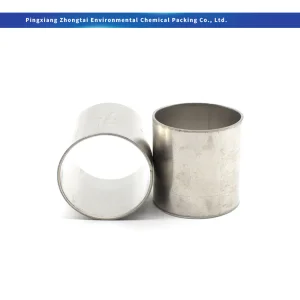
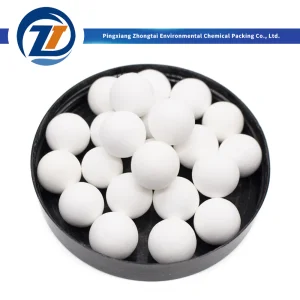
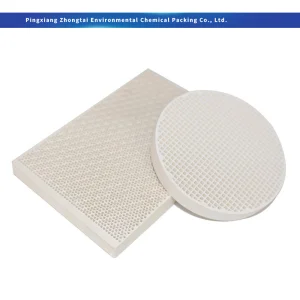

Optimized for thermal insulation, aggressive chemical tank blanketing, volatile organic compound (VOC) vapor suppression, and packed scrubbers across petrochemical, electrowinning, and water treatment operations worldwide.
When spherical floating hollow plastic balls form a single continuous mono-layer or dual-layer blanket over an open-surface liquid tank, they spontaneously assemble into a hexagonal close-packed (HCP) matrix. A single layer reliably covers 91.0% to 91.4% of the exposed liquid interface, immediately reducing VOC release, acidic mist dissipation, and vapor transfer into the ambient environment without interfering with submerging equipment or chemical immersion racks.
In heated process reservoirs, such as electroplating baths, anodizing vats, and phosphating systems operated between 60°C and 95°C, hollow spheres serve as a dynamic thermal barrier. The stagnant trapped air pocket within each hollow shell creates a remarkable convective insulation value, drastically trimming continuous steam, electricity, or boiler heating bills by up to 75%.
In hydrometallurgical electrowinning cells (e.g., copper, zinc, nickel refining) where oxygen and hydrogen bubbles burst violently at the surface, aerosolizing hazardous droplets of sulfuric acid, a double layer of polypropylene hollow balls halts droplet ejection by over 98%, safeguarding operator respiration, overhead crane gantry steel, and HVAC ducting.
When applied in vertical mass transfer scrubbers, degasifiers, and air strippers, hollow plastic balls provide a low-pressure-drop random packing. Their high void fraction (typically >85%) promotes continuous thin-film liquid shearing and high gas-liquid interfacial agitation without channeling or mechanical plugging.
Every industrial scenario dictates an explicit polymer resin to prevent environmental stress cracking (ESC), thermo-oxidative degradation, or premature sinking. Pingxiang Zhongtai manufactures hollow spheres using virgin-grade resins with precision blow molding and ultrasonic seam fusion.
| Resin Type | Specific Gravity | Operating Temp Range | Chemical Resistance Profile | Key Industrial Applications |
|---|---|---|---|---|
| PP (Polypropylene) | 0.90 – 0.92 g/cm³ | 0°C to +100°C (110°C peak) | Excellent resistance to acids, alkalis, inorganic salts, and plating solutions. | Electrowinning cells, plating baths, caustic storage, hot water blankets. |
| HDPE (High-Density Polyethylene) | 0.94 – 0.96 g/cm³ | -50°C to +80°C | Superior impact toughness, high cryogenic crack resistance, UV-stabilized grades. | Outdoor reservoirs, municipal lagoons, mining tailing ponds, algae control. |
| PVDF (Polyvinylidene Fluoride) | 1.76 – 1.78 g/cm³ (engineered ballast) | -30°C to +140°C | Exceptional resistance to elemental halogens (Cl₂, Br₂), concentrated nitric & HF acids. | Chlor-alkali plants, wet chlorine scrubbers, semiconductor etching waste. |
| PTFE (Polytetrafluoroethylene) | 2.14 – 2.20 g/cm³ | -200°C to +260°C | Virtually universal chemical inertness; zero moisture absorption; non-stick surface. | Ultra-pure pharmaceutical tanks, fuming sulfuric acid, high-temperature synthesis. |
| POM (Polyoxymethylene / Acetal) | 1.41 – 1.43 g/cm³ | -40°C to +100°C | High mechanical strength, exceptional dimensional stability, fuel & solvent inertness. | Check valves, fuel tanks, solvent vapor suppression, precision float gauges. |
*Note: Balls designed for surface blanketing are blow-molded with custom hollow cavity ratios, ensuring an effective bulk floating density ranging between 0.20 and 0.45 g/cm³ relative to the liquid medium.
Pingxiang, Jiangxi Province, stands as the undisputed global capital of industrial mass transfer, ceramic media, and chemical tower packings. Discover the structural cost, quality, and velocity benefits of direct factory integration.
Our factory procures virgin Sinopec, Formosa, and Sabic certified pellet lots in 100-ton master batches. By cutting intermediate compounding agents, we guarantee batch-to-batch chemical stability, zero reclaimed resin dilution, and consistent melt-flow indices across million-unit purchase orders.
Equipped with multi-cavity automated blow molding lines and precision robotic deburring equipment, Pingxiang Zhongtai delivers smooth, flash-free equators. Balls resist circumferential seam rupture under hydrostatic loads up to 1.5 MPa, ensuring zero liquid infiltration and zero sinking.
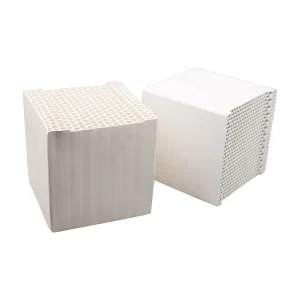
Unlike niche single-product vendors, Zhongtai consolidates hollow plastic balls with ceramic catalyst bed supports, stainless steel tower internals, and honeycomb ceramics into unified 40ft High Cube containers. This multi-material manufacturing scope saves international buyers up to 40% in maritime logistics and port clearance fees.
Each manufacturing run undergoes strict hydrostatic crush testing, boiling-acid exposure trials, dimensional laser micrometry, and accelerated weathering chamber analysis. Test reports (MTC) and third-party inspection certifications (SGS, Intertek) are archived with full supply chain traceability.
Meeting Western and Southeast Asian industrial regulations is not optional. Zhongtai ensures end-to-end product governance from raw pellet inspection to dockside container stuffing.
All polypropylene, polyethylene, and fluoropolymer spheres comply fully with EU Regulation (EC) No 1907/2006 (REACH) and RoHS 3 Directive (EU) 2015/863. Products are completely free of SVHCs (Substances of Very High Concern), phthalate plasticizers, polybrominated biphenyls, and heavy-metal pigments.
For drinking water storage, beverage processing, and bio-filtration facilities, we provide food-grade virgin PP and HDPE hollow balls certified according to FDA 21 CFR 177.1520 criteria, ensuring zero chemical leaching, negligible taste/odor alteration, and total biological safety.
Packaged in moisture-proof woven poly bags (typically 0.1 to 0.5 m³ each) or heavy-duty cardboard cartons secured on ISPM 15 heat-treated fumigation-free wooden pallets. Each shipment includes exact HS code classification (3926.9090), packing lists, commercial invoices, and Form E/CO certificates for preferential tariff treatment.
Field-proven across extreme environmental conditions: from mining electrowinning basins in Chile to wastewater odor abatement in Germany and petrochemical degassing columns in Texas.
The Problem: High-density sulfuric acid aerosols ejected into cathode rooms during copper and zinc electrowinning shorten equipment life and exceed OSHA airborne toxicity limits.
The Solution: Installing a double layer of Zhongtai 20mm or 38mm PP hollow floating spheres reduces acid mist concentration by up to 96%, drastically dropping building ventilation heating loads.
The Problem: Chromic, sulfuric, and hydrochloric acid tanks operate at 70°C+; continuous evaporation causes drastic liquid drawdown, chemical loss, and high electric power consumption.
The Solution: Deploying 50mm smooth-seam hollow balls locks in 70% to 75% of surface heat dissipation, stabilizing bath chemistry and generating full ROI in energy savings within 3 to 6 months.
The Problem: UV sunlight accelerates algae growth in agricultural and potable water reservoirs, while arid desert breezes accelerate evaporative water waste by millions of gallons.
The Solution: Large-diameter (100mm to 150mm) black carbon UV-stabilized HDPE "shade balls" block sunlight penetration completely, eliminating algae bloom without chemical algaecides.
From circular economy mandates to chemical vapor sensing, hollow sphere technology is evolving rapidly. Zhongtai is leading research into tomorrow's engineered solutions.
With stringent corporate ESG targets, multinational corporations demand Post-Consumer Recycled (PCR) and bio-derived polyolefins. Zhongtai has developed proprietary compounding formulations that maintain >90% tensile and crush integrity while reducing carbon footprints.
In explosive petrochemical storage environments (ATEX / NFPA 69 zones), electrostatic charges generated by ball friction pose spark risks. Carbon nanotube (CNT) enriched polyolefins provide safe surface resistivity (10⁴ to 10⁶ ohms/sq), dissipating static electricity harmlessly.
In turbulent aeration ponds and stripping towers subject to gale-force winds, traditional lightweight spheres drift and pile up. We manufacture internal gravity-ballasted spheres partially filled with potable water or inert slurry, keeping them seated regardless of extreme wind shears.
Integrating micro RFID and temperature tracking beacons inside floating spheres to map real-time thermal currents and liquid levels within closed caustic and acid tanks, feeding predictive maintenance data into plant-wide DCS/SCADA architectures.
Practical, calculation-level answers to solve selection, sizing, and international logistics inquiries.
A: The mathematical formula for hexagonal close packing (HCP) of spheres across an open planar surface is: Quantity = (Tank Area in m² ÷ Ball Footprint Area) × Hexagonal Packing Factor (1.15). For instance, using 50mm (0.05m) diameter balls: each square meter of tank requires approximately 460 balls for a single monolayer blanket. For a double layer (recommended for >95% acid mist suppression), simply multiply by 2 (approx. 920 balls per m²). Our engineering sales desk can instantly provide calculated tables for your tank dimensions.
A: Selection hinges on three parameters: liquid agitation, surface obstructions, and wind exposure. Small diameter balls (10mm to 25mm) adjust best around complex immersion heaters, cathode bars, and small plating racks because they minimize edge voids. Medium spheres (38mm to 50mm) offer the ideal economic balance for general chemical storage, scrubbers, and electrowinning tanks. Large spheres (100mm to 150mm) are used for large outdoor holding ponds and reservoirs, as their mass resists displacement under ambient winds.
A: Unlike low-end thermal press methods that leave fragile circumferential seams, Zhongtai utilizes precision injection-blow molding and computer-controlled ultrasonic fusion tooling. The tensile strength across our weld line exceeds 85% of the virgin resin's yield strength. In standard quality control routines, balls are submerged under a 0.2 MPa pressurized vessel for 48 hours to confirm zero seam weeping or liquid uptake.
A: Standard virgin polyolefins degrade under UV solar irradiation. For outdoor wastewater tanks and solar evaporation basins, we compound HDPE with 2.5% to 3.0% fine-particle furnace carbon black (ASTM D1603) alongside Hindered Amine Light Stabilizers (HALS). This specialized compound provides an outdoor service life exceeding 15 to 20 years in high-UV environments like Australia, Arizona, or the Middle East.
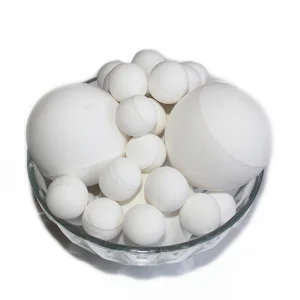
A: For standard catalog sizes (20mm, 25mm, 38mm, 50mm PP/HDPE balls in natural white or black), we maintain standard inventory with dispatch times of 3 to 7 working days. For custom resin grades (PVDF, PTFE, anti-static) or non-standard diameters, tooling and production lead times average 12 to 18 days. The typical MOQ for export sea freight is 5 to 10 cubic meters, perfectly combinable with ceramic balls or metal packings.
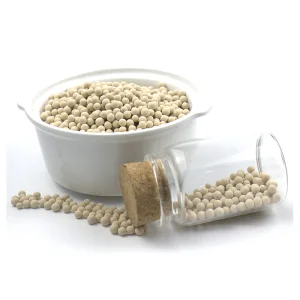
Explore our complete range of high-performance foundry filtration, structured mass transfer trays, high-alumina catalyst supports, and environmental thermal ceramics.
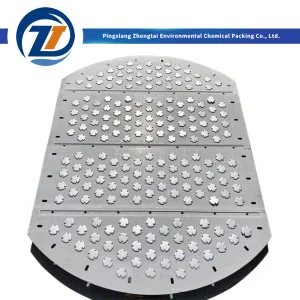
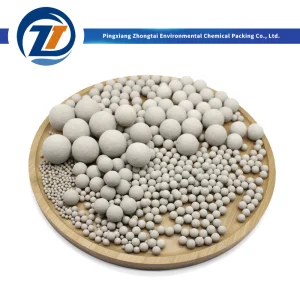
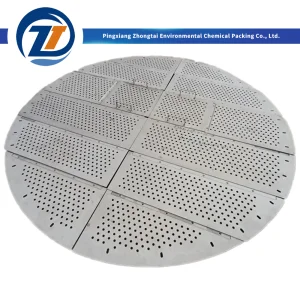
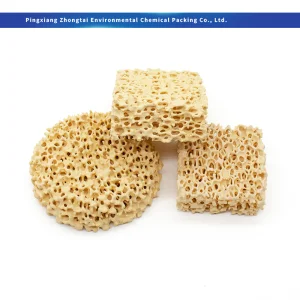
Connect directly with Pingxiang Zhongtai's chemical packing engineering department. Send us your operating temperatures, chemical compositions, tank dimensions, or tower gas velocities for tailored resin selection and mill-direct quotations.
