Explore our export-grade chemical packings, ceramic refractories, and high-performance molecular sieves manufactured under ISO 9001 quality controls.
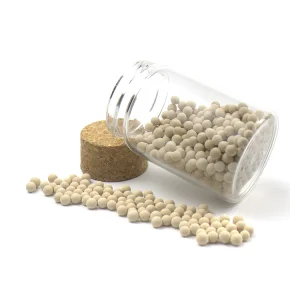
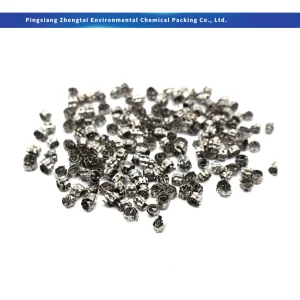
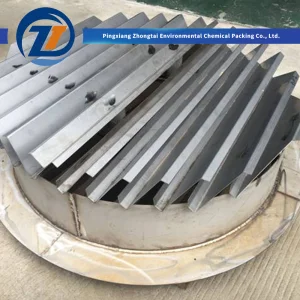
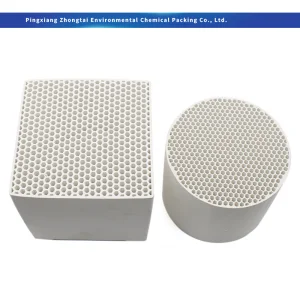
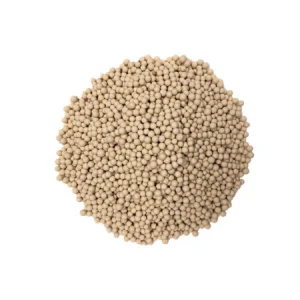
As global industries transition toward automated, high-purity, and energy-efficient gas generation, selecting an elite China Carbon Molecular Sieve (CMS) supplier has become a mission-critical factor for process engineers and procurement directors. Carbon Molecular Sieves are non-polar synthetic carbonaceous adsorbents characterized by an intricately controlled, micro-porous pore size distribution (ranging precisely between 3.2Å to 4.5Å).
Unlike traditional zeolite molecular sieves (such as 3A, 4A, 5A, or 13X APG) that separate gases based on thermodynamic equilibrium polarity, Carbon Molecular Sieves operate strictly via kinetic separation mechanisms. Because oxygen molecules ($O_2$, kinetic diameter 3.46Å) diffuse through carbon micropore apertures significantly faster than nitrogen molecules ($N_2$, kinetic diameter 3.64Å), compressed air passing through a CMS-packed bed under elevated pressure results in selective $O_2$ adsorption into the carbon matrix while high-purity $N_2$ is harvested at the tower outlet.
Rooted in China's industrial ceramic and mass-transfer cluster in Pingxiang, Jiangxi Province, Pingxiang Zhongtai Environmental Chemical Packing Co., Ltd. (founded in 2003) stands as a premier manufacturer of high-density CMS adsorbents, chemical tower packings, inert catalyst bed support balls, and honeycomb ceramic monoliths.
"By synthesizing ultra-pure coconut shell charcoal and coal-derived pitch precursors with precision chemical vapor deposition (CVD) pore mouth tuning, our CMS series delivers unmatched nitrogen production capacities ($\text{Nm}^3/\text{h}\cdot\text{t}$) and operational durability exceeding 10 years without bed compaction."
Understanding the kinetic diffusion rates ($D_{O2} / D_{N2} > 100$) and selecting the precise pore mouth size determines nitrogen recovery efficiency and energy consumption.
Through secondary thermal treatment and hydrocarbon cracking deposition, our manufacturing line fine-tunes pore openings down to the angstrom ($\text{\AA}$) scale. This restricts $N_2$ molecules while allowing $O_2$ to enter rapidly during the short pressurization cycle (usually 45–60 seconds).
Optimized pore volume maximizes volume efficiency. Lower Air-to-Nitrogen ratios mean reduced electricity consumption on air compressors, delivering substantial operational expenditure (OPEX) savings over the plant life.
Our proprietary extrusion binder formulation and high-density carbon compaction ensure that pellets withstand rapid pressure fluctuations (0 to 0.8 MPa) without micro-fracturing or fluidization pulverization.
| Grade Model | Target $N_2$ Purity | $N_2$ Capacity ($\text{Nm}^3/\text{h}\cdot\text{t}$) | Air-to-Nitrogen Ratio | Bulk Density ($\text{g/L}$) | Crush Strength |
|---|---|---|---|---|---|
| CMS-220 | 99.5% | 220 – 240 | 2.6 | 640 – 660 | ≥ 75 N/pellet |
| CMS-240 | 99.9% | 240 – 260 | 3.1 | 650 – 670 | ≥ 75 N/pellet |
| CMS-260 | 99.99% | 260 – 280 | 4.2 | 660 – 680 | ≥ 80 N/pellet |
| CMS-280 / CMS-330 | 99.999% (Ultra Pure) | 280 – 330 | 5.5 – 6.2 | 670 – 690 | ≥ 85 N/pellet |
Carbon Molecular Sieves serve as the technological backbone for decentralized nitrogen gas generation across energy, electronics, food preservation, and chemical industries globally.
In surface-mount technology (SMT) reflow soldering and wave soldering furnaces, high-purity nitrogen ($N_2 \ge 99.99\%$) prevents component oxidation, eliminates solder bridging, and enhances joint reliability. Global electronics hubs in North America, Southeast Asia, and Europe rely on CMS-driven PSA units for continuous, cost-effective inert gas blankets.
Excluding oxygen from food packaging prevents lipid oxidation, bacterial proliferation, and freshness degradation. CMS-220 and CMS-240 grades produce food-grade nitrogen ($99.5\% \text{ to } 99.9\%$) directly from ambient air, replacing liquid nitrogen tanks in agricultural and food processing facilities.
Underground coal mining operations inject large volumes of nitrogen ($95\% \text{ to } 98\%$ purity) into goaf areas to displace oxygen, suppress spontaneous combustion, and prevent methane explosions. High-capacity CMS adsorbents provide portable, high-throughput nitrogen output under harsh field conditions.
During shutdown maintenance, offshore platform purging, or tank car inerting, rapid supply of dry, inert nitrogen is required to eliminate explosion risks. Combined with 13X APG zeolite molecular sieves for pre-bed moisture/hydrocarbon cleanup, CMS systems provide total safety assurance.
A high-performance PSA system or mass-transfer tower requires a harmonious arrangement of support media, pre-adsorbents, primary adsorbents, and liquid/gas distributors.
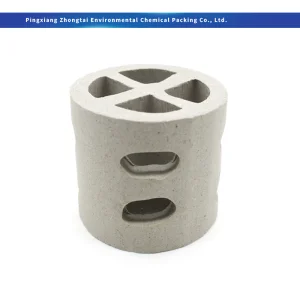
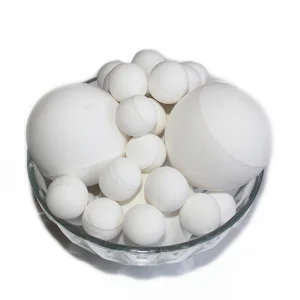
Positioned at the bottom and top of the adsorbent vessel, 99% Al2O3 or 17-23% Inert Ceramic Balls act as flow distributors and hold-down layers. They prevent gas channeling and safeguard expensive molecular sieve beds against high-velocity gas shock.
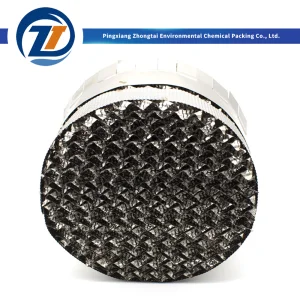
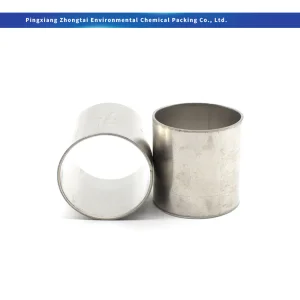
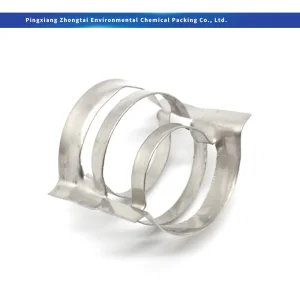
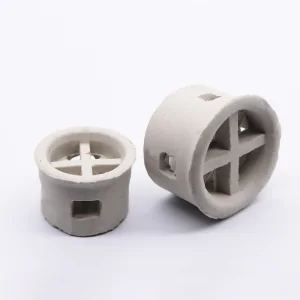
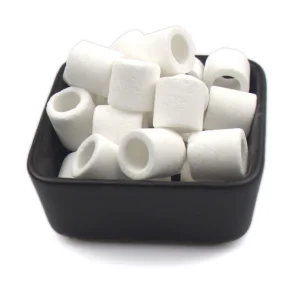
For chemical distillation, absorption, and stripping towers, Pingxiang Zhongtai supplies 304/316L Stainless Steel Metal Theta Rings, Raschig Rings, and Corrugated Plate Structured Packing, delivering minimal pressure drop and maximum mass transfer area.
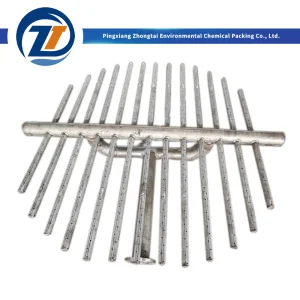
Proper liquid distribution is paramount. Our custom-engineered Stainless Steel Pipe Liquid Distributors and Redistributors eliminate wall flow effects, ensuring uniform wetting across packed beds in mass transfer towers.
Current R&D efforts focus on atomic-layer deposition techniques to narrow pore mouth variations down to $\pm 0.02\text{ \AA}$. By reducing the structural standard deviation of micropores, future CMS generations will increase nitrogen yields by an additional 15-20% while reducing air compressor energy requirements.
Furthermore, bio-based carbon precursor sourcing (such as modified coconut shell charcoals derived from sustainable agricultural waste) ensures lower carbon footprints during material synthesis.
As the world accelerates hydrogen economy infrastructure, CMS-based pressure swing adsorption is being adapted for helium recovery, methane upgrading (biogas purification to bio-LNG), and hydrogen tail-gas purification. Engineered CMS media will play a fundamental role in global carbon capture, utilization, and storage (CCUS) projects.
"The evolution of Carbon Molecular Sieves is shifting from traditional ambient air separation toward complex multi-component gas mixture separations under extreme temperatures and pressures."
Pingxiang Zhongtai guarantees absolute consistency across every production batch, backed by standardized lab testing and international compliance certificates.
Every lot of Carbon Molecular Sieve and Ceramic Media undergoes rigorous laboratory testing for bulk density, particle size uniformity, crushing strength, surface pore volume, and moisture content before release.
CMS adsorbents are highly hydroscopic. We pack materials in airtight 20kg or 40kg plastic drums with inner sealed foil liners, stacked on fumigation-free heavy-duty pallets to ensure 0% moisture ingress during ocean transit.
Our operations comply with ISO 9001:2015 Quality Management Systems and ISO 14001 Environmental Standards. Full technical data sheets (TDS) and Material Safety Data Sheets (MSDS) are provided with all commercial shipments.
Detailed solutions for process engineers, plant managers, and industrial equipment distributors.
Selection depends on your required nitrogen purity and target airflow capacity:
Dusting occurs primarily due to loose bed packing or rapid pressure shocks causing pellets to rub against each other (frictional attrition). Prevention strategies include:
CMS micropores (3.2Å – 4.5Å) are easily fouled by compressor oil aerosols and liquid water. Oil permanently blocks pore openings, degrading nitrogen yield irrecoverably. Moisture competes for adsorption sites, raising the dew point. To protect CMS beds, install a high-efficiency refrigerated dryer, desiccant air dryer, active carbon filter tower, and micro-oil mist separators upstream.
Under standard operating conditions (clean feed air, oil content < 0.01 ppm, pressure dew point ≤ -40°C, proper bed compaction), Pingxiang Zhongtai CMS adsorbents maintain high performance for 8 to 10+ years of continuous cycle operation.
Yes. Our engineering team evaluates your tower diameter, operating temperature, fluid density, corrosivity, and pressure drop budgets to recommend optimal random packings (Pall rings, Intalox saddles), structured packings, liquid distributors, or ceramic bed support media.
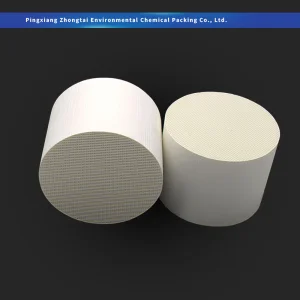
Discover our specialized random packings, structured corrugated sheets, refractory balls, and metal honeycomb catalyst carriers.