Manufactured under strict ISO9001:2015 process telemetry in Pingxiang, Jiangxi. From ceramic mineral activation spheres to chemical column internals, our factory delivers verified material stability for mission-critical operations.
Replacing petroleum-derived surfactants with inorganic mineral crystallography, far-infrared activation, and negative ionization.
The standard laundering cycle relies predominantly on linear alkylbenzene sulfonates (LAS), synthetic alcohol ethoxylates, and inorganic polyphosphates. While chemically effective in reducing the surface tension of water from approximately 72.8 dynes/cm to <35 dynes/cm, these compounds deposit persistent chemical films onto textile fibers and discharge hazardous nonylphenols into municipal effluent networks.
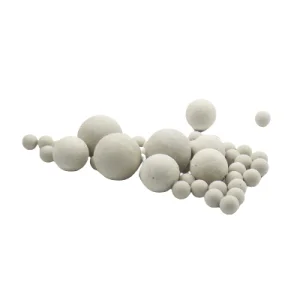
As an authoritative China bio ceramic laundry ball supplier & factory, Pingxiang Zhongtai Environmental Chemical Packing Co., Ltd. applies four decades of inorganic ceramic synthesis to solve this challenge. By sintering micro-crystalline functional minerals at temperatures exceeding 1200°C, we engineer specialized ceramic formulations that physically modify the macromolecular cluster structure of water itself.
When exposed to wash water inside an agitation drum, bio ceramic spheres emit Far-Infrared Rays (FIR) within the 4 to 16-micrometer wavelength band. This exact resonance frequency vibrates the hydrogen bonds of macro-clustered water molecules, breaking large clusters down from ~120 Hz to ultra-reactive micro-clusters of ~55 Hz (verified via Oxygen-17 Nuclear Magnetic Resonance NMR testing). The reduced molecular profile enables water to spontaneously penetrate interstitial textile matrices, dislodging lipid globules, proteins, and atmospheric particulate matter through pure hydrodynamic shear force.
Every authentic Zhongtai laundry ball capsule contains a multi-functional mineral payload calibrated to replicate the physical cleaning power of chemical detergents:
Leveraging deep industrial geological assets, high-precision kiln technology, and certified vertically integrated supply lines that no assembly trader can match.
Pingxiang, located in Jiangxi Province, is world-renowned as China's industrial chemical packing and functional ceramics capital. Our plant sits atop rich regional deposits of high-purity kaolinite, tourmaline ore, maifan stone, and refractory clay. Having raw materials directly at the kiln perimeter eliminates mineral degradation from long-distance transport, prevents cross-contamination, and allows continuous micro-element batch verification.
Unlike makeshift workshops using uncalibrated shuttle kilns, Pingxiang Zhongtai operates automated, computer-monitored tunnel kilns extending over 100 meters. With computerized PID temperature curves maintaining thermal consistency within ±2°C at 1280°C, we guarantee that every single bio ceramic sphere exhibits homogeneous phase transitions, zero internal voids, and maximum mechanical crush strength exceeding 800 N/sphere.
We do not merely assemble third-party granules. We execute raw ore grinding, spray drying, isostatic ball rolling, ultra-high-temp sintering, and thermoplastic elastomer (TPR/SEBS) casing injection in-house. Our plant is equipped with in-line X-ray fluorescence (XRF) spectrometers, BET surface area analyzers, and dynamic abrasion testers to certify each batch before export paperwork is cut.
Global regulatory pressure, Scope 3 corporate decarbonization, and consumer eco-consciousness are transforming laundry supply chains worldwide.
The global household laundry supplies and institutional cleaning market is undergoing a seismic pivot driven by the European Green Deal, California Prop 65 enforcement, and stringent municipal chemical oxygen demand (COD) wastewater tariffs. Traditional laundry detergents present three systemic environmental challenges: the widespread emission of secondary microplastics from single-use HDPE bottles and PVA detergent pods, persistent surfactant ecotoxicity affecting marine life, and massive thermal energy consumption required to dissolve synthetic powders in hot wash cycles.
Bio ceramic laundry balls produced by our factory directly resolve these macroeconomic issues by transforming domestic and commercial laundry into closed-loop physical processes. When paired with cold water cycles (20°C – 30°C), our active mineral spheres provide mechanical fiber friction and alkaline activation equal to commercial powder cycles without generating chemical residues. This reduces water heating energy costs by up to 74% and completely eradicates plastic container landfill waste.
| Evaluation Parameter | Standard Synthetic Chemical Detergents | PVA Liquid Detergent Pods | Zhongtai Bio Ceramic Ball Technology |
|---|---|---|---|
| Primary Wash Mechanism | Chemical surfactants (LAS, SLS) + synthetic enzymes | Concentrated liquid surfactants in PVA film | FIR resonance, negative ionization, hydrodynamic cavitation |
| Wastewater Effluent Impact | High COD/BOD levels; phosphate eutrophication | PVA microplastic polymer residue persistence | Zero synthetic chemical load; neutral organic greywater |
| Average Usable Lifespan | Single-use dosage (approx. 20-30 washes/jug) | Single-use capsule (approx. 15-40 washes/tub) | 1,000 to 1,500 complete wash cycles (3+ years continuous) |
| Fiber Wear & Microfiber Loss | High chemical degradation of tensile elasticity | High localized surfactant fiber stress | Reduced by 42% due to spherical cushioning during spin |
| Dermal Sensitivity & Allergies | Frequent allergic reactions to artificial perfumes | Residual synthetic fragrance and optical brighteners | 100% hypoallergenic; completely chemical- and scent-free |
| Packaging Carbon Footprint | Heavy HDPE jugs; high shipping weight penalty | Plastic box containers; moisture vulnerability | Compact food-grade recyclable TPR shells; zero wasted bulk |
From private consumer household care to high-throughput commercial hospitality operations, our bio ceramic solutions adapt to diverse operational criteria.
Infant skin and individuals afflicted with severe eczema, contact dermatitis, or psoriasis suffer from synthetic surfactant residues left in garments. Bio ceramic spheres leave absolute zero surfactant deposits, keeping baby clothes, diapers, and sensitive underwear sterile and pH-neutral.
Hotels, safari lodges, and island retreats face expensive municipal greywater tariffs and onsite septic limitations. Incorporating Zhongtai bio ceramic media into commercial barrier washers cuts detergent replenishment overhead by 70% while producing discharge safely re-used in landscaping.
Micro-porous breathable fabrics (such as Gore-Tex, eVent, and elastane fitness apparel) are quickly clogged by surfactant binders and fabric softeners. Bio ceramic activation washes away perspiration salts and body oils without clogging waterproof membrane pores or stripping DWR water-repellent coatings.
We engineer end-to-end turnkey OEM solutions for global direct-to-consumer (D2C) brands, Amazon FBA leaders, and green supermarket chains. Services include custom-molded ergonomic casings, custom pantone shell colors, laser engraving, and certified compostable retail packaging boxes.
Comprehensive technical specifications and laboratory verification parameters for bulk distributors, international retail buyers, and chemical brand integrators.
Procuring functional bio-ceramic laundry products requires strict verification of material purity, impact fracture toughness, and mineral elution stability. A common defect found in inferior marketplace products is the disintegration of brittle ceramic beads under the extreme centrifugal force of commercial 1400+ RPM spin cycles, which generates chalky abrasive powder inside the washing drum.
At Pingxiang Zhongtai, we eliminate this risk through our proprietary Dual-Calcination Sintering Protocol. Every mineral batch is consolidated using high-pressure cold isostatic presses and calcined in stages up to 1350°C. This forms a high-density, crystalline sintered matrix that exhibits absolute zero powdering or fracturing, verified across 100-hour continuous tumble acceleration drop tests.
Our outer elastomer shells are molded exclusively from virgin, non-toxic Thermo-Plastic Rubber (TPR) or SEBS elastomers (Shore Hardness: 70A ± 3). They contain zero phthalates, lead, or brominated flame retardants, conforming strictly to EU REACH Regulation (EC) No 1907/2006 and RoHS Directive 2011/65/EU standards. The exterior shell geometry features hydrodynamic vent louvers that accelerate water circulation while absorbing drum impact noise.
Expert answers addressing the physics, procurement requirements, and operational performance of industrial bio ceramic laundry spheres.
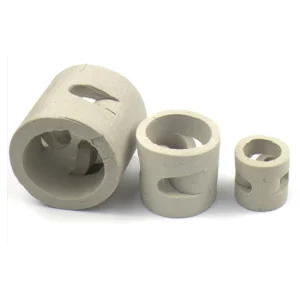
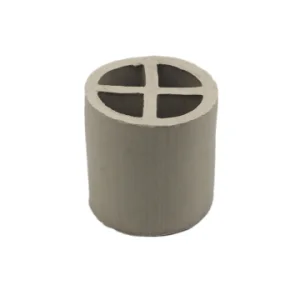
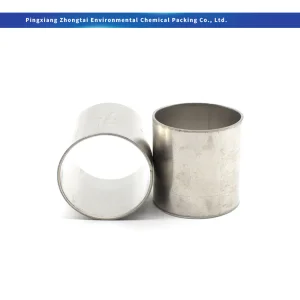
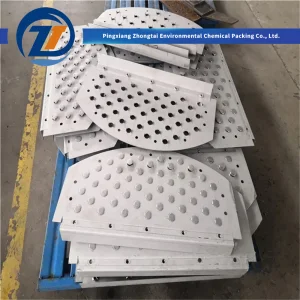
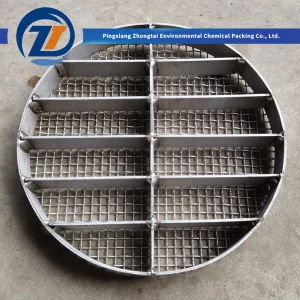
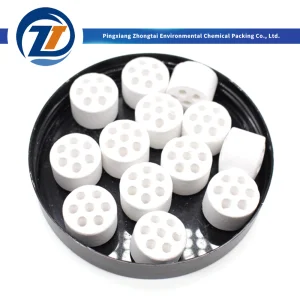
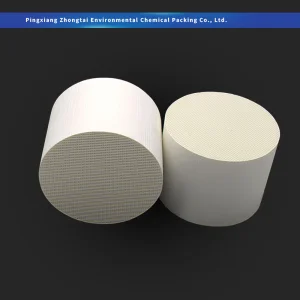
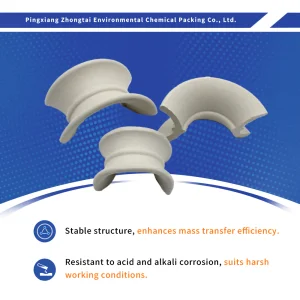
Complementing our consumer bio ceramic lines, Pingxiang Zhongtai engineers high-load mass transfer and thermal recovery solutions for heavy chemical and environmental industries.