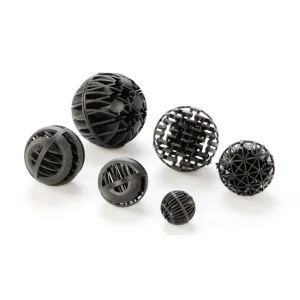
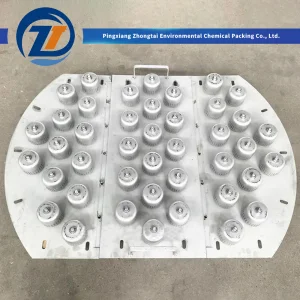
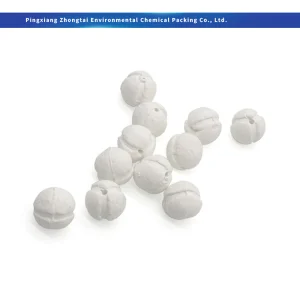
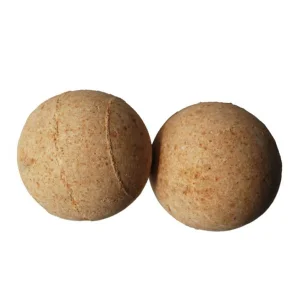
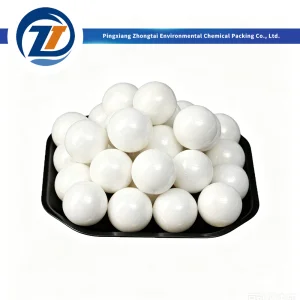
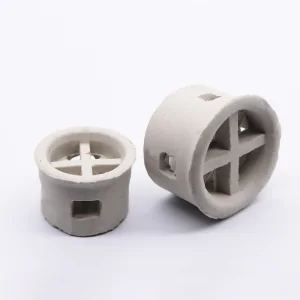
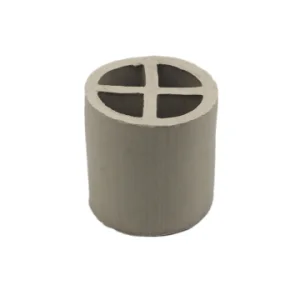
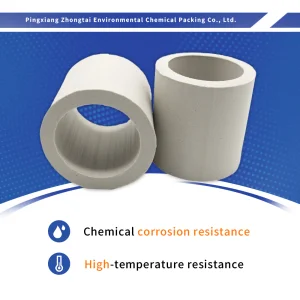
Procure certified industrial ceramic, metal, and mass-transfer contact media engineered for extreme thermal shock, acid environments, and aggressive chemical processing columns.
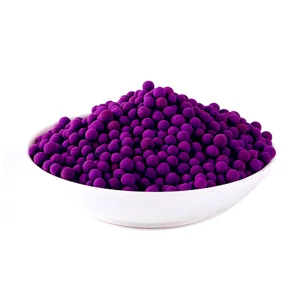
In modern industrial manufacturing, moving from micro-scale pulverization to nanoscale colloidal suspension requires grinding media with ultra-high true density, exceptional fracture toughness, and zero chemical cross-contamination.
Traditional grinding media like glass beads (2.5 g/cm³) or standard alumina balls (3.6–3.9 g/cm³) lack the kinetic energy transfer rate required for sub-micron comminution. Zirconia beads deliver true densities ranging from 4.0 g/cm³ to 6.25 g/cm³, cutting processing dwell times by over 65% in horizontal high-energy agitated pin and disc mills.
Tetragonal Zirconia Polycrystal (TZP) materials utilize phase-transformation toughening ($t \to m$). When stress concentrates at a microcrack tip, the metastable tetragonal phase converts to monoclinic with a 3–5% volume expansion, inducing compressive stresses that halt crack propagation, providing fracture toughness exceeding 9.0 MPa·m1/2.
Batch contamination from metal wear or silica leaching costs chemical processors millions in discarded yields. High-purity Yttria-Stabilized Zirconia (YSZ) beads, produced via aqueous micro-titration sintering, exhibit wear rates below 0.008 g/kg·h, preserving product purity in lithium battery slurries, CMP slurries, and active pharmaceutical ingredients (APIs).
Selecting the correct zirconia crystal phase and stabilizer composition ensures optimal wear resistance, preventing premature bead fragmentation and internal mill liner gouging.
| Media Grade | Chemical Composition | Specific Gravity | Crush Strength (Ø 1.0mm) | Primary Industrial Use-Case | Relative Wear Index |
|---|---|---|---|---|---|
| 95% Yttria-Stabilized (YSZ / 3Y-TZP) | ZrO₂ ~95%, Y₂O₃ 5.15±0.2% | ≥ 6.05 g/cm³ | ≥ 2100 N (215 kgf) | Li-ion cathodes (LFP/NCM), MLCC, CMP slurry, Inkjet | Ultra-Low (<0.01 g/kg·h) |
| Cerium-Stabilized Zirconia (Ce-TZP) | ZrO₂ ~80%, CeO₂ ~20% | ≥ 6.20 g/cm³ | ≥ 2300 N (235 kgf) | High-viscosity paints, heavy mineral refining (CaCO₃, TiO₂) | Low (<0.02 g/kg·h) |
| Zirconium Silicate Beads (ZrSiO₄) | ZrO₂ 65%, SiO₂ ~33% | ≥ 4.10 g/cm³ | ≥ 1100 N (112 kgf) | Pesticide SC formulations, kaolin bleaching, magnetic coatings | Medium (<0.08 g/kg·h) |
| Zirconia Toughened Alumina (ZTA) | Al₂O₃ 85–90%, ZrO₂ 10–15% | 3.80–4.00 g/cm³ | ≥ 1400 N (142 kgf) | Metallic ores, gold extraction, industrial glaze milling | Economic Alternative |
| Magnesia-Partially Stabilized (Mg-PSZ) | ZrO₂ ~96.5%, MgO ~3.5% | ≥ 5.65 g/cm³ | ≥ 1700 N (173 kgf) | Structural engineering, high-temperature wet chemical mixers | Low Thermal Fatigue |
Our micro-bead series (0.05 mm to 0.6 mm) are shaped via continuous aqueous electrolyte droplet titration. This avoids internal gas voids, off-center seams, and density gradients that plague dry-pressed alternatives. The result is an ultra-dense, homogeneous equiaxed sub-micron grain structure (<0.5 μm) after precision sintering at 1480°C.
For macro-diameter grinding balls (Ø 5.0 mm up to 50 mm) deployed in large ball mills and vertical attritors, automated rolling spheroidization combined with high-frequency vibratory finishing ensures uniform spherical roundness (>98%), zero surface spallation defects, and consistent bulk density across multi-ton factory orders.
Direct export pricing indexed against raw chemical precursor purities, bead diameter tolerances, and order volumes. Free from brokerage markups.
| Bead Diameter (mm) | Grade Classification | MOQ | Spot Tier (50–500 kg) | Container Tier (FCL ≥ 10 MT) | Lead-Time (Pingxiang Kilns) |
|---|---|---|---|---|---|
| Ø 0.05 mm – 0.1 mm | 95% YSZ Nano-Micro Beads (Titration) | 50 kg | $48.50 – $62.00 / kg | $38.00 – $44.50 / kg | 7–12 Business Days |
| Ø 0.2 mm – 0.4 mm | 95% YSZ Sub-Micron Precision | 100 kg | $36.00 – $44.00 / kg | $27.50 – $32.00 / kg | 5–10 Business Days |
| Ø 0.6 mm – 1.2 mm | 95% YSZ Industry Standard (Battery/Paint) | 100 kg | $28.50 – $34.00 / kg | $21.00 – $24.80 / kg | Immediate Factory Stock |
| Ø 1.4 mm – 2.5 mm | 95% YSZ Chemical Grinding Grade | 100 kg | $26.00 – $31.00 / kg | $19.50 – $22.50 / kg | Immediate Factory Stock |
| Ø 0.8 mm – 2.0 mm | Cerium-Stabilized (Ce-TZP 80%) | 200 kg | $22.00 – $27.00 / kg | $16.50 – $19.00 / kg | 5–8 Business Days |
| Ø 1.0 mm – 3.0 mm | Zirconium Silicate 65% (ZrSiO₄) | 500 kg | $8.50 – $12.00 / kg | $5.80 – $7.20 / kg | Immediate Factory Stock |
| Ø 15 mm – 50 mm | 95% YSZ Macro Balls (Tumbling/Ball Mill) | 200 kg | $32.00 – $39.00 / kg | $24.00 – $28.50 / kg | 10–14 Business Days |
Purchasing agents often focus only on initial $/kg purchase price, missing mill downtime costs caused by inferior media. Low-grade beads with internal micro-porosity shed fragmented shards that clog dynamic mill separation screens (0.1–0.3 mm gaps). This triggers mill shutdowns, product contaminations, and ruined batch campaigns. Investing in premium titration-grade 95% YSZ beads extends continuous mill run cycles from 450 hours to over 3,200 hours, slashing downtime expenses and lowering total cost per dry metric ton of finished product by 34%.
From clean energy battery active materials to sterile pharmaceutical nanosuspensions, discover where engineered zirconia media delivers essential performance advantages.
For Lithium Iron Phosphate (LiFePO₄ / LFP), ternary NMC, and silicon-carbon anodes, grinding target distributions must reach D50 < 350 nm with tight spans ($[D90-D10]/D50 < 1.2$). Our 0.1 mm to 0.4 mm YSZ micro-beads deliver the required shear energy without iron cross-contamination that impairs battery discharge and cycling life.
Multilayer Ceramic Capacitors require sub-100nm barium titanate ($BaTiO_3$) dielectric powders. Even trace particulate chipping will alter electrical breakdown voltages. 95% YSZ beads synthesized with trace SiO₂ < 0.01% eliminate dielectric degradation and electrode layer short-circuits.
High-end automotive clears, solvent-based flexographic inks, and digital inkjet pigments require clean transparency and gloss. YSZ beads eliminate optical hazing caused by media wear, achieving rapid pigment de-agglomeration down to full color intensity in fewer recirculation passes.
Poorly water-soluble APIs (BCS Class II and IV drugs) require particle reduction below 200 nm to boost dissolution velocity and biological absorption. Autoclavable, biocompatible YSZ beads meet strict FDA and USP Class VI limits, releasing zero heavy metal ions.
Headquartered in Pingxiang, Jiangxi Province—China's recognized chemical ceramic capital—Pingxiang Zhongtai Environmental Chemical Packing Co., Ltd. combines deep ceramic engineering heritage with modernized production facilities.
Our computerized tunnel and shuttle kilns use multi-zone PID temperature curves accurate to within ±2°C at 1550°C. This level of thermal control prevents abnormal grain growth and microcracks, yielding a uniform crystal matrix across high-volume production batches.
Operating within the Pingxiang Hi-Tech Industrial Park provides our facilities with direct rail connections, on-site natural gas grids, and immediate access to primary zircon sand processing refineries. This localized supply chain buffers against raw mineral disruptions and volatile transport surcharges.
With an annual output exceeding 12,000 metric tons of industrial ceramics, random packings, and grinding media, standard sizing runs (Ø 0.6–2.0 mm) stay pre-stocked in palletized inventory, supporting urgent air-freight dispatches within 48 hours and ocean FCL bookings within 10 days.
As advanced materials transition toward true molecular-scale engineering, milling media must evolve to withstand higher tip speeds, hydrothermal fatigue, and aggressive acidic media.
Yttria-stabilized zirconia can suffer from Low-Temperature Degradation (LTD) when run in continuous water-based slurries between 60°C and 140°C over extended campaigns. Water molecules penetrate the surface crystal lattice, inducing spontaneous transformation into monoclinic phase and surface micro-spalling. Zhongtai's R&D team is pioneering dual-stabilized rare-earth formulations (Y₂O₃-CeO₂-La₂O₃ co-doped) that neutralize hydroxyl ion diffusion, tripling continuous service lifetimes in aqueous cathode slurries.
Next-generation solid-state battery electrolytes (LLZO/sulfides), quantum dot displays, and advanced ceramic capacitors demand particle dispersion down to 10–20 nm without causing mechanical lattice destruction. Producing 30 μm beads requires electrostatic droplet micro-jetting combined with microwave-assisted fast sintering. This process prevents crystal grain enlargement while maintaining near-theoretical density (6.06 g/cm³).
Every shipment is backed by verified testing documentation, ensuring straightforward customs clearance and seamless integration into plant quality systems across Europe, the Americas, and Asia.
Inductively Coupled Plasma Mass Spectrometry checks batch purity, verifying that trace heavy metal contamination (Fe, Cu, Cr, Ni) remains strictly below 5 ppm for high-purity battery slurries.
Helium displacement pycnometry validates true density on each lot to verify that zero closed internal micro-pores exist prior to factory drum packaging and palletizing.
Diamond indentation testing (HV0.5) performed under ASTM E384 protocols confirms micro-hardness values across cross-sectioned polished beads exceed 1250 kgf/mm².
Packed in reinforced 25 kg steel or virgin HDPE hermetic drums, secured on IPPC-heat-treated, ISPM 15-compliant fumigated pallets with protective shrink-wrap.
To receive an accurate quotation and customized bead sizing analysis, engineering buyers can utilize this standardized inquiry framework:
Indicate mill manufacturer (Netzsch, Bühler, Drais, Hosokawa), grinding chamber capacity (liters), rotor design (pin, peg, smooth disc), and operating circumferential tip speed (m/s).
State dynamic separation screen gap width (typically 0.1 mm, 0.2 mm, or 0.3 mm). The golden rule: Selected bead diameter must measure at least 2.5× to 3× the screen gap opening to prevent jamming.
Provide solvent base (aqueous vs. organic), solid contents percentage, dynamic viscosity (mPa·s), starting particle size ($D_{90}$), and required target fineness ($D_{50}$ / $D_{99}$).
Direct technical answers addressing bead loading, mill operation, and maintenance best practices.
Explore our full range of chemical processing components—engineered to meet stringent international standards for thermal resistance, acid resistance, and particulate filtration.