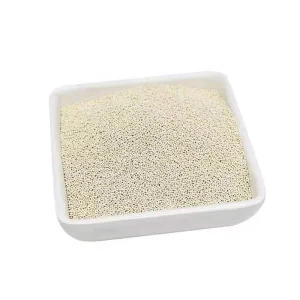
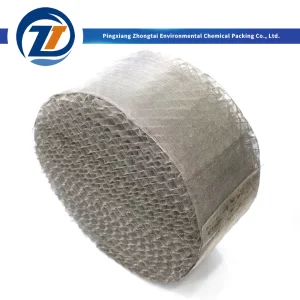
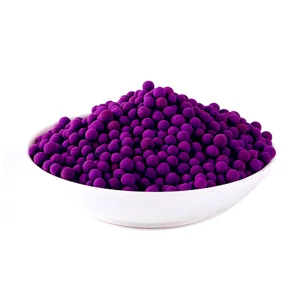
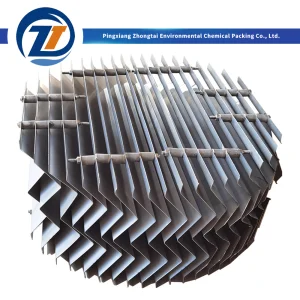
Explore our high-performance mass transfer media, ceramic substrates, and zeolite supports manufactured for critical process plants worldwide.
The global air separation industry is experiencing a seismic paradigm shift. Traditional cryogenic air separation units (ASUs), while historically effective for ultra-large-scale liquid oxygen production, carry massive capital expenditure (CAPEX) hurdles and excessive ongoing energy footprints. Today, modern industrial and healthcare infrastructures are aggressively transitioning to Pressure Swing Adsorption (PSA) and Vacuum Pressure Swing Adsorption (VPSA) systems powered by synthetic Zeolite Oxygen Molecular Sieves.
Zeolite oxygen sieves—specifically highly engineered synthetic crystalline aluminosilicates belonging to the synthetic Faujasite (FAU) structural family—are the core functional engines of modern non-cryogenic oxygen generation plants. As global healthcare demands scale alongside aggressive carbon-neutrality directives across metallurgical, chemical, and aquaculture sectors, the global market demand for high-capacity, low-energy molecular sieves has reached unprecedented levels.
From localized medical oxygen concentrators (POCs) to centralized hospital PSA oxygen generation units, demand for medical-grade oxygen (93% ± 3%) requires extreme moisture resilience, rapid adsorption kinetics, and high mechanical crush strength to avoid dusting in continuous operations.
Large-scale VPSA plants in steel making, gold cyanidation, ozone oxidation, and glass manufacturing leverage specialized Lithium-type zeolites to drastically minimize compressor power consumption, reducing total operation costs by up to 35%.
High-density recirculating aquaculture systems (RAS) and municipal wastewater treatment facilities rely on high-efficiency oxygen sieves to supply oxygen feedstocks for ozone generators, achieving high dissolution rates without nitrogen lock issues.
To understand how synthetic zeolites separate atmospheric air (composed roughly of 78% $\text{N}_2$, 21% $\text{O}_2$, and 0.93% $\text{Ar}$), one must analyze the microscopic lattice geometry and electrostatic surface interactions inside the zeolite pores.
Zeolite oxygen sieves utilize thermodynamic equilibrium adsorption based on quadrupole moment interactions. The nitrogen molecule ($0.31 \times 10^{-26} \text{ esu cm}^2$) possesses a significantly larger electric quadrupole moment than the oxygen molecule ($0.10 \times 10^{-26} \text{ esu cm}^2$). When atmospheric air flows under elevated pressure through a tightly packed bed of synthetic zeolite, the extra-framework cations ($\text{Li}^+$, $\text{Na}^+$, or $\text{Ca}^{2+}$) embedded inside the $10\text{Å}$ supercages create an intense localized electric field.
While traditional sodium-based 13X molecular sieves (Na-X) utilize $\text{Na}^+$ ions, modern high-efficiency plants deploy Lithium Low-Silica X (Li-LSX) zeolites. By exchanging sodium ions with lithium ions and reducing the silicon-to-aluminum ratio ($\text{Si/Al}$) strictly to 1.0, the charge density of the lattice structure is maximized.
Because $\text{Li}^+$ ions have an exceptionally small ionic radius ($0.68\text{Å}$) and high polarizability, they generate a vastly superior localized electric field strength compared to $\text{Na}^+$ ($0.97\text{Å}$) or $\text{K}^+$ ($1.33\text{Å}$). This leads to a nitrogen-to-oxygen adsorption selectivity ratio ($\alpha_{\text{N2/O2}}$) that is up to 3 times higher than conventional molecular sieves.
| Performance Parameter | Standard 13X-HP (Medical Grade) | Premium Li-X / Li-LSX (Industrial VPSA) | Testing Standard / Methodology |
|---|---|---|---|
| Cation Exchange Type | Sodium / Calcium ($\text{Na}^+/\text{Ca}^{2+}$) | Lithium Exchange ($\text{Li}^+ \ge 95\%$) | ICP-OES / XRF Chemical Analysis |
| N2 Adsorption Capacity | $\ge 8.0 \text{ cm}^3/\text{g}$ (at 25°C, 1 bar) | $\ge 20.0 \text{ cm}^3/\text{g}$ (at 25°C, 1 bar) | Volumetric Gas Sorption Analyzer |
| N2 / O2 Selectivity Ratio ($\alpha$) | $\approx 2.8 - 3.2$ | $\ge 6.2 - 6.5$ | Pure Component Isotherm Ratio |
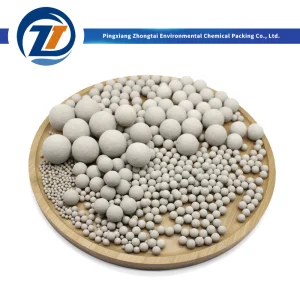
| Particle Size Options | 0.4-0.8mm (POCs) / 1.6-2.5mm (PSA) | 0.4-0.8mm / 1.6-2.5mm (VPSA) | Laser Diffraction / Sieve Analysis |
| Bulk Density (g/mL) | $0.62 - 0.68 \text{ g/cm}^3$ | $0.60 - 0.64 \text{ g/cm}^3$ | ASTM D4164 Tapped Density |
| Crush Strength (N/particle) | $\ge 25 \text{ N}$ (for 1.6-2.5mm beads) | $\ge 35 \text{ N}$ (for 1.6-2.5mm beads) | ASTM D4179 Single Pellet Crush |
| Attrition Rate (% wt) | $\le 0.1\%$ | $\le 0.05\%$ | ASTM D4058 Attrition Test |
| Residual Moisture Content | $\le 0.5 \text{ wt}\%$ | $\le 0.3 \text{ wt}\%$ | Karl Fischer / Loss on Ignition (LOI 550°C) |
Located in Pingxiang, Jiangxi Province—China's global capital for chemical packing and advanced industrial ceramics—our manufacturing ecosystem integrates raw synthetic powder crystallization, precision bead forming, binderless extrusion, high-temperature calcination, and automated vacuum packaging under one seamless roof.
We directly synthesize high-purity Faujasite crystal powder utilizing high-grade sodium aluminate and silicate solutions in automated hydrothermal crystallization reactors. This guarantees zero iron or heavy metal impurities, preventing premature catalytic degradation of the sieve structure.
Our multi-stage continuous counter-current ion exchange lines ensure that lithium exchange rates consistently exceed 95 atom %. Higher lithium substitution directly yields maximum nitrogen working capacities and prevents lattice collapse during thermal regeneration cycles.
By chemically converting inert clay binders into functional active zeolite crystals during post-forming heat treatment, our binderless oxygen sieves feature up to 20% higher active mass per unit bed volume compared to traditional clay-bound zeolites.
Selecting the correct zeolite sieve mesh size and cation profile depends heavily on the specific mechanical design, operating pressure, cycle time, and target gas volume of the oxygen generation plant.
Recommended Sieve: Micro-bead 13X-HP / Li-X (0.4mm - 0.8mm).
Operating Conditions: Fast cycle times (2-5 seconds), compact adsorption columns, low operating power.
Key Benefit: Ultra-small bead diameter minimizes intra-crystalline diffusion pathways, enabling rapid pressure swing cycles while generating 93% ± 3% oxygen output at reduced compressor power.
Recommended Sieve: Standard 13X-HP / High-Density Li-X (1.6mm - 2.5mm).
Operating Conditions: Continuous 24/7 duty, adsorption pressure $0.3 - 0.5 \text{ MPa}$, strict medical compliance (ISO 13485).
Key Benefit: Superior crush strength ($\ge 35\text{ N}$) eliminates dusting risk that could clog hospital downstream filtration systems or compromise breathing air purity.
Recommended Sieve: Premium Lithium Low-Silica X (Li-LSX) (1.6mm - 2.5mm).
Operating Conditions: High-volume output ($500 - 10,000 \text{ Nm}^3/\text{h}$), vacuum desorption ($-0.05 \text{ to } -0.07 \text{ MPa}$).
Key Benefit: Extreme nitrogen working capacity cuts bed sizing requirements by up to 50% and reduces specific energy consumption to $< 0.32 \text{ kWh/Nm}^3 \text{ O}_2$.
When global procurement directors and EPC engineering teams evaluate oxygen molecular sieve vendors, assessing unit price per ton alone often leads to severe operational loss. The true economic metric is the Total Cost of Ownership (TCO) over a typical 5-to-10-year bed lifespan.
Electricity accounts for over 70% of the total operating expenditure in a commercial VPSA plant. Utilizing premium Li-X sieves with lower bed pressure drop directly lowers blower motor amperage, recovering the initial sieve price premium within 6 to 12 months of operation.
Under continuous high-velocity pneumatic pressure swings, low-quality molecular sieves undergo mechanical attrition. The resulting powder fills bed voids, increases pressure drop, creates gas channeling, and causes premature bed failure. Our ASTM-verified attrition rates ($< 0.05\%$) ensure stable bed geometry.
Zeolites are aggressive desiccant materials. Water vapor preferentially binds to cation sites, reducing nitrogen capacity. Every batch supplied by our factory undergoes strict vacuum hermetic sealing with heavy-duty aluminum foil lining, maintaining residual water levels below $0.3\text{ wt}\%$ upon arrival.
As the air separation sector pushes toward higher energy efficiency and system miniaturization, three major technology vectors are defining the next decade of molecular sieve engineering:
By synthesizing micro-porous functional shells over high-density inert cores, new core-shell lithium sieves eliminate dead diffusion space in the pellet interior, enabling ultra-fast pressure equalization steps in high-frequency oxygen generators.
Advanced surface coating techniques are being developed to create selective hydrophobic barriers on zeolite pore mouths, allowing high-purity oxygen generation even under elevated relative humidity conditions without requiring massive front-end air drying beds.
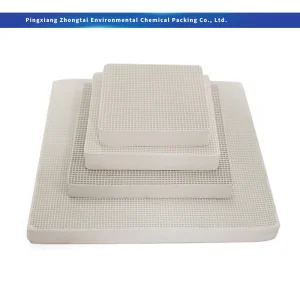
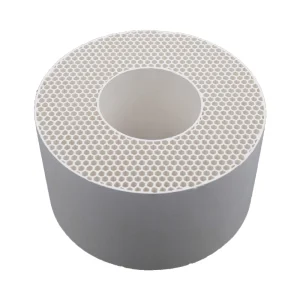
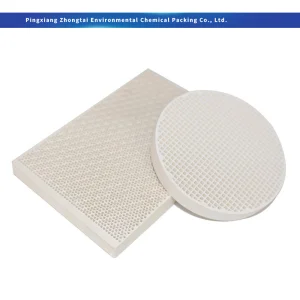
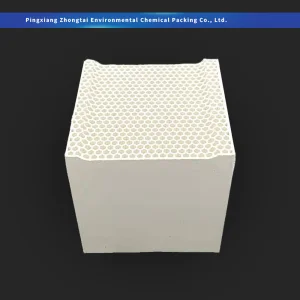
Transitioning from traditional random spherical bead beds to extrusion-molded 3D honeycomb zeolite structures provides zero bed movement, zero attrition risk, and dramatically reduces fluid bed friction, opening doors to ultra-compact modular industrial VPSA designs.
Direct answers to common technical queries from plant engineers, maintenance managers, and procurement specialists.
Discover our expanded range of structured packings, mist eliminators, activated alumina, and special filtration ceramic media.