
An engineering-grade industrial guide to Type 3A, 4A, 5A, 13X, and carbon molecular sieves. Analyze macro cost structures, crystalline zeolite purity benchmarks, adsorption thermodynamics, and factory-direct procurement intelligence from Pingxiang Zhongtai Environmental Chemical Packing Co., Ltd.
Factory-direct distillation packing, high-capacity zeolite desiccants, and catalytic support systems produced under strict ISO 9001:2015 quality standards.
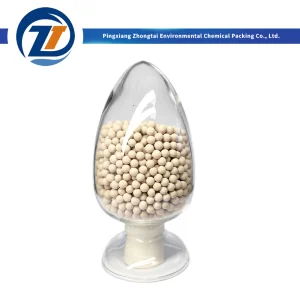
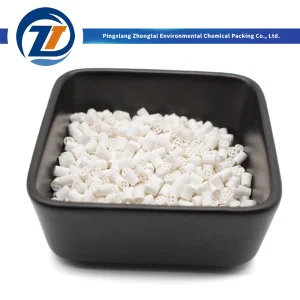
Navigating international synthetic zeolite pricing requires a granular breakdown of raw material feedstocks, binder calcination energy demands, and batch crystallization yields.
The foundational pricing driver of sodium aluminosilicate crystal lattices (AlO₄ and SiO₄ tetrahedra) is the fluctuating industrial index of sodium silicate (water glass) and aluminum hydroxide. Variations in regional caustic soda ($NaOH$) tariffs directly influence precursor crystallization costs. For potassium-exchanged Type 3A and calcium-exchanged Type 5A, the stoichiometry of secondary ion-exchange wash processes contributes up to 18% of the net chemical manufacturing overhead.
Removing non-framework intra-crystalline water molecules requires prolonged thermal treatment at 450°C–620°C in industrial rotary calcination kilns. Factory natural gas consumption accounts for roughly 22% of total operational expenditure. Plant locations in Pingxiang with dedicated thermal energy corridors and natural gas pipelines allow Pingxiang Zhongtai to maintain stable batch-to-batch wholesale pricelists, dampening the volatility seen in international spot markets.
Commercial zeolite powder must be agglomerated into mechanical spheres (beads) or cylindrical extrudates (pellets) using refined clay binders such as attapulgite, sepiolite, or kaolin (typically 15%–20% by mass). High-performance binderless sieves command a 30%–45% price premium due to multi-stage chemical caustic digestions that convert the binder phase into active crystalline zeolite, yielding 20% higher dynamic adsorption capacity.
| Zeolite Type | Pore Size (Å) | Cationic Form | Standard Bulk Density | Crush Strength (Bead) | Benchmark Price Range (USD/MT, FOB) | Industrial Grade Service |
|---|---|---|---|---|---|---|
| Type 3A | ~3.0 Å | Potassium ($K^+$) | 0.68 – 0.74 g/mL | ≥ 35 N (1.6-2.5mm) | $1,450 – $1,950 | Ethanol, Ethylene, Propylene, Crushed Gas Deep Drying |
| Type 4A | ~4.0 Å | Sodium ($Na^+$) | 0.66 – 0.72 g/mL | ≥ 30 N (1.6-2.5mm) | $1,250 – $1,650 | Refrigeration, Air Brake Systems, Static Insulating Glass |
| Type 5A | ~5.0 Å | Calcium ($Ca^{2+}$) | 0.68 – 0.73 g/mL | ≥ 40 N (1.6-2.5mm) | $1,750 – $2,300 | PSA Hydrogen Separation, Normal/Iso-Paraffin Extraction |
| Type 13X (NaX) | ~10.0 Å | Sodium ($Na^+$ Faujasite) | 0.62 – 0.70 g/mL | ≥ 35 N (1.6-2.5mm) | $1,600 – $2,100 | Cryogenic Air Separation (CO₂/H₂O Removal), Hydrocarbon Sweetening |
| 13X-HP / APG | ~10.0 Å | Modified Sodium Faujasite | 0.60 – 0.66 g/mL | ≥ 38 N (1.6-2.5mm) | $2,100 – $2,850 | ASU Cryo Pre-Purification Unit (Trace CO₂ < 0.5 ppmv) |
| Carbon Sieve (CMS) | 3.0 – 4.0 Å | Microporous Carbon Matrix | 0.64 – 0.68 g/mL | ≥ 75 N (Extrudate) | $3,200 – $4,800 | PSA Nitrogen Generation Systems (99.5% – 99.999% N₂) |
*Note: Quoted price bands reflect international commercial container load orders (FCL). Actual batch pricing varies based on packaging configurations, mechanical crush thresholds, and bespoke equilibrium capacity demands.
How international chemical engineering consortia, LNG liquefaction plants, and engineering, procurement, and construction (EPC) contractors qualify desiccant suppliers to mitigate total lifecycle risk.
In industrial scale cryogenic air separation facilities, ambient atmospheric air must be cleaned of trace moisture and carbon dioxide down to sub-ppm levels ($H_2O < 0.1\text{ ppmv}$, $CO_2 < 0.5\text{ ppmv}$) to prevent explosive accumulation of nitrous oxides ($N_2O$) and ice formation inside main plate-fin heat exchangers. EPC buyers mandate Type 13X-APG (Air Pre-Purification Grade) with steep dynamic CO₂ adsorption isotherms at elevated temperatures (up to 35°C). Purchasing criteria focus on mass transfer zone (MTZ) length: a shorter MTZ reduces required vessel bed volume by up to 15%, slashing both capital expenditure for pressure vessels and operational desorption energy during Thermal Swing Adsorption (TSA) cycles.
In ethylene and propylene fractionation loops, co-adsorption of unsaturated olefins leads to rapid intra-pore coking, polymer formation ("green oil"), and catastrophic thermal runaways. Polymer producers enforce rigid pore exclusion specifications: Type 3A sieves must maintain an effective aperture strictly under 3.2 Ångströms to allow water vapor ($2.6\text{ Å}$) ingress while completely rejecting ethylene ($3.9\text{ Å}$) and propylene ($4.3\text{ Å}$). Procurement managers calculate the true cost of ownership not by initial metric ton price, but by desiccant bed service lifetime; high-purity sieves guarantee 3 to 5 years of uninterrupted multi-cycle regeneration without excessive carbon laydown or bed pressure drop spikes ($\Delta P$).
Breaking the ethanol-water constant-boiling azeotrope (95.6 wt% ethanol) demands resilient desiccant matrices operating in alternating vapor-phase pressure-swing cycles. Industrial distilleries require high-crush-strength Type 3A spherical beads capable of handling repeated hydraulic pressure shocks and acidic alcohol vapor carryovers without dusting. Attrition dusting clogs post-bed bag filters and downstream catalyst systems, inducing emergency plant shutdowns that cost upwards of $60,000 per operational day.
Subsea natural gas transmission pipelines and LNG feed preparation demand dehydration to moisture dewpoints lower than $-100^\circ\text{C}$ (under 0.1 ppmv) to prevent cryogenic hydrate formation. Modern sour-gas processing complexes frequently utilize multi-functional adsorbent combinations—incorporating Type 4A or 13X beds formulated to simultaneously extract corrosive mercaptans ($R\text{-}SH$), hydrogen sulfide ($H_2S$), and carbon oxysulfide ($COS$). Factory guarantees on crushing strength under saturated hydrothermal stress are paramount for these multi-hundred-ton installations.
Maximizing molecular sieve bed longevity through dynamic dual-layer bed design, flow distribution calculations, and thermal regeneration thermodynamics.
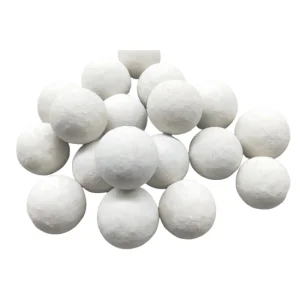
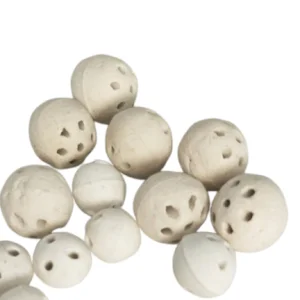
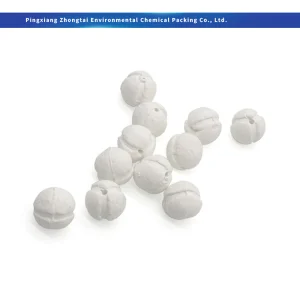
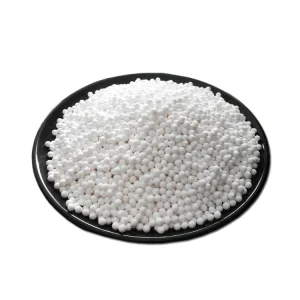
Leading process licensors recommend pairing molecular sieves with upstream protective media. Placing a 15%–20% buffer layer of Activated Alumina Balls at the inlet prevents free liquid slugs from fracturing fragile zeolite crystalline frameworks. Furthermore, top hold-down beds and bottom catalyst supports using Inert Ceramic Balls (17–23% or 99% Al₂O₃) ensure uniform superficial gas velocities, preventing localized channelings and vortex-induced bed fluidization.
The regeneration protocol governs thermal wear and hydrothermal aging. Standard desorptive regeneration heating ranges from 200°C to 280°C for Type A sieves, and up to 315°C for Type 13X. High-moisture purge gas during heating creates high-pressure steam environments within internal zeolite pores, which can leach tetrahedrally coordinated framework aluminum, reducing equilibrium capacity. Engineers balance heating ramp rates (≤ 2.5°C/min) with dry slip-stream sweeps to maximize life cycles beyond 1,500 run-regeneration cycles.
Superficial gas velocity through the adsorption vessel must stay within strict hydrodynamic windows ($0.15\text{ m/s} \le U_s \le 0.45\text{ m/s}$) to balance mass transfer rates against superficial pressure drop ($\Delta P / L$). An undersized bed accelerates mass transfer breakthrough, shortening on-stream cycles. Pingxiang Zhongtai’s chemical application engineers collaborate directly with EPC clients to generate dynamic breakthrough profiles, optimizing column geometry, diameter-to-height ratios, and bead size distributions (e.g., 4x8 mesh vs. 8x12 mesh).
Ensuring zero humidity ingress from our Pingxiang kilns to customer transshipment sites across Europe, the Middle East, Southeast Asia, and the Americas.
Every production lot undergoes rigorous laboratory testing adhering to ASTM D3802 (Ball-Pan Hardness), ASTM D4180 (Vibratory Packing Density), and ASTM D2862 for particle sizing. Complete physical and chemical test certificates accompany each shipment.
Delivered in factory-sealed, nitrogen-purged 55-gallon carbon steel drums (150 kg net) or air-tight multi-ply composite aluminum foil big bags (super sacks of 1,000 kg net) with thermal inner welds to guarantee residual moisture ($LOI$) below 1.5 wt% upon site arrival.
Situated in Pingxiang, Jiangxi Province—China’s epicenter for chemical packing and industrial ceramics—our factory integrates upstream kaolin quarries, raw chemical synthesis plants, and automated kilns within a 30-km logistics radius, driving down supply chain overheads.
From our Pingxiang base, bilingual mass-transfer engineers provide remote column modeling, pressure drop profile calculations, and on-site desiccant loading supervision (dense-phase sock loading) to prevent particle abrasion and early dusting.
Next-generation crystalline architectures: How binderless synthesis, carbon capture adsorbents, and low-energy thermal desorption lattices are reshaping the desiccant landscape.
Standard commercial sieves dilute active adsorption capacity by incorporating 15%–20% non-adsorptive clay binders. Our modernized hydrothermal post-conversion synthesis systematically transforms inert clay binders into pure crystalline Zeolite A and Faujasite structures. This architecture yields a 20% to 25% surge in volumetric adsorption capacity, allowing refinery operators to downscale vessel dimensions or lengthen operating cycle runtimes by hundreds of on-stream hours.
Addressing industrial decarbonization mandates, specialized 13X derivatives functionalized with amine-grafted mesoporous frameworks (MCM-41 / SBA-15 hybrid lattices) achieve dramatic improvements in CO₂/N₂ selectivity. Engineered specifically for post-combustion flue gas streams and biogas biomethane upgrading, these adsorbents display high equilibrium capacity at low partial pressures ($P_{CO_2} < 0.15\text{ bar}$) alongside moisture-resilient frameworks.
A primary thermal handicap of traditional molecular sieves is the steep energy penalty required during TSA regeneration (often exceeding 280°C). By tailoring the silica-to-alumina ratio ($Si/Al$ framework composition) and engineering intra-crystalline hierarchical macropores, next-generation adsorbents lower desorption temperatures down to 140°C–160°C. This allows facilities to exploit low-grade industrial waste heat, cutting refinery and chemical plant operational energy budgets by up to 35%.
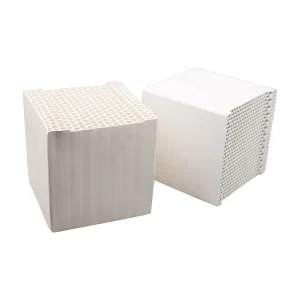
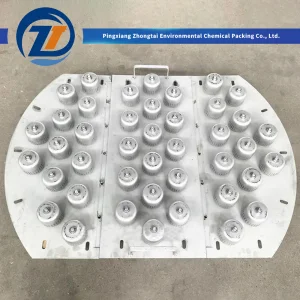
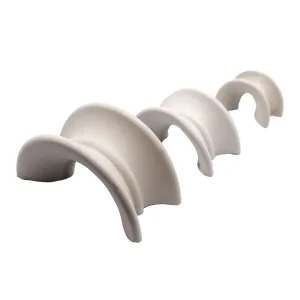
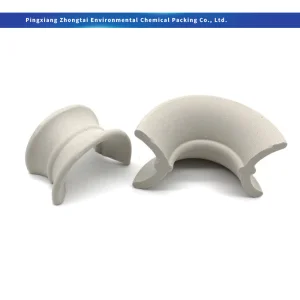
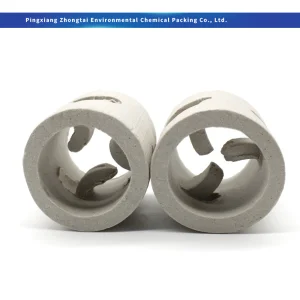
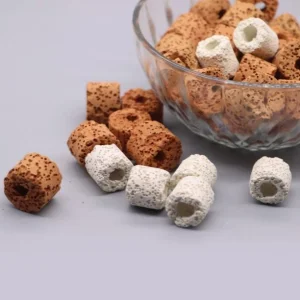
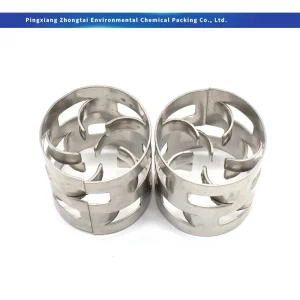
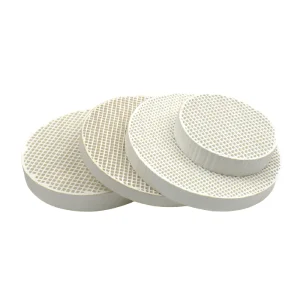
Comprehensive random tower packings, acid-resistant ceramic saddles, structured heat-storage blocks, and high-purity support elements.
Direct engineering clarifications regarding factory MOQ, pore selectivity, bed packing calculations, and international logistics safeguards.
Connect directly with Pingxiang Zhongtai Environmental Chemical Packing Co., Ltd.'s mass-transfer engineers. Submit your tower dimensions, gas flow metrics, and adsorption parameters for a complete technical quotation and batch sample evaluation.