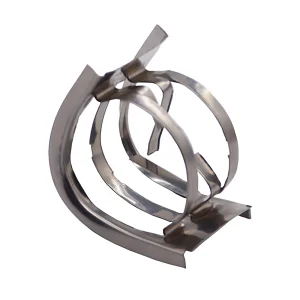
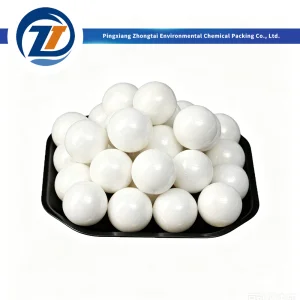
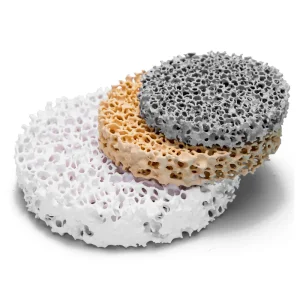
Precision-machined high alumina spheres, high-voidage structured adsorbents, and molten casting filtration elements manufactured under strict dimensional and metallurgical tolerances.
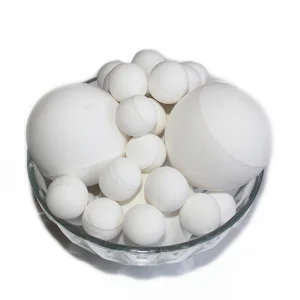
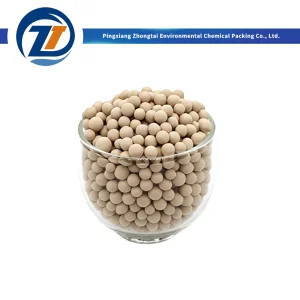
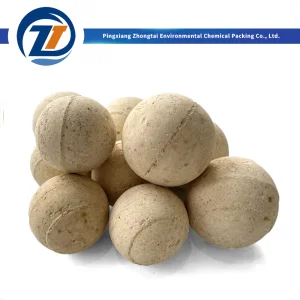
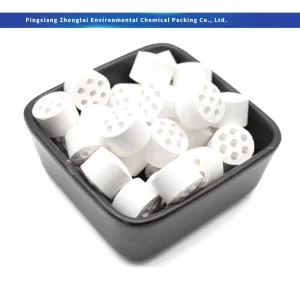
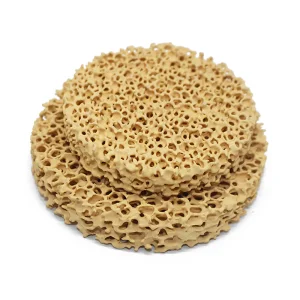
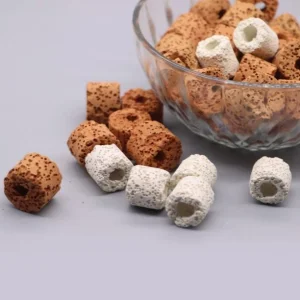
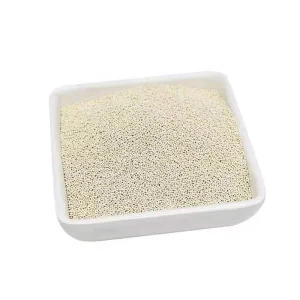
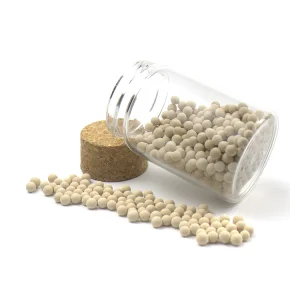
Alkaline ceramic balls represent an engineered convergence of structural silicate chemistry, submicron tourmaline piezo-activation, and bio-available mineral leaching designed for process-grade fluid modification.
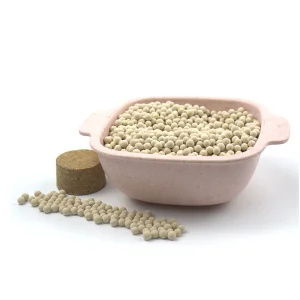
Alkaline bioceramics incorporate finely ground electrical-polar tourmaline crystals ($Na(Mg,Fe)_3Al_6(BO_3)_3Si_6O_{18}(OH)_4$). When fluid passes through the packed bed, microscopic electrostatic potentials generate micro-currents (approx. 0.06 mA) that decompose complex water clusters ($H_2O$) into active hydronium ions and hydroxyl ions ($OH^-$), reducing the cluster size to 50–60 Hz NMR line-width for accelerated cellular absorption.
By blending sub-sieve elemental magnesium composites and reduced-state calcium carbonates within an aluminosilicate refractory matrix sintered under controlled vacuum reduction (800°C–1050°C), our media triggers a steady, sustained micro-electrochemical reaction:
$$Mg + 2H_2O \rightarrow Mg(OH)_2 + H_2 \uparrow$$
This liberates active dissolved molecular hydrogen ($0.2–0.8\text{ ppm}$), dropping Oxidation-Reduction Potential (ORP) from $+200\text{ mV}$ to down to $-500\text{ mV}$, yielding potent free-radical neutralizing efficacy.
Unlike raw mineral gravels that exhaust soluble minerals in hours, our proprietary spherulitic agglomeration process fuses Maifanite, Muyu stone, high-purity calcite, and diatomaceous earth into a tortuous, nano-porous ceramic framework. The dissolution kinetics maintain an equilibrium extraction rate of ionic $Ca^{2+}$, $Mg^{2+}$, $K^+$, $Sr^{2+}$, and metasilicic acid ($H_2SiO_3$), stabilizing TDS between $30\text{ and }90\text{ ppm}$ over an extended bed lifespan exceeding 12–24 operating months.
| Physical / Chemical Property | Standard Alkaline Spheres | Hydrogen ORP Reduction Grade | High-Purity Inert Bed Support | Testing Protocol |
|---|---|---|---|---|
| Active Component Content | Maifanite / Tourmaline (45–60%) | Mg Composite + Bioceramic (>75%) | $\alpha\text{-}Al_2O_3$ (99.2%–99.7%) | XRF / ICP-OES Mass Spec |
| Effluent pH Value | 8.2 – 9.5 | 8.8 – 10.4 | Neutral (6.8 – 7.2 Inert) | ASTM D1293 Digital Electrode |
| Oxidation-Reduction Potential (ORP) | $-50\text{ to }-150\text{ mV}$ | $-250\text{ to }-550\text{ mV}$ | Ambient Process Dependent | Calibrated Platinum Pin Probe |
| Single-Bead Crush Strength | $\ge 150\text{ N/particle}$ | $\ge 120\text{ N/particle}$ | $\ge 4500\text{ N/particle}$ ($\varnothing 19\text{mm}$) | ASTM C517 / HG/T 3683.1 |
| Bulk Density ($\text{g/cm}^3$) | $1.35 – 1.45$ | $1.20 – 1.30$ | $2.00 – 2.15$ | ASTM D2854 Volumetric Core |
| Surface Specific Area ($m^2/\text{g}$) | $15 – 35$ | $25 – 45$ | $< 0.5$ (Low Porosity Vitrified) | BET Nitrogen Physisorption |
| Operating Temperature Threshold | $\le 85^\circ\text{C}$ Continuous | $\le 65^\circ\text{C}$ High Efficiency | $\le 1400^\circ\text{C}$ Ultra-Refractory | Thermal Dilatometry / Pyrometry |
From post-demineralization conditioning in municipal water installations to high-capacity biological filtration in land-based recirculation aquaculture systems (RAS), our media delivers predictable, long-term chemical kinetics.
Industrial and residential RO membranes consistently produce permeate water characterized by aggressive, acidic pH profiles (pH 5.5–6.2) devoid of electrolytes. Installing an alkaline ceramic ball remineralization column downstream stabilizes the Langelier Saturation Index (LSI > 0), prevents distribution pipe corrosion, and introduces $15–30\text{ ppm}$ of ionic calcium and magnesium for optimal health and taste.
Zero Chemical Injection DosingIn wellness water packaging and beverage preparation lines, electrochemical hydrolysis cells suffer from electrode scaling and high electricity consumption. Our negative-ORP bioceramic spheres provide passive, high-yield hydrogen enrichment ($H_2$ gas saturation up to $800\text{ ppb}$) in storage silos and vending machine dispense filters without ozone generation or anode degradation.
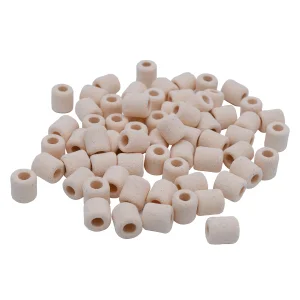
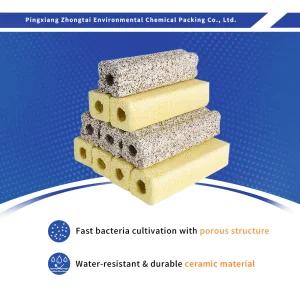
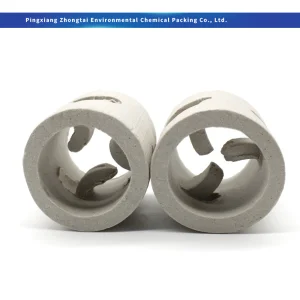
Continuous -350mV TargetIntensive recirculating aquaculture produces massive organic acid loads during biological nitrification ($NH_4^+ \rightarrow NO_2^- \rightarrow NO_3^-$), depleting system alkalinity ($CaCO_3$) and crashing biofilter pH below 6.8. Combining our porous breath ceramic bio-rings with alkaline mineral balls provides self-regulating alkaline release, maintaining a continuous pH 7.4–8.0 buffer zone for nitrifying colonies.
Biological Biome BufferMetal finishing, galvanic plating, and battery recycling plants generate low-volume rinse streams with volatile, acidic pH spikes. Using alkaline ceramic media columns as fixed-bed passive neutralizers absorbs free protons ($H^+$) and adsorbs trace heavy metals (such as $Cu^{2+}$, $Ni^{2+}$, and $Zn^{2+}$) onto the high-porosity matrix, dramatically reducing costly sodium hydroxide (NaOH) consumption.
CapEx & OpEx Cost OptimizationIn industrial washing tunnels and hotel laundry facilities, combining far-infrared bio-balls with alkaline dechlorination balls softens water, increases surfactant hydration efficiency, and elevates pH to 9.0. This allows operators to reduce synthetic detergent dosages by up to 35% while eliminating residual hypochlorite bleach odors from processed fabrics.
Eco-Detergent SaverPingxiang City, Jiangxi Province is universally recognized as the industrial ceramics and chemical packing epicenter of the world. Zhongtai leverages 20+ years of localized supplier clustering, ultra-pure mineral reserves, and automated continuous sintering kilns.
Located immediately adjacent to South China's kaolin, high-grade tourmaline, bentonite, and mullite deposits, our plant eliminates cross-province raw material transport delays. Raw materials are tested via X-ray fluorescence (XRF) prior to batching, guaranteeing consistent chemical profiles free of non-ferrous contaminants, toxic lead ($Pb$), mercury ($Hg$), cadmium ($Cd$), or hexavalent chromium ($Cr^{6+}$).
Our production facilities operate multi-zone computerized roller hearth kilns and shuttle kilns engineered with tight digital PID temperature controls ($\pm 2^\circ\text{C}$). Sintering curves are customized per formulation grade—from 850°C low-temperature sintering for hydrogen-activating bioceramics up to 1650°C ultra-high-temperature sintering for 99% $\alpha\text{-}Al_2O_3$ catalyst bed support spheres.
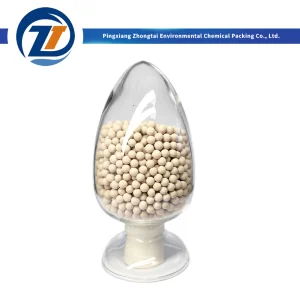
Spherical granulating disks and high-speed tumbling machines guarantee particle sphericity tolerances within $\pm 0.5\text{ mm}$ of designated diameters ($\varnothing 2\text{mm}$ to $\varnothing 25\text{mm}$). Automated multi-deck vibratory screens reject sub-sized fines and abnormal out-of-round agglomerations before packaging, ensuring maximum bed voidage and minimum hydraulic pressure drop ($\Delta P$) in pressurized filter housings.
Every industrial production run is assigned an encrypted batch tracking number. Our on-site metallurgy and chemical analysis laboratory performs crush resistance testing, boiling water attrition tests, leachability assays, and bulk density determinations. Mill test certificates (MTC) and Certificates of Analysis (COA) accompany every ocean container leaving our loading dock.
Navigating stringent multinational drinking water and industrial chemical regulations is straightforward with Zhongtai. Our products comply with strict international regulatory directives, ensuring uninterrupted customs clearance and smooth site receiving.
Tested in accordance with toxicology and heavy metal extraction norms. Formulations maintain leachable metals well below EPA Maximum Contaminant Levels (MCLs). Arsenic ($As$), lead ($Pb$), and barium ($Ba$) are below ICP-MS instrument detection limits ($< 0.001\text{ mg/L}$), making them fully safe for municipal, commercial, and residential direct drinking contact.
Fully compliant with European Regulation (EC) No 1907/2006 concerning the Registration, Evaluation, Authorization and Restriction of Chemicals. Free from all Substances of Very High Concern (SVHC 240+ compounds). Polybrominated biphenyls, phthalates, and asbestos-forming amphiboles are 100% excluded from our plant formulation rosters.
The natural mineral components (Maifan stone, natural tourmaline, calcium-magnesium carbonates) are classified as Generally Recognized as Safe (GRAS) under standard food contact guidelines. Every export shipment features non-toxic, food-grade packaging linings and vacuum-sealed poly barrier bags to preserve desiccant freshness during transit.
Available in 20kg/25kg multi-wall sealed Kraft paper bags with inner PE liners, 500kg/1000kg reinforced UV-stabilized bulk supersacks (jumbo bags), or hermetically sealed steel/poly drums. Palletized using heat-treated ISPM-15 fumigation-free solid plywood pallets protected with complete waterproof stretch wrapping and corner edge protectors.
Our experienced logistics department provides complete export documentation: Harmonized Tariff Code (HS Code) optimization (typically Chapter 69 for ceramic goods or Chapter 38 for chemical preparations), Form E/Form F for ASEAN trade concessions, RCEP certificates, Commercial Invoices, and Verified Gross Mass (VGM) declarations.
We welcome and regularly facilitate on-site batch sampling and verification audits from internationally recognized third-party agencies including SGS, BV (Bureau Veritas), TÜV Rheinland, and Intertek prior to factory gate release, assuring Tier-1 EPC contractors and global brand owners complete peace of mind.
As global water safety standards evolve and the hydrogen-wellness sector scales exponentially, Zhongtai's R&D engineering center is leading four transformative technological transitions across 2025–2035.
Traditional bioceramic spheres suffer from non-linear release curves: high early dissolution followed by surface calcification and passivating scaling. Our Generation 5 R&D program incorporates atomic-layer surface functionalization, creating microporous core-shell spheres. The protective outer silicate shell modulates ion diffusion, ensuring uniform trace mineral leaching for over 36 continuous months in high-throughput RO machines.
Integrating nano-$TiO_2$ and zinc-doped bioceramic matrices enables combined functionality: simultaneous pH buffering, far-infrared activation, and persistent bacterial inhibition. Under ambient hydraulic flow, micro-galvanic contact potentials disrupt bacterial cell membranes ($E.\text{ coli}$, $Staphylococcus$), inhibiting biofilm formation inside stagnant water dispenser filter columns without silver ($Ag^+$) leaching.
Under China’s national dual-carbon goals (Carbon Peaking 2030, Carbon Neutrality 2060), our Pingxiang production complex is transitioning from LNG-fired burners to zero-emission electric kilns powered by provincial hydroelectricity and rooftop solar arrays. This cuts embodied carbon emissions per metric ton of ceramic by 62%, helping multinational enterprise buyers satisfy strict Scope 3 ESG supply chain disclosure criteria.
Future iterations of our high-grade catalyst bed supports and mineral spheres incorporate inert microscopic rare-earth spectral markers. Using handheld Raman or XRF scanners, global logistics managers and chemical engineers can instantly verify origin authenticity, prevent counterfeit factory substitute media, and audit batch formulation records directly on the plant floor.
Detailed, whitepaper-depth answers addressing design parameters, service lifetime, operating limits, and shipping structures for engineering procurement specialists.
Corrosion-resistant random packing geometries, advanced zeolitic molecular sieves, and ultra-fine ceramic micro-milling media engineered for harsh petrochemical, biological, and processing duties.