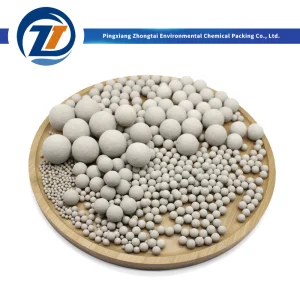
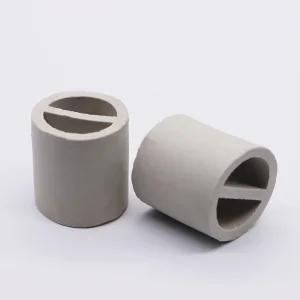
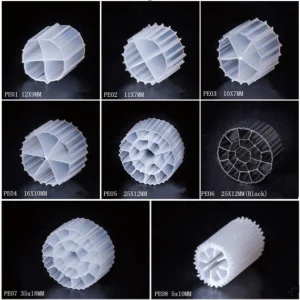
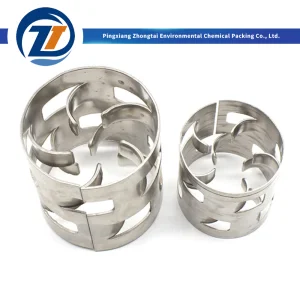
Explore our precision-manufactured catalyst supports, random packings, and molecular sieves exported to global gas processing plants.
A technical guide on molecular sieve physics, cation exchange thermodynamics, and industrial engineering standards for oxygen generation.
Synthetic zeolites utilized in oxygen concentrators are highly crystalline aluminosilicates characterized by three-dimensional interconnecting pore networks. In Pressure Swing Adsorption (PSA) and Vacuum Pressure Swing Adsorption (VPSA) equipment, ambient air (composed primarily of 78% Nitrogen, 21% Oxygen, and 1% Argon) is passed through a pressurized adsorbent bed containing synthetic zeolites.
Because nitrogen molecules possess a significantly higher quadrupolar moment ($0.31 \times 10^{-26} \text{ esu}\cdot\text{cm}^2$) compared to oxygen molecules ($0.10 \times 10^{-26} \text{ esu}\cdot\text{cm}^2$), the extra-framework cations (such as $Li^+$ or $Na^+$) embedded inside the faujasite ($FAU$) crystal frame exert a localized electrostatic attraction on nitrogen. This allows the zeolite to preferentially trap nitrogen molecules while allowing pure oxygen to pass through as an unabsorbed effluent gas stream at concentration purities ranging from 93% to 95% ± 3%.
When selecting a molecular sieve for oxygen concentrator manufacturing, engineers evaluate the interaction between cation type, ratio of silica-to-alumina ($SiO_2/Al_2O_3$), equilibrium adsorption capacity, dynamic bed capacity, and mechanical attrition resistance. As a premier Chinese manufacturer located in the industrial chemical cluster of Pingxiang, our facility delivers molecular sieves tailored for medical-grade standards (ISO 13485) and heavy-duty industrial VPSA systems.
A quantitative engineering analysis comparing nitrogen loading capacity, void space mechanics, and energy efficiency parameters.
To design oxygen generation systems with minimal power requirements and ultra-compact foot-prints, OEM medical device engineers must evaluate the thermodynamic equilibrium isotherms of the underlying zeolite. The low ionic radius and high charge density of the $Li^+$ ion in a fully lithium-exchanged low-silica X-type zeolite ($Si/Al \approx 1.0$) creates an exceptionally strong electrostatic field inside the supercage ($13 \text{ Å}$ pore diameter). This creates an isotherm curve that adsorbs significantly more nitrogen at low partial pressures ($0.2 \text{ to } 1.0 \text{ bar}$) than conventional sodium or calcium zeolites.
| Performance Characteristic | Lithium-X Zeolite (Li-X) | Molecular Sieve 13X-HP | Molecular Sieve 5A (Ca-A) |
|---|---|---|---|
| Primary Extra-Framework Cation | Lithium ($Li^+$ $\ge 96\%$) | Sodium ($Na^+$) | Calcium / Sodium ($Ca^{2+}/Na^+$) |
| Framework Crystal Structure | Low Silica FAU (X-Type, Si/Al = 1.0) | Standard FAU (X-Type, Si/Al = 1.25) | LTA Framework (Pore Size ~5 Å) |
| N2/O2 Separation Factor ($\alpha$) | 5.8 – 6.4 | 2.8 – 3.2 | 2.3 – 2.6 |
| N2 Adsorption Capacity (cm³/g @ 25°C, 1 bar) | 22 – 26 cm³/g | 8 – 11 cm³/g | 6 – 8 cm³/g |
| Power Consumption per Nm³ O₂ Produced | 0.28 – 0.35 kWh/Nm³ | 0.50 – 0.65 kWh/Nm³ | 0.70 – 0.85 kWh/Nm³ |
| Minimum Required Bed Volume (Home Medical) | Ultra-compact (100–150 ml per column) | Medium (250–350 ml per column) | Large (> 450 ml per column) |
| Primary Target Applications | Portable Concentrators (POC), Mini PSA, Medical Units | Stationary Home Care Concentrators, Industrial VPSA | Baseline Industrial Air Separation, Oxygen/Nitrogen PSA |
Both Lithium and Sodium zeolites possess extreme hydrophilic tendencies. Water molecules possess a dipole moment ($1.85 \text{ D}$) much stronger than nitrogen, meaning $H_2O$ molecules will irreversibly block zeolite pore apertures if ambient moisture reaches the bed. A well-designed oxygen concentrator circuit must incorporate upstream moisture traps or integrated multi-layer desiccant guard beds (such as 3A molecular sieve or silica gel) to keep the dew point entering the zeolite column below -60°C, ensuring a bed operational service life of 5 to 10 years.
From micro-scale wearable respiratory units to municipal health infrastructure and high-density industrial oxygen plants.
Operating Environment: Wearable, battery-operated respiratory devices used by patients with chronic obstructive pulmonary disease (COPD).
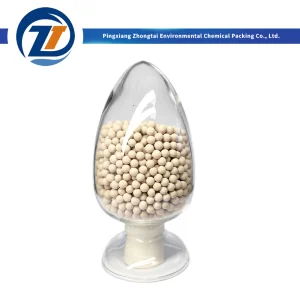
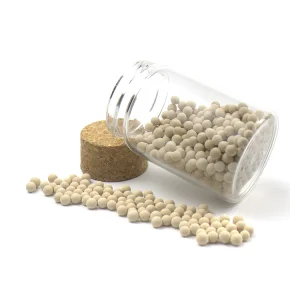
Technical Requirement: Requires ultra-small 0.4mm–0.8mm Li-X micro-beads. These micro-beads maximize mass transfer rates due to shortened intragranular diffusion paths, permitting cycle times under 1.5 seconds and cutting overall compressor weight to under 2.0 kg.
Operating Environment: High-flow 50–500 Nm³/h multi-bed PSA/VPSA arrays piping oxygen directly to clinical wards and ICUs.
Technical Requirement: Employs 1.6mm–2.5mm Li-X or 13X-HP beads in dual-tower configurations. Prioritizes extreme mechanical crushing resistance (>35 N/bead) to withstand continuous bed fluidization, pressure shocks, and gas velocities without dusting.
Operating Environment: High-density indoor fish farms and salmon hatcheries demanding continuous dissolved oxygen supersaturation.
Technical Requirement: Low-cost continuous VPSA systems using specialized 13X/5A zeolites. High operational efficiency lowers energy overhead per kg of biomass, enhancing survival rates and preventing bio-fouling in marine recirculating loops.
Operating Environment: Advanced oxidation processes (AOPs) requiring high-purity oxygen feed streams free of moisture and hydrocarbon contaminants.
Technical Requirement: Oxygen purities of 93–95% delivered via dense-packed zeolite columns. Dry, high-purity feed streams prevent dielectric breakdown and formation of corrosive nitric acid inside high-voltage ozone generators.
Operating Environment: Pressurized ambient oxygen enrichment for high-altitude hotel rooms, plateau mining facilities, and mountain tunnel construction.
Technical Requirement: Requires wide ambient pressure operation capabilities. Zeolite adsorbents must maintain high nitrogen kinetic uptake even under reduced barometric pressures found at altitudes exceeding 3,500 meters above sea level.
Operating Environment: On-site thermal cutting, jewelry manufacturing, and artistic glass manipulation requiring stable high-temperature flames.
Technical Requirement: Replaces hazardous compressed high-pressure oxygen cylinders with localized 13X-HP molecular sieve PSA beds, eliminating cylinder logistics while supplying non-stop oxygen feed lines.
Innovation horizons: From mixed transition-metal exchanged frameworks to monolithically structured adsorbents.
By incorporating micro-concentrations of silver cations ($Ag^+$) alongside lithium ($Li^+$), researchers have demonstrated $N_2/O_2$ polarizability interactions that double the nitrogen adsorption capacity of traditional Li-X. This paves the way for micro-concentrators capable of delivering 3L/min oxygen continuous flow while fitting inside a handbag.
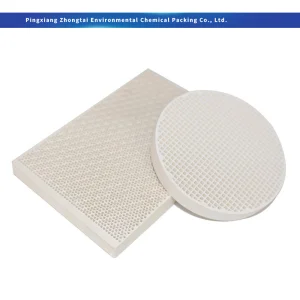
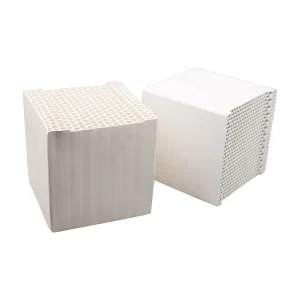
Moving away from traditional spherical beads, structured monolithic zeolite honeycombs with micro-channel architectures eliminate intra-bed friction, bed fluidization, and particle attrition. This structural shift allows pressure drops to decrease by up to 70%, facilitating high gas velocity and whisper-quiet medical oxygen devices.
Advancements in high-efficiency vacuum regeneration pumps combined with low-heat desorbing Li-X matrices are reducing overall energy footprints down to $0.22 \text{ kWh/Nm³}$ of pure oxygen. This advance allows solar-powered oxygen stations to be deployed in off-grid rural clinics across developing nations.
Located in the heart of Pingxiang's chemical packing industrial cluster—delivering raw material security, automated quality control, and cost advantages.
Pingxiang City, Jiangxi Province, stands as China's premier hub for industrial ceramic and mass transfer media manufacturing. Our facility leverages complete supply chain integration—from upstream high-purity sodium silicate and aluminate chemical synthesis to precise hydrothermal crystallization, ion-exchange enrichment, and automated sphere forming.
Because raw material sourcing, lithium salt processing, and kiln calcination occur within a unified industrial zone, we guarantee operational continuity and shield international OEM clients from global supply shocks.
Every metric ton of molecular sieve produced undergoes rigorous batch-level quality verification. Our automated rotary kiln calciners utilize precise temperature controls ($\pm 2^\circ\text{C}$) to activate zeolites without damaging the crystal lattice.
Understanding market forces, replacement economics, and OEM supply management for healthcare device brands.
Following the global surge in emergency medical oxygen procurement, the market for zeolite adsorbents has transitioned toward long-term home health maintenance, localized medical gas generation in rural hospitals, and green industrial applications. OEM equipment builders face intense price competition, forcing a shift away from expensive Western sieve brands toward tier-1 Chinese manufacturers capable of supplying equivalent chemical performance at 30% to 45% lower Capex cost.
Over a 10-year operating horizon for a hospital 100 Nm³/h PSA plant, adsorbent media costs represent less than 12% of overall lifecycle expenses, while electricity accounts for over 70%. Upgrading from standard 13X to high-selectivity Lithium-X zeolite reduces motor energy consumption by up to 30%, yielding full payback on sieve procurement within the first 14 months of continuous operation.
We work directly with oxygen concentrator manufacturers across North America, Europe, South America, and Southeast Asia. Whether delivering micro-beads pre-filled in hermetically sealed aluminum canisters or supplying bulk 50 kg moisture-proof steel drums with nitrogen blanket protection, our packaging logistics ensure zero hydration during transit.
Full regulatory compliance supporting global customs clearance, medical device registration, and hazardous material safety protocols.
Our molecular sieves comply with international biocompatibility safety requirements. Materials are free of heavy metal leachables, toxic binders, or volatile organic compounds (VOCs), rendering them completely safe for inhalation therapy devices.
Fully certified under European Union REACH registration protocols and compliant with RoHS directives. Comprehensive Safety Data Sheets (SDS) and Certificate of Analysis (COA) documents accompany every export shipment.
Shipped in airtight vacuum-sealed metal drums, composite jumbo bags with double PE liners, or nitrogen-purged custom cartridges engineered for automated robot assembly lines.
Addressing engineering queries on service life, bed packing, dew point requirements, and lithium sieve replacement.
Explore our full range of water treatment media, environmental catalysts, and gas separation adsorbents manufactured in China.