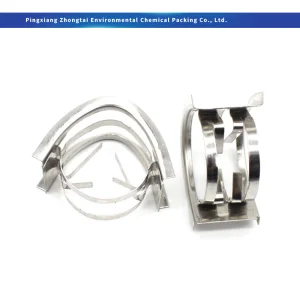
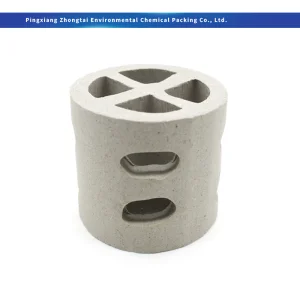
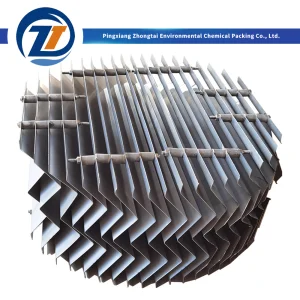
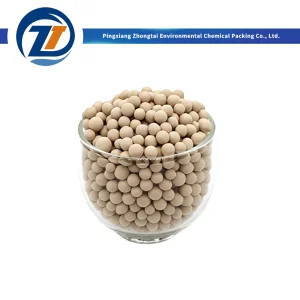
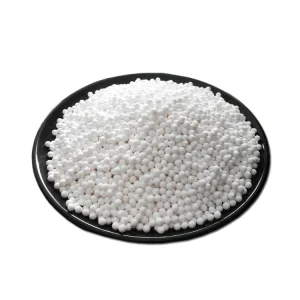
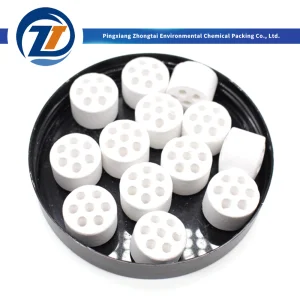
Engineered for extreme hydrodynamic and thermal environments across global chemical distillation, refining, metallurgical casting, and catalytic adsorption units.
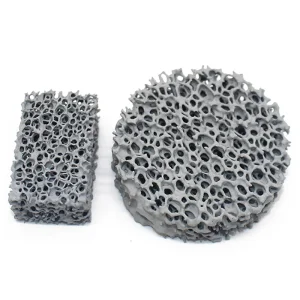
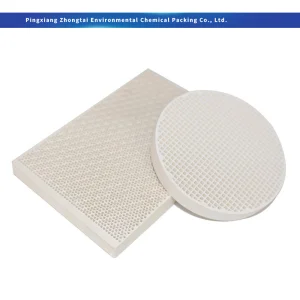
Honeycomb ceramics represent the pinnacle of structured mass and heat transfer media. By optimizing cellular channel matrices and stoichiometric mineral synthesis, modern manufacturing achieves exceptional thermal recovery and hydrodynamic efficiency.
The core performance of thermal-regenerative honeycomb ceramics relies on formulating a pure synthetic cordierite phase (2MgO·2Al₂O₃·5SiO₂). By strictly controlling secondary mullitization and crystalline orientation during tunnel kiln firing, China's Tier-1 producers eliminate residual free silica that otherwise accelerates thermal fatigue cracking under rapid cycling.
Channel geometry dictates the boundary layer thickness and laminar-turbulent transition during gas passage. Advanced extrusion dies produce square, hexagonal, and circular cell geometries with wall thicknesses down to 0.4 mm. This provides an open frontal area (OFA) exceeding 72%, significantly reducing fan energy consumption in RTO systems.
In petrochemical and hazardous waste incineration streams, flue gases carry acidic anions (SOx, NOx, Cl⁻) alongside vaporized alkali metal fluxes (Na₂O, K₂O). Specialized mullite-corundum composite formulations introduce an acid-insoluble barrier phase that prevents flux-induced surface vitrification and pore collapse.
Located in Pingxiang, Jiangxi Province—the historic heart of China's chemical ceramics industry—our production network leverages geographical concentration, vertically integrated raw materials, and decades of industrial mass transfer expertise.
Pingxiang's industrial cluster provides unhindered access to high-purity kaolinitic clays, bauxites, talc, and synthetic silicates within a 50 km logistics radius. This close raw material proximity shields international buyers from global supply disruptions, minimizes domestic transit costs, and guarantees batch chemical uniformity from the base slurry phase forward.
Decades of continuous capital reinvestment have transitioned Pingxiang's production base from manual firing pits to 120-meter computerized natural gas tunnel kilns. Multi-stage automated vacuum extrusion presses maintain uniform green body density across complex cross-sections, preventing the internal voids that cause premature spalling under high shear loads.
Factory-direct integration with the Shanghai, Ningbo, and Shenzhen maritime gateways enables rapid container stuffing, export customs clearance, and streamlined shipping routes. Full integration of fumigation-free ISPM-15 export pallets, reinforced heavy-duty edge protectors, and waterproof shrink film wrap safeguards sensitive cellular monoliths during multi-modal ocean transit.
When specifying honeycomb ceramic packing for thermal storage (RTO/RCO) and catalytic oxidation, plant engineers must benchmark five non-negotiable physical and thermal criteria to avoid catastrophic bed failures.
Thermal shock resistance is the primary determinant of service longevity in switching-valve RTO towers. Rapid cyclical reversal between incoming cold ambient VOC exhaust and 900°C combustion chambers generates severe thermal gradients. Specify substrates that survive at least 30 rapid cycles from 1,000°C to ambient water quench without macro-cracking or face delamination.
Bed media must withstand the cumulative static weight of multiple stacking layers (typically 1.5 to 2.4 meters bed height) combined with cyclic aerodynamic vibration from high-volume process blowers. Insist on longitudinal cold crushing strengths > 12.0 MPa and transverse strengths > 3.0 MPa, verified in accordance with ASTM C133 test procedures.
Thermal regeneration requires rapid heat absorption during exhaust purging and continuous heat transfer to incoming combustion air. Quality cordierite-mullite materials deliver specific heat capacity ratings ($C_p$) between 1,000 and 1,150 J/(kg·K) at 800°C, delivering thermal recovery rates (η) over 95% and lowering auxiliary burner natural gas consumption.
| Material Formulation | Predominant Crystal Phase | Bulk Density (g/cm³) | CTE (×10⁻⁶/°C, 20-1000°C) | Cold Crushing (MPa) | Max Temp (°C) | Primary Industrial Use |
|---|---|---|---|---|---|---|
| Standard Cordierite | 2MgO·2Al₂O₃·5SiO₂ | 1.85 – 2.10 | 1.2 – 1.6 | ≥ 12.0 | 1,250 | Standard VOC RTOs |
| Mullite-Enhanced | 3Al₂O₃·2SiO₂ | 2.15 – 2.35 | 2.8 – 3.4 | ≥ 18.5 | 1,400 | Chemical Waste Incineration |
| Corundum-Mullite | α-Al₂O₃ + Mullite | 2.40 – 2.65 | 4.5 – 5.2 | ≥ 25.0 | 1,550 | Metallurgical Heat Storage |
| Silicon Carbide (SiC) | β-SiC Matrix | 2.60 – 2.85 | 3.8 – 4.2 | ≥ 35.0 | 1,450 | High Corrosion / High Abrasion |
Engineered honeycomb ceramic blocks serve as vital components across a diverse range of environmental abatement systems, metallurgical heating units, and chemical processing facilities worldwide.
In high-volume paint shops, pharmaceutical synthesis rooms, and polymer extrusion plants, process exhaust air contains hazardous solvent vapors (BTEX, esters, ketones). Arranged in 2-bed, 3-bed, or rotary multi-chamber RTOs, honeycomb ceramic beds recover up to 96% of thermal energy, maintaining self-sustaining auto-thermal combustion down to VOC concentrations as low as 1.5 g/Nm³.
Modern steel billet rolling mills, aluminum remelt furnaces, and glass annealing lehrs use regenerative industrial burners (HTAC technology) to preheat incoming combustion air up to 1,000°C using hot flue gases. High-density corundum-mullite honeycomb inserts handle repetitive hot gas impingement without softening, reducing furnace fuel consumption by 30% to 50%.
For coal-fired boilers, cement kilns, and marine diesel engines, extruded honeycomb ceramics serve as high-surface-area catalytic catalyst supports. Extruded with tailored micro-porosity (pore volume > 0.35 cm³/g), these monoliths are washcoated with active V₂O₅-WO₃/TiO₂ formulations to facilitate the selective catalytic reduction of harmful NOx emissions into nitrogen and water.
International EPC contracts demand verified compliance, batch-level physical testing, and traceable documentation. Chinese tier-one manufacturers operate under rigorous ISO frameworks to meet strict global environmental and chemical regulations.
All delivered chemical packing and honeycomb ceramic materials are certified compliant with EU REACH (EC 1907/2006) regulations, confirming complete absence of Substances of Very High Concern (SVHC). Finished substrates comply with RoHS directives, EPA Clean Air Act particulate purity standards, and regional environmental rules governing synthetic refractory materials.
Every factory production run undergoes destructive and non-destructive laboratory testing prior to packaging. Factory testing logs record cold crushing strength (CCS), water absorption, bulk density, thermal expansion coefficients, and X-ray fluorescence (XRF) elemental chemical composition, with batch test certificates archived for 10 years to ensure complete trace integrity.
Procurement teams regularly conduct on-site factory audits in Pingxiang or employ third-party inspection firms (SGS, TÜV, Bureau Veritas) to witness pre-shipment testing. Factory engineering personnel deliver English-language bed packing diagrams, pressure drop modeling calculations, and troubleshooting support for RTO retrofits and plant turnarounds worldwide.
Our Pingxiang engineering department provides complete custom CAD die extrusion tooling for non-standard CPSI layouts, segmented circular regenerator beds, and specialty mullite-cordierite formulas. Rapid sample prototyping is completed within 14 business days.
As global manufacturing transitions toward carbon neutrality and tighter VOC capture mandates, industrial ceramic media continue to evolve with thinner cell walls, catalytic integration, and specialized formulations for the hydrogen economy.
Next-generation precision extrusion dies have enabled the fabrication of 400 to 600 CPSI honeycomb structures with wall thicknesses under 0.18 mm. These ultra-thin wall architectures expand open frontal area to 80%, reducing system fan static pressure drop and lowering electrical operating expenditures across high-capacity industrial emission plants.
Industrial burners transitioning to green hydrogen blends face adiabatic flame temperatures exceeding 2,100°C and higher steam partial pressures. Tier-1 Pingxiang research facilities are developing dense silicon carbide and zirconia-toughened mullite honeycomb formulations that resist water vapor leaching and high-temperature thermal spalling.
Environmental standards now penalize spent refractory landfill disposal. Modern manufacturing operations incorporate advanced mechanical crushing, hydrocyclone cleaning, and micronizing systems to reprocess clean post-service cordierite ceramic blocks back into high-performance refractory grog, advancing sustainability in industrial ceramic manufacturing.
Detailed technical answers to common questions regarding cellular geometry selection, thermal stress management, factory auditing, and transport protections.
Engineered tower packing, high-temperature infrared plates, and molecular sieves designed for aggressive chemical columns, foundries, and gas purification units.