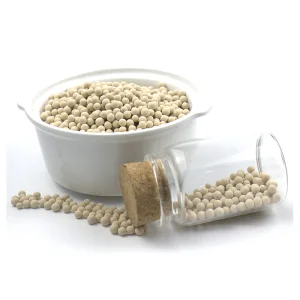
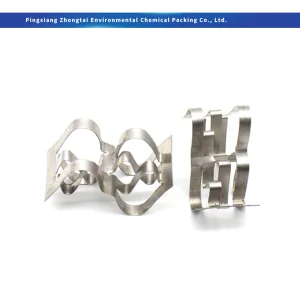
Engineered catalytic supports, desiccant sieves, and column internals manufactured under strict metallurgical and crystallographic quality control protocols in Pingxiang, China.
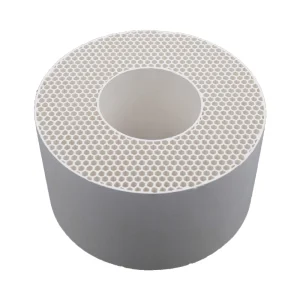
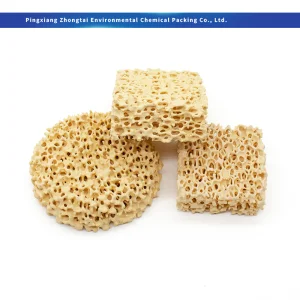
Cordierite ceramic substrates represent the zenith of refractory cellular materials, synthetically derived from pure talc, calcined kaolin, and alumina trihydrate to achieve near-zero thermal expansion in extreme thermal cycling.
Cordierite (2MgO·2Al₂O₃·5SiO₂) features an orthorhombic crystalline lattice with a negative expansion coefficient along the c-axis. Synthetic formulations maintain a macroscopic Coefficient of Thermal Expansion (CTE) of ≤ 1.0 × 10⁻⁶/K (25°C to 800°C), preventing spalling during violent thermal shocks over 1000°C.
With a specific heat capacity exceeding 1050 J/(kg·K) at operating temperatures and a bulk density calibrated between 2.1 and 2.5 g/cm³, our honeycomb blocks deliver thermal recovery efficiencies up to 96.5% in continuous regenerative thermal oxidation systems.
By controlling pore former burnout and mineral sintering stages (1380°C–1430°C window), our substrates offer tailored wall porosities from 22% to 52% with median pore diameters of 3.5 to 15.0 μm, guaranteeing exceptional catalyst washcoat anchoring without compromising bulk mechanical crush resistance.
| Physicochemical Parameter | Standard RTO Regenerative Block | High-Purity Catalytic Substrate | High-Temperature Burner Core | Test Standard |
|---|---|---|---|---|
| Primary Crystalline Phase | Synthetic Cordierite / Mullite | Pure α-Cordierite (>90%) | Cordierite-Mullite Solid Solution | XRD Quantitative Analysis |
| Bulk Density (g/cm³) | 2.10 – 2.35 | 1.75 – 2.10 | 2.25 – 2.45 | ASTM C373 / ISO 5017 |
| Coefficient of Thermal Expansion (25-800°C) | ≤ 1.6 × 10⁻⁶ / K | ≤ 0.9 × 10⁻⁶ / K | ≤ 1.8 × 10⁻⁶ / K | ASTM E228 Dilatometry |
| Axial Compressive Strength (A-Axis) | ≥ 15.0 MPa | ≥ 18.5 MPa | ≥ 12.0 MPa | ASTM C133 / EN 993-5 |
| Thermal Shock Resistance (Air Quench) | ΔT ≥ 950°C (No Cracking) | ΔT ≥ 1050°C (No Cracking) | ΔT ≥ 900°C (No Cracking) | Internal Cyclic Shock Test |
| Continuous Service Temperature | 1250°C (Peak 1320°C) | 1300°C (Peak 1380°C) | 1350°C (Peak 1400°C) | Continuous Firing Kiln Audit |
| Standard Cell Densities (CPSI) | 25, 40, 43, 50, 60 CPSI | 100, 200, 300, 400, 600 CPSI | 8, 12, 16, 25 CPSI | Micro-Optical Coordinate Metrology |
Engineering Insight: The mechanical survivability of cordierite ceramics under cyclic thermal fatigue is dictated by microcrack formation at anisotropic grain boundaries. Zhongtai's proprietary synthesis incorporates precisely graded sub-micron alumina hydrates and reactive silicon dioxides, buffering localized lattice expansion and increasing thermal fracture endurance by 38% compared to standard dry-pressed ceramics.
International environmental pacts (COP28, EU Green Deal, EPA Tier 4 Final, China VI) are forcing an engineering evolution in energy efficiency, volatile organic compound (VOC) destruction, and process exhaust purification.
Chemical synthesis, automotive paint shops, and battery separator plants generate volatile organic streams. Monolithic cordierite beds allow Regenerative Thermal Oxidizers (RTOs) to operate with auto-thermal combustion down to 1.5 g/Nm³ VOC concentrations, drastically reducing auxiliary natural gas consumption.
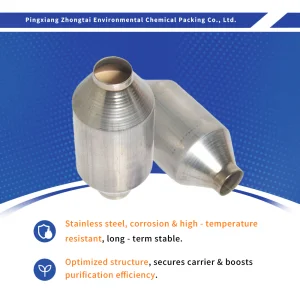
From highway Euro VI freight fleets to off-road tier 4 excavators and marine auxiliary engines, high-cell-density cordierite flow-through substrates carry Three-Way Catalysts (TWC) and Selective Catalytic Reduction (SCR) formulations, eliminating 99%+ of NOx, CO, and unburned hydrocarbons.
With the global shift toward industrial electrification and concentrated solar power (CSP), cordierite honeycomb serves as a solid-state thermal battery. Operating continuously at up to 1300°C without slagging or structural sintering, it bridges intermittent green power generation with process heat loads.
Minimizing system electrical fan power while maximizing heat transfer requires precise laminar flow control within extruded honeycomb channels. Here is how cell geometry determines system OPEX.
The global baseline for industrial RTO regenerative beds. In 40 CPSI and 43 CPSI formats, it provides an open frontal area (OFA) of 72% to 76%. The continuous straight channels suppress turbulent eddy friction, reducing fan electrical consumption by up to 22% compared to random saddle packing.
Hexagonal channels eliminate right-angle dead zones, ensuring ultra-uniform washcoat slurry deposition during catalyst loading. Triangular geometries optimize volumetric surface area (up to 3200 m²/m³ at 400 CPSI), essential for space-constrained automotive and aerospace catalytic converters.
Alternating inlet and outlet channel plugs force particulate-laden process gas through the microporous cordierite channel walls. This setup functions as a diesel particulate filter (DPF) or high-temperature soot filter, trapping sub-micron carbon particles with > 99% filtration efficiency.
In standard laminar flow (Reynolds number Re < 2000), pressure drop per linear meter of monolith bed is expressed through the Hagen-Poiseuille relationship modified for non-circular ducts: ΔP = (32 · μ · v · L) / (D_h² · OFA), where D_h represents hydraulic diameter and OFA is the open frontal area ratio. Zhongtai’s extrusion die micro-finishing reduces surface wall roughness (Ra < 1.2 μm), suppressing skin-friction boundary layer detachment and preventing particulate fouling in tar-laden exhausts.
International process procurement demands unequivocal material tracing. Zhongtai integrates batch-level pyrometric validation, dilatometric recording, and accredited export documentation.
From laser verification of die channel pitch to high-temperature dilatometric testing of thermal expansion, every production run is certified with complete MTC 3.1 chemical and mechanical inspection logs.
Substrates meet EPA Tier 4/CARB clean air catalyst requirements and strict EU REACH Annex XVII / SVHC regulations, guaranteeing zero toxic heavy metal leaching during operation or disposal.
Located in Pingxiang, Jiangxi—the epicenter of chemical packing—our facilities operate within an integrated supply chain radius of raw kaolin, talc mines, precision tooling fabricators, and advanced kilns.
Seaworthy, multi-layer cushioning: individually boxed monoliths seated in export-grade, heat-treated plywood crates (ISPM 15 compliant) with anti-moisture barrier wraps prevent shipping vibration damage.
Examine how Zhongtai cordierite honeycomb monoliths deliver verified fuel savings and emission destruction across petrochemistry, automotive manufacturing, and metal refining.
Client Service: Heavy solvent laden exhaust (toluene, ethylbenzene, MEK) at a petrochemical polymer plant.
Media Installed: 43 CPSI Synthetic Cordierite Blocks (150×150×300 mm).
Results: Thermal recovery efficiency achieved 96.2%, cutting natural gas burner fuel inputs by 91% in steady state with bed ΔP remaining below 135 Pa/m after 24 months of continuous operation.
Client Service: Marine & industrial generator exhaust NOx reduction.
Media Installed: 300 CPSI Cordierite Honeycomb Substrates with V₂O₅-WO₃/TiO₂ catalyst washcoat.
Results: Surviving 12,000 thermal cycles (-20°C to 550°C rapid throttle steps) without structural delamination or cell rupture, maintaining 98.4% continuous NOx conversion.
Client Service: Low-NOx industrial textile drying and food bakery lines.
Media Installed: Micro-perforated cordierite ceramic radiation plates.
Results: Conversion to complete flameless surface combustion lowered fuel use by 35%, eliminated CO hot-spot spikes, and reduced NOx emissions to < 15 ppm.
As industrial processes shift toward hydrogen combustion, electrified heating, and extreme low-backpressure requirements, Zhongtai’s materials laboratory is spearheading next-generation ceramic substrate architectures.
Pioneering 2.0-mil (50 μm) web thickness in 600–900 CPSI substrates. UTW configurations increase geometric surface area by 40% while dropping vehicle exhaust backpressure to near-zero, unlocking breakthrough fuel economy for hybrid engine powertrains.
Pure H₂ combustion produces extreme moisture contents in exhaust streams, accelerating silica extraction in standard ceramics. Our modified Cordierite-Mullite-Zirconia solid solutions resist high-temperature water-vapor de-silication at up to 1400°C.
Developing stereolithography (SLA) and binder-jet 3D printing of high-purity cordierite bodies with gyroid and triply periodic minimal surface (TPMS) channel profiles, promoting 3D convective mass transfer without straight-channel bypass.
Authoritative technical answers covering crystallographic stability, pressure drop modeling, catalyst washcoating, and freight handling for international delivery.
Explore the full range of Zhongtai’s thermal storage monoliths, catalytic substrates, molten metal filters, and column internals engineered for high-performance chemical plants.