Engineered in Pingxiang, Jiangxi—China's core industrial ceramic cluster. Every unit conforms strictly to ISO 9001 quality frameworks for petrochemical fractionation, tower mass transfer, and catalyst bed support.
An authoritative engineering analysis of cellular ceramic substrates, precision extrusion metallurgy, thermal fatigue mitigation, and catalytic converter assembly protocols across international regulatory landscapes.
Established in 2003 within the West Section Hi-Tech Industry Park of Pingxiang, Jiangxi, Pingxiang Zhongtai Environmental Chemical Packing Co., Ltd. has developed specialized tunnel-kiln thermal synthesis infrastructure, yielding sub-micron tolerance honeycomb ceramics.
Ultra-low thermal expansion coefficient (CTE) cordierite matrix engineered to survive rapid thermal cycling from ambient temperatures up to 1200°C without micro-fracturing or cell collapse under high thermal gradient surges.
From heavy wall 100/17 mil regenerators for RTO/RCO VOC thermal recovery to 600/2.5 mil ultra-thin-wall (UTW) automotive gasoline substrates optimizing surface-area-to-backpressure ratios for internal combustion powertrains.
The industrial performance of a ceramic honeycomb catalytic converter is fundamentally dictated by its mineral phase purity and microstructural crystallite orientation. High-purity talc, kaolin clay, reactive alumina, and silica are wet-milled into homogenous colloidal slip, precisely dosed with specialized plasticizers and pore-forming binders, and extruded through ultra-hard tungsten carbide dies.
During thermal sintering inside computerized 1400°C tunnel kilns, strict thermodynamic control directs the mineral crystallization process toward the targeted orthorhombic cordierite phase ($2\text{MgO}\cdot 2\text{Al}_2\text{O}_3\cdot 5\text{SiO}_2$). This engineered microstructural phase provides anisotropic expansion properties, locking thermal expansion below $1.0 \times 10^{-6}/\text{K}$ between 25°C and 800°C.
How international environmental mandates (Euro 6d/7, EPA Tier 4, IMO Tier III, China VI) are accelerating technical demands on Chinese substrate manufacturing hubs.
While battery electric vehicles expand, Plug-in Hybrids (PHEVs) and Extended-Range EVs (EREVs) generate unique thermal shock challenges due to frequent high-load engine start-ups, demanding elevated thermal shock parameters from cordierite substrates.
Stringent particulate matter (PM) and NOx caps in agriculture, marine, and mining engines necessitate heavy-duty Silicon Carbide (SiC) wall-flow diesel particulate filters (DPF) paired with high-porosity cordierite SCR substrates.
Chemical synthesis, coil coating, printing, and semiconductor fabrication operations face zero-leak volatile organic compound limits. Regenerative Thermal Oxidizers (RTO) rely directly on honeycomb blocks to maintain >95% thermal recovery efficiency.
Global Tier-1 system integrators are actively de-risking supply chains by qualifying tier-one Chinese ceramic manufacturers possessing independent raw material supplies, automated extrusion, and stable PGM-coating compatibility.
Precision parameters calculated for optimal contact kinetics, mass transfer coefficients, and laminar flow pressure drop constraints.
| Cell Configuration (cpsi / mil) | Channel Geometry | Wall Thickness (mm) | Geometric Surface Area (m²/m³) | Open Frontal Area (OFA) | Primary Industrial Application Duty |
|---|---|---|---|---|---|
| 100 / 17 | Square / Hex | 0.43 mm | 1,050 – 1,180 | 69.5% | RTO / RCO VOC Thermal Storage |
| 200 / 12 | Square | 0.30 mm | 1,540 – 1,620 | 71.8% | Marine DeNOx SCR / Industrial Off-Gas |
| 300 / 8 | Square | 0.20 mm | 2,050 – 2,140 | 74.2% | Diesel Oxidation Catalyst (DOC) |
| 400 / 6.5 | Square / Triangle | 0.165 mm | 2,450 – 2,560 | 75.6% | Automotive TWC Standard Gasoline |
| 400 / 4.0 | Square | 0.102 mm | 2,710 – 2,820 | 84.6% | High-Throughput Downpipe Converters |
| 600 / 3.0 | Square / Hex | 0.076 mm | 3,380 – 3,490 | 83.8% | Euro 6d/7 Close-Coupled Catalysts (CCC) |
By reducing wall thickness to 3.0 mils and optimizing cell density, the thermal mass of the ceramic monolith decreases by up to 34%. This ensures faster catalyst light-off within the critical first 30 seconds of engine ignition, capturing cold-start HC and CO spikes.
Tailored mean pore size (4–7 μm) and uniform volumetric pore distributions enable $\gamma$-Al₂O₃ washcoats with active Platinum Group Metals (Pt, Pd, Rh) or Base Metal Zeolites (Cu-CHA, Fe-beta) to mechanically anchor deep inside channel wall matrices without spalling.
Cellular geometries boast open frontal areas up to 85%, significantly minimizing engine pumping losses and fuel penalties while sustaining steady fully developed laminar flow across the entirety of the reactive monolithic channels.
Distinct physical and chemical requirements demand specific substrate formulations, cell configurations, and canning architectures.
Used in close-coupled and underfloor converters for stoichiometric gasoline passenger vehicles. Our 400 and 600 cpsi cordierite monoliths provide immediate catalytic conversion of unburned hydrocarbons ($HC$), carbon monoxide ($CO$), and nitrogen oxides ($NO_x$) under severe pulsation.
Formulated with enhanced radial and axial mechanical strength to resist vibration in commercial logistics trucks, excavators, and generators. Compatible with copper or iron-zeolite SCR washcoating for 98%+ DeNOx efficiency in ammonia slip systems.
High heat capacity mullite and cordierite structured honeycomb blocks (100–200 cpsi). Employed as regenerative heat transfer matrices in solvent painting, chemical refining, and resin curing lines, reducing plant operating fuel consumption by up to 95%.
Large-scale square and circular cordierite blocks built into modular catalyst racks for natural gas turbines and combined heat and power (CHP) installations. Engineered for continuous operation at 450°C–650°C under continuous flue gas throughput.
Specialized high-sulfur-tolerant cordierite matrices designed to operate downstream of heavy marine diesels. Monoliths resist sulfur poisoning and acidic condensation while sustaining high shear-stress resilience in open-ocean conditions.
Economical 16–25 cpsi and 100 cpsi cellular ceramic combustors. Positioned above residential and commercial solid-fuel biomass chambers to re-burn toxic carbon monoxide, creosote, and particulate matter at reduced ignition temperatures.
Substrate survival inside operating exhaust tracts requires precise structural canning technology to prevent mechanical fracturing under acoustic vibration and high-velocity gas shear.
A ceramic monolith has a low coefficient of thermal expansion, whereas the stainless steel canning shell (typically SS304 or 409/441 grade ferritic steel) expands significantly under high exhaust heat. To bridge this dynamic mechanical gap, intumescent vermiculite-infused ceramic mats or polycrystalline alumina-silica non-intumescent mats are wrapped around the substrate under calibrated mounting pressure (Gap Bulk Density target of 0.85 – 1.15 g/cm³).
Our Pingxiang production lines verify dimensional tolerances of substrate outer diameters using automated non-contact laser optical micrometers (tolerance within ±0.5 mm), guaranteeing that automated tourniquet or stuffing canning machines achieve the exact radial pressure required without crushing the cellular matrix.
Every extruded cylinder or oval is 3D laser-scanned for out-of-roundness and axial camber prior to packaging.
Specialized inorganic colloidal silica coatings applied to upstream face edges prevent erosion from direct high-velocity exhaust pulse impingement.
Individually cushioned in high-density polyethylene cell dividers within corrugated cartons, palletized on heat-treated, fumigated wood with moisture-barrier film.
Anticipating emerging decarbonization pathways, synthetic fuel exhausts, ultra-low emissions, and advanced powertrain electrification.
Integration of metallic-doped conductive honeycomb zones powered by 48V vehicle architectures to deliver instantaneous sub-5-second light-off, eliminating Euro 7 cold-start non-compliance.
Advancements in micro-grain raw mineral synthesis enabling 750–900 cpsi cellular substrates with 2.0 mil (0.05 mm) walls for extreme geometric surface areas and near-zero flow backpressure.
Engineering moisture-tolerant mullite-cordierite ceramic formulations capable of withstanding extreme water vapor concentrations and localized heat spikes characteristic of 100% $H_2$ combustion engines.
Deploying monolithic cellular ceramics as continuous micro-channel reactors for direct industrial point-source CO₂ mineralization and stationary catalytic methane cracking.
Direct, engineering-level answers addressing thermal shock tolerances, washcoat anchoring chemistry, backpressure sizing, and overseas containerized logistics.
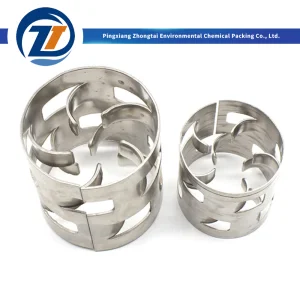
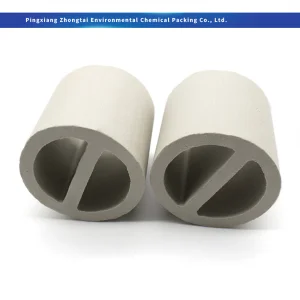
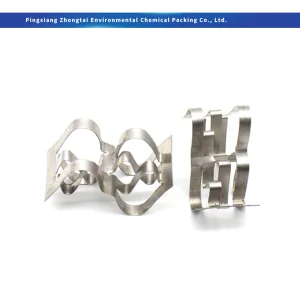
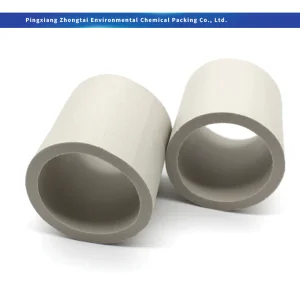
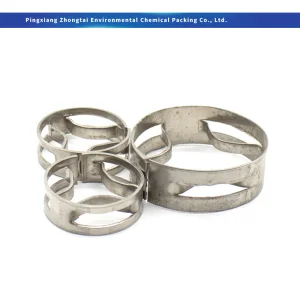
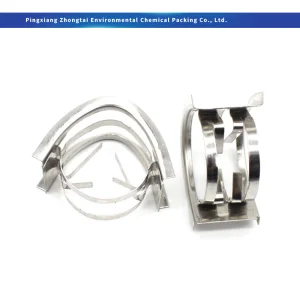
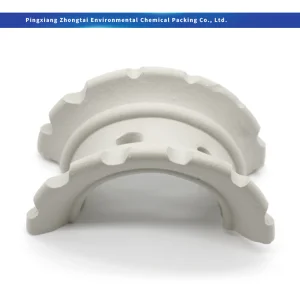
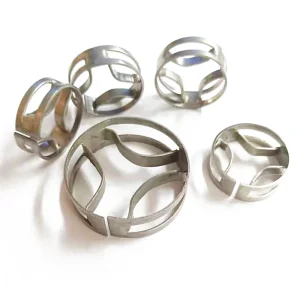
Engineered alongside our honeycomb lines, providing global industrial plants with world-class mass transfer, acid scrubbing, and mechanical support media.