Explore our factory-direct industrial ceramic balls, metal random packings, and specialized catalyst bed supports engineered for chemical, petrochemical, and environmental processes.
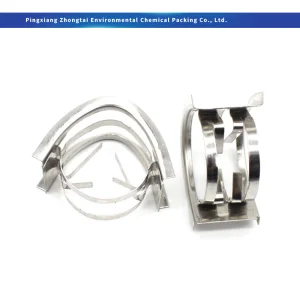
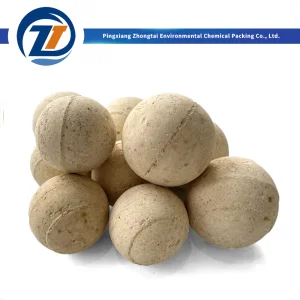
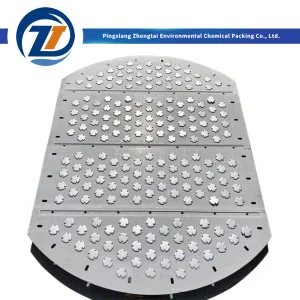
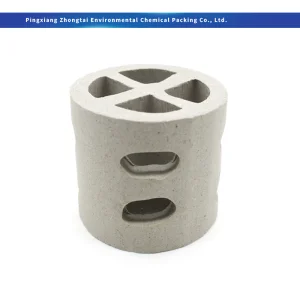
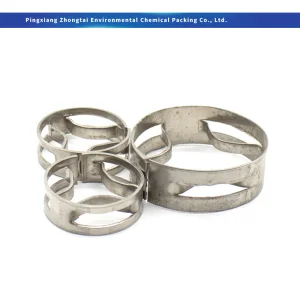
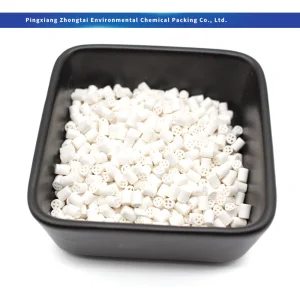
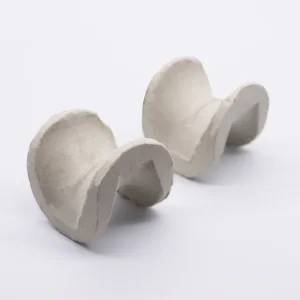
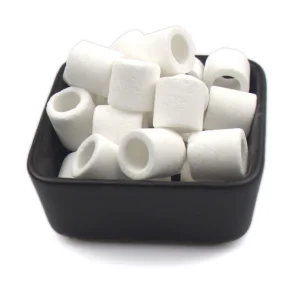
In modern chemical process industries (CPI), petroleum refining, fertilizer manufacturing, and environmental protection plants, the operational efficiency of fixed-bed reactors and mass transfer towers depends heavily on the chemical integrity and mechanical durability of industrial ceramic media. As global processing facilities push toward higher thermal efficiency, extended catalyst cycle lengths, and strict emissions compliance, selecting the correct alumina ball manufacturer and supplier in China has become a strategic procurement decision.
China, and specifically established chemical packing hubs such as Pingxiang in Jiangxi Province, accounts for a substantial percentage of global production for inert catalyst bed support balls, high-alumina wear-resistant grinding media, and mass transfer structured/random packings. Driven by localized supply chains, advanced cold isostatic pressing tech, and automated tunnel kiln firing, top-tier Chinese manufacturers offer global EPCs (Engineering, Procurement, and Construction contractors) and plant operators an unmatchable balance of structural quality, chemical purity, and Total Cost of Ownership (TCO) optimization.
Industrial alumina ceramic balls are broadly classified based on their crystalline structure ($\alpha$-alumina vs. $\gamma$-alumina phase), chemical formulation, density, and intended operational duty. Understanding these distinct material pathways is critical for process engineers to prevent bed channeling, pressure drop spikes, catalyst poisoning, or premature equipment abrasion.
Engineered primarily from high-purity $\alpha$-alumina and high-grade kaolin silicates. Designed to act as a hold-down, top-cover, and bottom-support layer for active catalysts in hydroprocessing, reforming, and ammonia synthesis units. Key features include exceptional thermal shock resistance, low water absorption (< 1%), and chemical inertness against harsh organic solvents, acids, and alkalis.
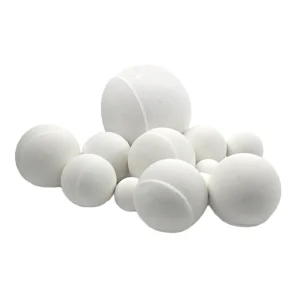
Formulated with 92% to 95%+ aluminum oxide to deliver high bulk density ($\ge 3.60 \text{ g/cm}^3$) and Mohs hardness (grade 9). Used extensively in ball mills for wet and dry ultrafine grinding of ceramic glazes, mineral ores, quartz, and battery cathode materials. Offers extremely low wear loss (< 0.01%), eliminating iron contamination in ultra-clean slurry processes.
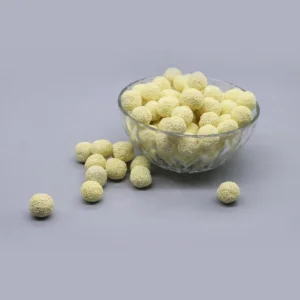
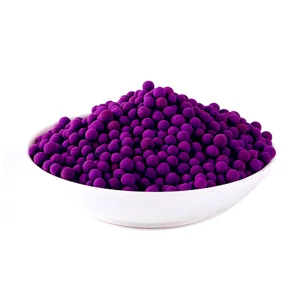
Includes high-density refractory heat-storage ceramic balls for Regenerative Thermal Oxidizers (RTO) and activated alumina spherical adsorbents ($\gamma$-alumina). Active forms feature high surface area ($> 300 \text{ m}^2/\text{g}$) for gas drying, fluoride removal, and catalyst carrier roles, while heat storage spheres withstand sudden thermal recycling up to 1400°C.
The table below provides a comprehensive physical and chemical baseline for engineering specification assessments:
| Property Parameter | 17%–23% Al₂O₃ Inert | 90%–92% High Alumina | 99% Super High Alumina | Active / Adsorbent Alumina |
|---|---|---|---|---|
| Al₂O₃ Content (%) | 17.0 – 23.0% | 90.0 – 92.0% | ≥ 99.0% | ≥ 93.0% ($\gamma$-phase) |
| SiO₂ Content (%) | 70.0 – 76.0% | 4.0 – 7.0% | ≤ 0.15% | ≤ 0.20% |
| Leachable Silica (ppm) | < 50 ppm | < 15 ppm | ≤ 5 ppm (Zero Poisoning) | N/A |
| Bulk Density (g/cm³) | 1.35 – 1.45 | 2.00 – 2.20 | 2.05 – 2.25 | 0.68 – 0.78 |
| Water Absorption (%) | ≤ 1.0% | ≤ 0.5% | ≤ 0.2% | High (Pore Vol > 0.45 ml/g) |
| Max Operating Temp (°C) | 1100 °C | 1550 °C | 1750 °C | 350 °C (Desiccant Mode) |
| Crush Strength (25mm sphere) | ≥ 3.5 kN/ball | ≥ 11.5 kN/ball | ≥ 15.0 kN/ball | ≥ 0.18 kN/bead |
When procuring thousands of metric tons of chemical media for turnarounds or greenfield projects, global procurement managers must look beyond FOB pricing per ton. Low-quality ceramic balls with micro-cracks or improper sintering will crumble under operational bed pressures, leading to catastrophic reactor pressure drop ($\Delta P$) spikes, localized thermal runaway, and unplanned shutdowns costing millions of dollars per day.
Verify that the factory utilizes computer-controlled roller hearth or tunnel kilns capable of sustained firing above 1650°C. Uniform sintering eliminates internal porosity in inert support spheres, ensuring high resistance to pressure fluctuations and thermal shocks.
Ensure the vendor provides batch-level test certification compliant with ASTM C773 (Compressive Strength of Rigid Ceramics) and Chinese Chemical Industry Standards HG/T 3686-2014 for inert alumina ceramic balls.
In high-temperature steam environments (e.g., secondary reformers, hydrogen generation), silica ($SiO_2$) can leach out of low-grade ceramics, depositing downstream on heat exchangers and catalyst beds. Insist on $\ge 99\%$ low-silica alumina balls (<0.15% $SiO_2$).
Alumina ceramic spheres and chemical tower packings serve as vital components across a multi-trillion-dollar industrial processing landscape. Below are key sector-specific implementations where material performance directly dictates plant uptime and yield efficiency.
In high-pressure hydrotreaters operating above 15 MPa and 400°C, graded inert alumina balls (ranging from 1/8" to 2" diameter) are layered at the reactor inlet and outlet. They distribute gas/liquid feeds evenly across the catalyst bed, trap rust/scale particulates, and prevent active catalyst extrusion through collector trays.
Secondary reformers and shift converters require ultra-pure 99% alumina media capable of enduring extreme steam partial pressures. The absence of silica leaching protects expensive noble metal catalysts and downstream boiler feed water exchangers from fouling.
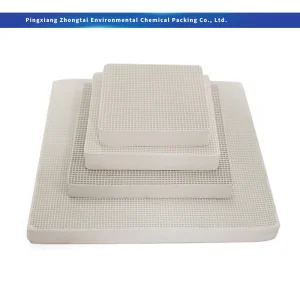
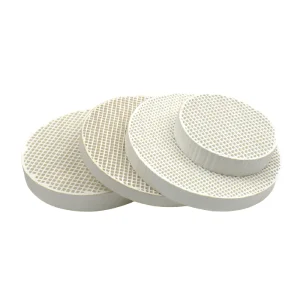
Regenerative Thermal Oxidizers (RTO) treating Volatile Organic Compounds (VOCs) utilize high-density heat storage ceramic balls and honeycomb ceramic monoliths. Their high specific heat capacity and resistance to acid-gas thermal shock optimize heat recovery efficiency up to 97%.
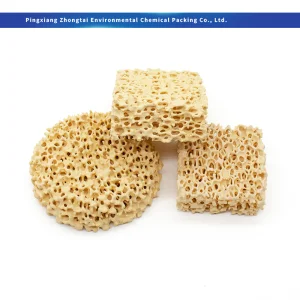
High-porosity alumina ceramic foam filters are integrated into gating systems to capture oxide inclusions, dross, and non-metallic particles in molten aluminum and alloy castings, significantly reducing scrap rates in automotive and aerospace manufacturing.
As the global process industry pivots toward green hydrogen, carbon capture, utilization, and storage (CCUS), and zero-landfill circular manufacturing, China's leading ceramic engineering facilities are advancing Next-Gen product roadmaps:
Refining grain size to sub-micron levels to boost crush strength by 40% while reducing weight.
Optimized surface-modified packing geometries for low-energy amine-based carbon capture towers.
Closed-loop reprocessing of spent inert ceramics into refractory raw materials to achieve zero waste.
Custom additive manufacturing of complex channel geometries for zero pressure-drop reactor beds.
Transitioning production kilns from natural gas firing to hydrogen-electric hybrid heating arrays.
Shipping bulk chemical media requires robust quality management systems and comprehensive export compliance. Leading Pingxiang manufacturers maintain ISO 9001 (Quality), ISO 14001 (Environmental), and ISO 45001 (Occupational Health) certifications. Overseas buyers are supported through:
Shipped in heavy-duty ton bags (Jumbo bags), steel drums, or moisture-sealed wooden boxes mounted on ISPM-15 compliant heat-treated or plastic pallets to streamline port clearance.
Full support for pre-shipment sampling and testing by international inspection agencies including SGS, Bureau Veritas (BV), Intertek, and TÜV Rheinland.
Complete regulatory compliance dossiers for European Union imports, ensuring raw mineral materials are fully certified and safe for chemical processing deployment.
Technical and procurement answers directly from our senior chemical packing process specialists.
Discover additional ceramic, molecular sieve, foam filter, and mass transfer solutions for specialized global industrial facilities.
Our engineering design team provides column mass transfer calculations, bed pressure-drop modeling, and sample dispatch within 24 hours.
