Explore our precision-engineered tower internals, ceramic supports, and high-performance random packings exported worldwide.
A comprehensive examination of physical chemistry, fluid dynamics, structural rigidity, and operational stability in modern mass transfer columns.
Polyvinylidene Fluoride (PVDF) stands as a premier thermoplastic fluoropolymer engineered via the polymerization of vinylidene difluoride. Featuring an alternating structure of non-polar carbon-fluorine ($CF_2$) and carbon-hydrogen ($CH_2$) groups, PVDF imparts exceptional chemical resistance against harsh oxidizing agents, strong mineral acids (such as 98% $H_2SO_4$, concentrated $HCl$, and hydrofluoric acid $HF$), halogens (wet $Cl_2$, $Br_2$), and aliphatic hydrocarbons. As a top-tier wholesale PVDF Pall Ring manufacturer, our raw material sourcing guarantees 100% virgin resin without secondary regrind filler, ensuring mechanical integrity up to operational temperatures of 150°C (302°F).
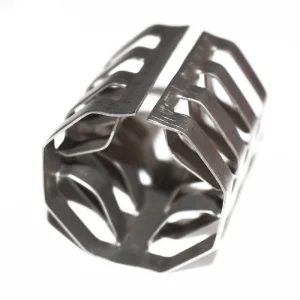
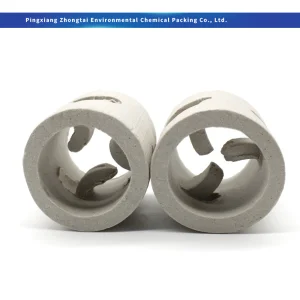
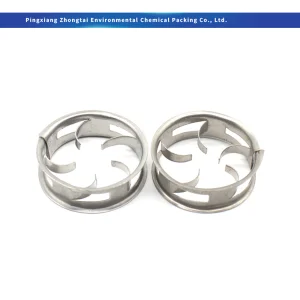
The Pall Ring geometry represents a major evolutionary leap over classic solid-wall Raschig rings. By punching two rows of inward-curved tabs (tongues) into the cylindrical wall, PVDF Pall Rings create an open-wall architecture with void fractions exceeding 88-92%. This open structure allows continuous gas-liquid contact across both internal and external ring surfaces. Fluid dynamics studies demonstrate that this configuration reduces column pressure drop by up to 50% while boosting liquid handling capacity by 40% over classic Raschig ring packings, virtually eliminating stagnant liquid pockets and localized channeling.
Quantitative benchmarks comparing PVDF Pall Rings against alternative random packing polymers and metal alloys across critical process parameters.
| Performance Metrics | Virgin PVDF (Zhongtai Standard) | Polypropylene (PP) | Reinforced Polypropylene (RPP) | PTFE (Polytetrafluoroethylene) | 316L Stainless Steel |
|---|---|---|---|---|---|
| Continuous Temp Limit (°C) | 140 - 150 | 90 - 100 | 110 - 120 | 180 - 200 | 400+ |
| Tensile Strength at Yield (MPa) | 45 - 55 | 25 - 35 | 35 - 42 | 20 - 30 | 515+ |
| Wet Chlorine Resistance | Outstanding (No Attack) | Poor (Oxidizes/Embrittles) | Moderate | Outstanding | Severe Pitting Attack |
| Hydrofluoric Acid (HF) 50% | Fully Resistant | Resistant (<60°C) | Resistant (<80°C) | Fully Resistant | Rapid Degradation |
| Specific Bulk Density (kg/m³) | 160 - 240 (size dependent) | 85 - 130 | 95 - 150 | 280 - 390 | 450 - 680 |
| Fouling & Scale Resistance | Extreme (Non-stick Surface) | Moderate | Moderate | Extreme | Low (Subject to corrosion scaling) |
| Nominal Size (mm / Inch) | Wall Thickness (mm) | Specific Surface Area (m²/m³) | Free Volume / Voidage (%) | Packing Factor $a/e^3$ (m⁻¹) | Approx. Pieces per m³ |
|---|---|---|---|---|---|
| 16 mm (5/8") | 1.0 ± 0.1 | 340 | 87.5% | 415 | ~225,000 |
| 25 mm (1") | 1.2 ± 0.1 | 228 | 90.2% | 245 | ~54,000 |
| 38 mm (1.5") | 1.4 ± 0.1 | 152 | 91.8% | 160 | ~15,500 |
| 50 mm (2") | 1.8 ± 0.1 | 112 | 92.5% | 115 | ~6,800 |
| 76 mm (3") | 2.4 ± 0.2 | 74 | 94.1% | 70 | ~2,150 |
Real-world engineering implementations across chemical processing, semiconductor fabrication, and environmental scrubbers worldwide.
Regional Focus: North American Gulf Coast & Western European Chemical Parks.
In membrane chlor-alkali electrolysis facilities, wet chlorine gas exiting the cells is saturated with water vapor and highly reactive at elevated temperatures. Standard metallic packings (including Titanium and Hastelloy C) suffer localized pitting or stress cracking over time, while standard Polypropylene undergoes severe oxidative degradation within months. Wholesale PVDF Pall Rings demonstrate zero chemical degradation when exposed to wet $Cl_2$ gas and concentrated sodium hypochlorite ($NaOCl$) streams at 95°C. Their non-oxidizing fluoropolymer surface extends bed operating lifespan from 12 months to over 8 years, significantly lowering downtime costs for major chemical operators.
Regional Focus: Taiwan, Japan, South Korea, Silicon Forest (US) & Dresden (EU).
Modern semiconductor fabrication plants require Ultra-Pure Water (UPW) systems and hydrofluoric acid ($HF$) waste treatment loops with zero metallic ion leaching (sub-ppb contamination standards). Ceramic packings cannot be utilized due to silica dissolution caused by $HF$. Metal packings leach micro-quantities of $Fe, Cr, Ni$. Pure PVDF Pall Rings, manufactured under cleanroom-certified injection molding lines, exhibit extremely low extractables ($<0.05$ ppb total organic carbon TOC and zero detectable heavy metal ion contamination). Packed towers utilizing 25mm PVDF Pall Rings efficiently strip volatile organic contaminants and dissolved gases from UPW polishing loops while withstanding concentrated HF chemical cleaning cycles.
Regional Focus: Greater China, Southeast Asia & European Energy-from-Waste Facilities.
Thermal waste abatement systems produce flue gases containing high concentrations of hydrochloric acid ($HCl$), hydrofluoric acid ($HF$), sulfur dioxide ($SO_2$), and trace dioxins at gas temperatures fluctuating between 110°C and 140°C. Standard PP packings soften and collapse under thermal spikes, causing catastrophic bed packing compaction and column flooding. High-purity PVDF Pall Rings retain over 80% of their compressive modulus at 135°C, sustaining uniform gas distribution without structural deformation. Their low surface tension resists scaling from heavy metal salts and fly ash entrainment in wet quench scrubbers.
How advanced polymer physics, surface functionalization, and computational fluid dynamics (CFD) are defining the next decade of packed tower performance.
In flammable hydrocarbon distillation and explosive gas scrubbing (e.g., ethylene oxide or solvent recovery), traditional PVDF can accumulate electrostatic charge due to its high dielectric insulation property. Our technical roadmap incorporates carbon nanotube (CNT) and functionalized graphene nano-fillers into the virgin PVDF polymer matrix. This creates a surface resistivity range of $10^4$ to $10^6 \ \Omega/\text{sq}$, achieving full ATEX compliance for static dissipation while maintaining original chemical resistance against aggressive solvents.
Fluoropolymers naturally display hydrophobic surface properties (water contact angle ~85-90°), which can reduce liquid film spreading during initial bed startup. Zhongtai’s proprietary surface activation process utilizes laser-induced micro-grooving and atmospheric plasma treatment to imprint micro-capillary channels onto the internal tabs of the PVDF Pall Ring. This structural modification reduces the effective dynamic contact angle to <45°, increasing liquid film wetting efficiency by 35% without requiring chemical surfactant additives.
Utilizing high-performance 3D Computational Fluid Dynamics (CFD) modeling of two-phase gas-liquid counter-current flow, our R&D team is developing Gen-3 asymmetric PVDF Pall Rings. By re-engineering the internal tongue angles and wall ribbing, the new design reduces dry pressure drop by an additional 14% while expanding operational flexibility before column flooding occurs ($u_g \cdot \sqrt{\rho_g}$ capacity factors exceeding $2.8 \ \text{Pa}^{0.5}$).
Aligning with global ESG and Net-Zero mandates, Zhongtai has implemented an industrial fluoropolymer reclamation initiative. Clean spent PVDF tower packings decommissioned from chemical plants undergo rigorous ultrasonic solvent decontamination, microscopic filtration, re-granulation, and structural blending with fresh virgin resin. This process manufactures eco-rated tower packing lines with a 45% lower carbon footprint while preserving ASTM mechanical specifications.
Leveraging Pingxiang’s world-class chemical packing industrial cluster to deliver uncompromised quality, competitive wholesale pricing, and rapid international delivery.
Zhongtai operates strategic raw material reserve partnerships with premier international fluoropolymer resin producers (including Solvay, Arkema, and Dongyue Group). By maintaining long-term bulk polymer reserves directly in Pingxiang, we buffer global market resin price volatility and guarantee 100% virgin PVDF grade consistency. Every production batch undergoes Melt Flow Index (MFI) verification and Differential Scanning Calorimetry (DSC) purity testing prior to processing.
Our modern manufacturing facility houses over 35 fully automated multi-cavity precision injection molding machines equipped with robotic pick-and-place systems. Operating 24/7 under computer-controlled thermal zone regulation, our facility produces up to 15,000 cubic meters of plastic and fluoropolymer random tower packings annually. Custom mold design, rapid tooling, and dimension-controlled cooling minimize internal thermal stresses, preventing ring distortion or rib cracking during heavy bed loading.
Quality control protocols follow ISO 9001:2015 management standards. Every wholesale shipment is backed by Factory Acceptance Testing (FAT) certificates detailing bulk density ($kg/m^3$), piece counts, radial crush strength ($kN/ring$), and heat deflection temperature under load (HDT per ASTM D648). Rigorous lot tracking ensures complete traceability from raw resin lot numbers to final container loading.
Evaluating long-term economic returns: Why leading EPC firms specify PVDF Pall Rings over metal alloys and lower-grade polymers.
While standard Polypropylene (PP) carries a lower initial capital expenditure (CapEx), its functional life in hot corrosive environments ($>90^\circ\text{C}$ or oxidizing halogen streams) rarely exceeds 12 to 18 months due to thermal oxidative degradation. Frequent bed replacements require shutdown labor, vessel opening, catalyst dump fees, and lost production capacity. Conversely, high-cost exotic metals like Titanium Grade 2 or Hastelloy C276 demand upfront CapEx up to 500% higher than PVDF while remaining vulnerable to pitting in acidic chloride media. PVDF Pall Rings deliver an optimal mid-point initial CapEx with extended 8 to 10+ year operational durability, yielding the lowest total cost of ownership (TCO) over a decade of continuous service.
The global fluoropolymer random packing market is projected to expand at a compound annual growth rate (CAGR) of 6.8% through 2032. Primary demand drivers include expanding semiconductor wafer fabrication lines globally, stringent EPA / EU VOC emissions compliance mandates requiring high-temperature scrubber upgrades, and rapid growth in green chlor-alkali hydrogen generation plants. Wholesale buyers benefit from established factory direct procurement frameworks, avoiding distributor markups and securing tailored lead-time scheduling for major overhaul turnarounds.
Full adherence to global environmental safety directives and engineering design support for plant revamps.
Our virgin PVDF Pall Rings comply fully with European Union Regulation (EC) No 1907/2006 (REACH) concerning Substances of Very High Concern (SVHC) and Directive 2011/65/EU (RoHS). Material certificates verifying zero heavy metal additives, lead, cadmium, or unauthorized plasticizers are provided with each export documentation package.
For pharmaceutical extraction, food-grade acid recovery, and high-purity water systems, our specialized sanitary PVDF series utilizes resins evaluated under FDA 21 CFR 177.2510 (Repeated use contact with food/pharmaceutical media), guaranteeing ultra-low extractable profiles and zero microbiological growth nourishment.
Zhongtai’s chemical engineering software team provides clients with personalized tower sizing simulations (including flooded gas velocity calculations $u_{fl}$, liquid holdup predictions, pressure drop curves $\Delta P / H$, and HETP estimations) tailored to your exact gas-liquid physical properties and flow rates.
In-depth answers to common questions asked by process engineers, EPC buyers, and plant procurement managers.
PVDF Pall Rings offer substantially superior thermal and chemical resistance compared to PP. Polypropylene soft-deforms around 95-100°C and quickly degrades under strong oxidizing agents (such as wet chlorine, nitric acid, or chromic acid). PVDF operates continuously up to 150°C (302°F), exhibits outstanding UV and gamma radiation resistance, and is chemically inert to almost all strong mineral acids, halogens, and organic solvents.
PTFE withstands slightly higher continuous temperatures (up to 200°C), but it suffers from severe cold-flow (creep) behavior under compressive loads, meaning PTFE Pall Rings can deform at the bottom of deep packed beds. Furthermore, PTFE cannot be processed via injection molding, requiring costly paste extrusion and machining. PVDF features double the tensile and compressive modulus of PTFE, resisting structural crushing in tall columns while costing significantly less to manufacture via high-precision injection molding.
PVDF is completely resistant to Hydrofluoric Acid ($HF$) across all concentrations up to 100°C, making it the premier choice for semiconductor HF waste gas scrubbers where ceramics dissolve. However, PVDF has moderate limitation in high-temperature concentrated strong bases (such as 50% $NaOH$ or $KOH$ above 65°C), as strong alkalis can induce gradual dehydrofluorination of the polymer chain. For hot concentrated caustics, Polypropylene (PP) or specialized metals may be recommended.
The general engineering rule of thumb dictates that column diameter ($D$) to nominal packing size ($d$) ratio should be $D/d \ge 10 - 15$ to prevent liquid wall-channeling. Smaller sizes (16mm, 25mm) provide higher specific surface area ($m^2/m^3$) and lower HETP for pilot plants or high-purity separation towers, but generate higher pressure drop. Larger sizes (38mm, 50mm, 76mm) provide lower pressure drop and higher gas capacity, making them ideal for high-throughput industrial scrubbers. Our engineering team can compute the exact optimum size for your process data.
As a direct manufacturer, standard sizes (25mm, 38mm, 50mm) are routinely maintained in stock with MOQs starting at 1 cubic meter ($1 \ m^3$). Wholesale orders are packaged in heavy-duty 25kg double-walled woven bags, 1 $m^3$ super sacks (jumbo bags), or export-grade wooden crates on fumigated pallets. Production lead times for custom containerload orders ($20'GP$ or $40'HQ$) are typically 7 to 14 business days from order confirmation.
Explore our comprehensive selection of molecular sieves, structured packings, bio-media, and refractory ceramics.