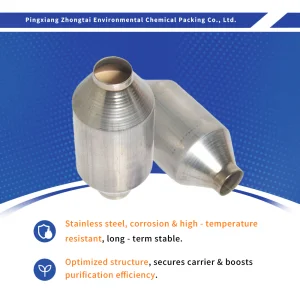
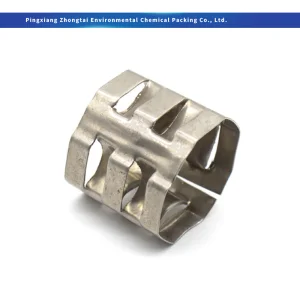
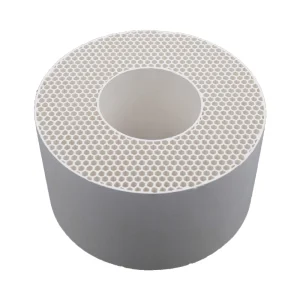
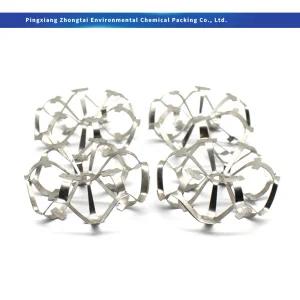
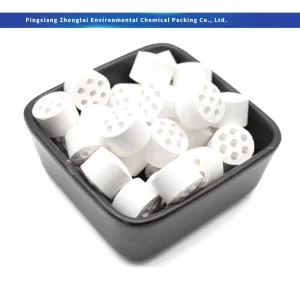
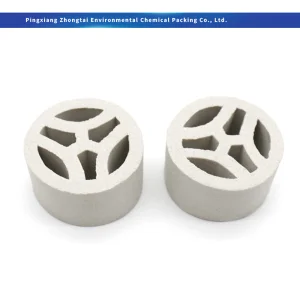
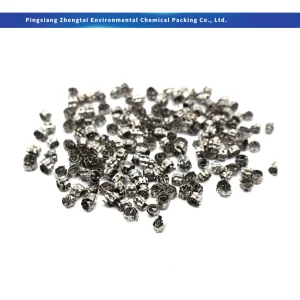
Precision-manufactured mass transfer media, ceramic regenerative storage cores, and column internals engineered in our Pingxiang manufacturing base for high-capacity global chemical towers.
Aerodynamic fin topology, high free-volume hydraulics, and continuous liquid-film renewal for next-generation scrubbers, strippers, and bio-trickling filters.
Constructed from two semi-hemispherical shells joined at an equilateral central ring, each sphere integrates 12 to 24 radial aerodynamic fan leaves. This configuration breaks laminar gas streamlines into localized micro-vortices, continuously shear-thinning descending scrubbing liquids into microscopic, high-interfacial area droplets without droplet agglomeration.
Unlike traditional Raschig rings or saddle packings prone to crystalline scaling in chlor-alkali and desulfurization circuits, the multi-leaf open structural lattice of polyhedral hollow spheres eliminates dead hydraulic stagnations. High-velocity gas-liquid shear continuously scours the internal vane surfaces, extending run-lengths by up to 300% in scaling media.
Operating with high volumetric free space (>75% to 92%), polyhedral hollow balls significantly elevate the hydraulic flooding point ($u_{flood}$) compared with equal-sized pall rings. Facilities revamping older scrubbers achieve a 30% reduction in blower kilowatt consumption while scaling volumetric flue gas treatment capacities without expanding tower shells.
Compare physical dimensions, specific surface areas, void volumes, and resin options formulated for extreme thermomechanical and corrosive scrubber towers.
| Nominal Size (mm / in) | Resin Options Available | Specific Surface Area ($m^2/m^3$) | Bed Void Fraction ($\varepsilon$ %) | Packing Count ($pcs/m^3$) | Bulk Density (PP kg/$m^3$) | Dry Packing Factor ($F_p$ $m^{-1}$) |
|---|---|---|---|---|---|---|
| 25 mm (1.0") | PP / RPP / PE / PVC / CPVC / PVDF | 460 - 500 | 76% - 80% | ~85,000 | 115 - 125 | 185 |
| 38 mm (1.5") | PP / RPP / PE / PVC / CPVC / PVDF | 300 - 330 | 82% - 85% | ~28,000 | 90 - 98 | 120 |
| 50 mm (2.0") | PP / RPP / PE / PVC / CPVC / PVDF | 200 - 236 | 88% - 91% | ~11,500 | 75 - 82 | 75 |
| 76 mm (3.0") | PP / RPP / PE / PVC / CPVC / PVDF | 130 - 150 | 90% - 93% | ~3,200 | 50 - 58 | 48 |
| 100 mm (4.0") | PP / RPP / PE / PVC / CPVC / PVDF | 90 - 110 | 92% - 95% | ~1,350 | 40 - 45 | 32 |
Temperature: -10°C to 100°C (PP) / Up to 125°C (Glass-Filled RPP).
Chemical Inertness: Excellent resistance to organic acids, caustic lyes, and alkaline washes. RPP incorporates glass fiber reinforcement to elevate compressive modulus under heavy hydraulic liquid holdups.
Temperature: Up to 60°C (PVC) / 95°C (CPVC).
Chemical Inertness: Highly recommended in wet chlorine generation, sodium hypochlorite absorption, hydrochloric acid (HCl) synthesis, and aggressive oxidizing acid environments where polyolefins suffer cracking.
Temperature: -30°C to 150°C.
Chemical Inertness: Fluoropolymer class-leading resistance to concentrated nitric acid, aggressive halogens, chlorine dioxide, ozone, and aromatic solvents. Unmatched mechanical rigidity and flame retardancy for critical offshore and nuclear scrubbers.
Accelerating the green transition with high-efficiency random packing that complies with regional and international environmental emission caps.
Across North America, the European Union, and the Asia-Pacific region, processing plants face aggressive mandates under the EU Industrial Emissions Directive (IED 2010/75/EU) and the US EPA Maximum Achievable Control Technology (MACT) standards. Chemical processing, electronics manufacturing, and municipal waste handling facilities are under regulatory orders to drive acid gas ($SO_x$, $NO_x$, $HCl$, $HF$) and volatile organic compound (VOC) emissions down below single-digit parts per million (ppm).
High-purity CPVC and PVDF polyhedral hollow balls are the premier media specified in semiconductor cleanroom exhaust systems to capture hydrofluoric acid ($HF$) and silicon tetrafluoride ($SiF_4$) gas without silicon leaching or particulate contamination.
In reverse osmosis (RO) desalination and thermal power condensate polishing, 50mm and 76mm PP balls provide massive volumetric contact area with minimal gas resistance to flash carbon dioxide ($CO_2$) and oxygen ($O_2$) out of liquid streams.
Used inside multistage packed towers operating on hydrogen sulfide ($H_2S$), methyl mercaptan, and ammonia emissions in municipal wastewater treatment, resisting microbial slime accumulation through continuous self-scouring hydraulics.
Floated as floating blanket layers over open electrowinning cells, acid pickling reservoirs, and plating tanks to suppress hazardous acid mists by up to 95%, safeguarding personnel and mitigating plant asset structural corrosion.
Pingxiang Zhongtai Environmental Chemical Packing Co., Ltd. applies end-to-end quality control from resin raw materials to containerized export dispatch.
We use 100% prime virgin polymers from tier-1 petrochemical producers. Every resin lot is verified for Melt Flow Index (ASTM D1238), tensile modulus (ASTM D638), and density. Zero regrind or industrial scrap is permitted in critical chemical-grade production runs.
Molded polyhedral balls undergo compressive failure force testing at room and elevated operating temperatures. Packed beds are tested in hydraulic simulation columns to ensure pressure drop ($\Delta P$) and volumetric mass transfer coefficients align with customer process specifications.
Full export support including EU REACH (SVHC declaration), RoHS compliance certification, and mill test certificates per heat/lot. Packed in heavy-duty UV-stabilized 1.0 $m^3$ or 1.5 $m^3$ jumbo bulk bags or double-layer woven sacks on ISPM-15 heat-treated fumigated pallets.
Pioneering advancements in low-carbon bio-polymers, nano-textured surface treatments, and CFD-guided blade geometry.
Our engineering R&D group is deploying micro-grooved serrated vanes along the ball's outer perimeter blades. By inducing localized micro-vortex shedding along the boundary layers, fluid surface renewal rates improve by 18% with negligible impact on static bed flow resistance.
In accordance with carbon border adjustments (CBAM) and corporate Scope 3 decarbonization commitments, Zhongtai is qualifying mass-balanced bio-circular polypropylenes. These resins match virgin petrochemical mechanical stability while reducing upstream embodied cradle-to-gate carbon footprints by up to 65%.
Polyolefins naturally display a contact angle exceeding 90 degrees with water. Our patented post-molding plasma surface-activation technique imparts a hydrophilic nano-texture across the blades, preventing liquid rivulets and forcing uniform liquid sheeting at low liquid loading rates ($L < 5 m^3/m^2\cdot h$).
Answers to common chemical engineering, sizing, and procurement questions regarding polyhedral hollow balls.
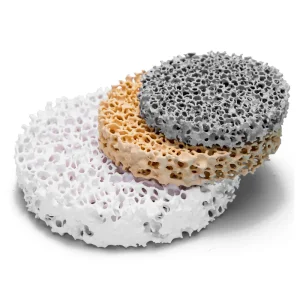
Explore our full line of corrosion-resistant random packing, carbon rings, foundry foam filters, and laboratory high-vacuum mass transfer media.
Send your scrubber dimensions, fluid compositions, temperature envelopes, and design capacity targets. Our application engineering team provides packing calculations, pressure drop estimates, and tailored pricing within 24 hours.