Direct factory wholesale supply for gas-liquid separation, distillation, absorption, and heat transfer operations.
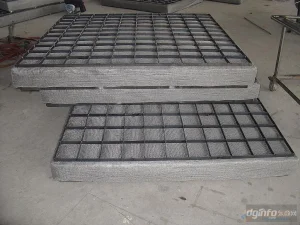
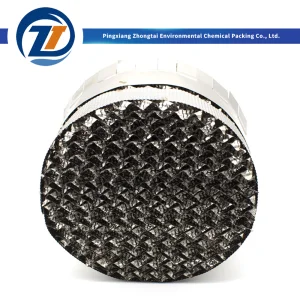
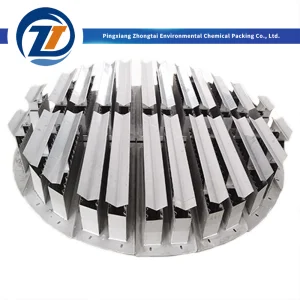
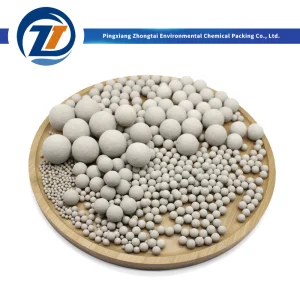
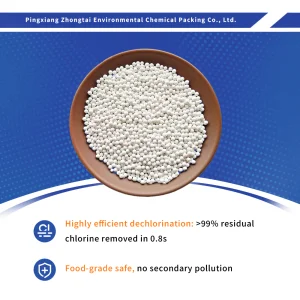
A rigorous review of hydraulic capacity, structural optimization, and fluid dynamics superiorities over legacy random packing media.
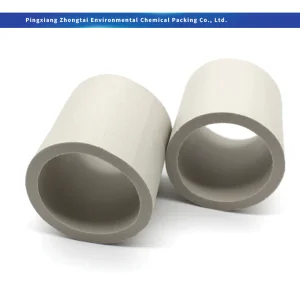
In modern mass transfer unit operations—encompassing distillation, gas absorption, liquid extraction, and stripping—the efficiency of packed towers depends heavily on the physical geometry of the random packing elements. The historical standard, the Raschig Ring, presented significant hydraulic bottlenecks due to its closed cylindrical wall, which created dead zones, encouraged liquid channeling, and restricted interstitial gas flow paths.
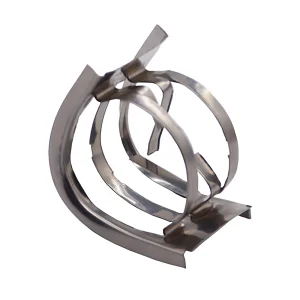
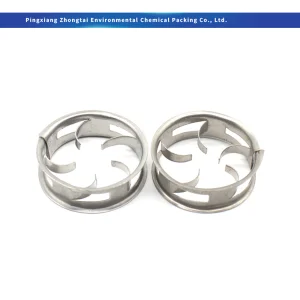
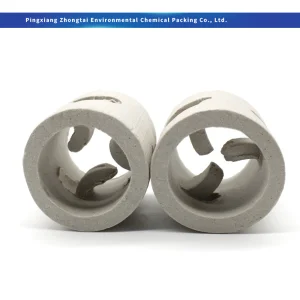
The introduction of the Pall Packing Ring represented a major breakthrough in industrial tower internal design. By punching inward-curved tabs (fingers) out of the cylinder wall while keeping the structural framework intact, the internal volume of the ring becomes fully accessible to gas-liquid contact. These open windows increase the effective geometric surface area and substantially elevate the void fraction (typically between 90% and 96% depending on wall gauge and sizing).
Selecting the optimal column packing requires balancing target operational capacity, allowable pressure drop, fouling tolerance, and financial investment. Below is a comparative performance matrix across major industrial random packings:
| Packing Type | Relative Voidage (%) | Relative Capacity | Pressure Drop ($\Delta P$) | Resistance to Fouling | Primary Industrial Use Case |
|---|---|---|---|---|---|
| Raschig Ring | 72% - 85% | Baseline (1.0) | High | Low (Subject to bridging) | Legacy installations, heavy ceramic acid duty |
| Pall Ring (Metal/Plastic) | 90% - 96% | 1.45x - 1.60x | Medium-Low (-40% vs Raschig) | Moderate to High | High-throughput distillation, CO2 scrubbing, stripping |
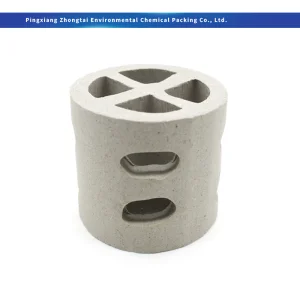
| Cascade Mini Ring (CMR) | 92% - 97% | 1.65x - 1.80x | Low | High | Ultra-low pressure drop columns, debottlenecking |
| Intalox / Super Saddles | 88% - 94% | 1.35x - 1.50x | Low | Moderate | Heavy acid drying absorption, harsh thermal shock towers |
Understanding volume pricing dynamics, alloy surcharges, wall gauge specifications, and packaging density to optimize overall project CAPEX.
Pricing scales closely with metallurgy and chemical-grade polymer selections. Premium alloys like Titanium, Hastelloy C276, and SS316L carry raw material surcharges over standard SS304 or virgin Polypropylene (PP).
Wholesale quotations factor in wall thickness (e.g., 0.4mm vs 0.8mm for 25mm Metal Pall Rings). Thicker walls increase mechanical crush strength for high bed heights, directly impacting tonnage cost per cubic meter ($m^3$).
Because random packings are low-density, high-volume cargo, wholesale quotes utilize compressed jumbo bags or optimized carton nesting to maximize 40ft HQ container payload capacity (approx. 60–65 $m^3$ per container).
The following table provides baseline procurement cost estimates for common Pall Packing Ring configurations. Actual quotes vary depending on real-time nickel/polymer market prices, volume discounts, and custom packaging requirements:
| Packing Diameter | Material Specification | Bulk Density ($\text{kg/m}^3$) | Specific Surface Area ($\text{m}^2/\text{m}^3$) | Indicative Price Range (USD / $\text{m}^3$) | MOQ Requirement |
|---|---|---|---|---|---|
| 16mm (5/8") Metal | Stainless Steel 304 (0.4mm) | ~470 kg/m³ | ~340 m²/m³ | $480 - $560 / m³ | 5 m³ |
| 25mm (1") Metal | Stainless Steel 304 / 316L | ~390 kg/m³ | ~220 m²/m³ | $390 - $490 / m³ | 5 m³ |
| 38mm (1.5") Metal | Stainless Steel 316L (0.6mm) | ~320 kg/m³ | ~150 m²/m³ | $450 - $580 / m³ | 5 m³ |
| 50mm (2") Plastic | Virgin Polypropylene (PP) | ~55 kg/m³ | ~110 m²/m³ | $110 - $160 / m³ | 10 m³ |
| 50mm (2") Ceramic | Chemical Porcelain / Alumina | ~560 kg/m³ | ~120 m²/m³ | $180 - $240 / m³ | 10 m³ |
Engineered solutions tailored for extreme corrosive environments, high-pressure fractionators, and environmental compliance systems.
In atmospheric and vacuum distillation units, 304L/316L Metal Pall Rings provide exceptional liquid distribution efficiency. Their low pressure drop prevents thermal degradation of heat-sensitive hydrocarbons while delivering precise HETP separation efficiency across multi-component fractionation zones.
For CO2 capture, acid gas stripping, and MDEA amine scrubbing, Stainless Steel or PVDF Pall Rings ensure uniform liquid holdup without severe foaming. The high void space prevents gas choking under high gas-to-liquid volumetric loading conditions.
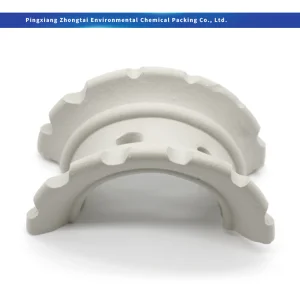
Acid-resistant ceramic Pall Rings withstand concentrated sulfuric acid (H2SO4), wet chlorine gas, and severe thermal shock in drying and absorption towers where metallic alternatives face aggressive pitting corrosion.
Polypropylene (PP) and Reinforced Polypropylene (RPP) Pall Rings are widely installed in municipal water degassing units, VOC thermal oxidation recovery absorbers, and packed scrubber scrubbers due to their cost-efficient mass transfer surface and chemical resistance to volatile organic compounds.
Leveraging automated high-speed stamping, precision ceramic kilns, and Pingxiang's world-class chemical packing industrial cluster.
Our facility utilizes fully automated multi-stage progressive stamping dies capable of pressing millions of precise metal Pall Rings monthly with zero burrs, consistent tab curvature, and tight structural dimensional tolerances.
Every production batch undergoes mandatory XRF material analysis, crush strength testing (for ceramics), wall gauge micrometer verifications, and bulk density recordings to ensure strict compliance with international engineering specifications.
Located in Pingxiang, Jiangxi—the global capital for chemical packing manufacturing—our supply chain integrates raw material refining, continuous tunnel kiln firing, and streamlined export logistics within a 50-kilometer radius.
Pioneering advancements in surface energy modification, micro-structured texturing, and computational fluid dynamics (CFD) modeling.
As chemical synthesis plants transition toward net-zero carbon goals and low-energy separations, random packing technology is undergoing significant material and structural refinements:
Traditional smooth metal strip surfaces are being replaced by micro-grooved patterns that utilize capillary action to force liquid film spreading across 99% of the available metal area, eliminating dry spots even under extremely low liquid irrigation rates ($L_w < 5 \, \text{m}^3/\text{m}^2\cdot\text{h}$).
Emerging polymer-ceramic matrix formulations offer the high corrosion immunity of ceramics alongside the ultra-lightweight structural ductility of thermoplastics, pushing maximum temperature thresholds above 220°C without thermal degradation.
Integrating artificial intelligence into Computational Fluid Dynamics (CFD) allows process engineers to model exact pressure drop curves, liquid holdup gradients, and flooding points for custom random packing beds prior to physical installation.
Global procurement teams now mandate 100% material traceability. Modern manufacturing integrates recycled high-purity stainless steel alloys certified via Spectrographic analysis to minimize embedded carbon footprints in major plant revamps.
Meeting international engineering standards, international trade compliance, and enterprise procurement requirements.
Our packing media products fully conform to REACH, RoHS, ISO 9001:2015, ISO 14001, and ASTM material specifications (ASTM A240 for stainless steel plates). Full Mill Test Certificates (MTC EN 10204 3.1) are supplied with every shipment.
We provide comprehensive technical datasheets, CAD drawings, liquid distributor compatibility sizing, and packed bed volume calculations in English, Spanish, Russian, and Arabic to assist regional EPC contractors.
To eliminate site receiving headaches, products are shipped in fumigated ISPM-15 wooden crates, reinforced poly-woven super-sacks, or heavy-duty steel drums with customized batch tagging for instant inventory audit.
Full suite of random tower packings, molecular sieves, and water purification media.
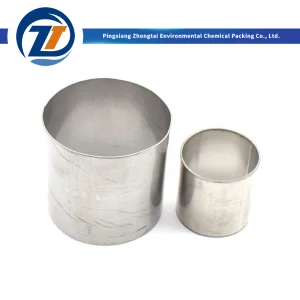
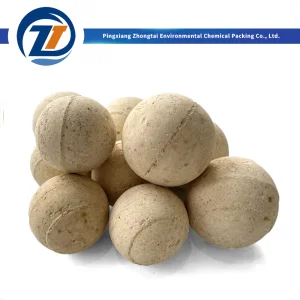
In-depth responses regarding hydraulic sizing, material selection, bulk density, and factory delivery timelines.
Column diameter is governed by the hydraulic flooding velocity (typically sizing for 70%–80% of flooding point using standard generalized pressure drop correlation charts or packing factor $F_p$). Bed height ($H$) is calculated by multiplying the required number of theoretical stages ($N_{OG}$) by the Height Equivalent to a Theoretical Plate ($\text{HETP}$):
$$\text{Bed Height } (H) = N_{OG} \times \text{HETP}$$
For standard 25mm (1") Stainless Steel Pall Rings in distillation service, baseline $\text{HETP}$ typically ranges between 0.45 meters to 0.65 meters depending on liquid load and operating pressure.
Stainless Steel 316L contains 2% to 3% Molybdenum, which drastically increases its resistance to localized pitting and crevice corrosion in chloride-rich environments, organic acid distillations, and marine atmospheres compared to SS304. SS304 is economical for general chemical hydrocarbons, whereas SS316L is mandatory for aggressive organic or weak inorganic acids.
Bulk density determines both the mechanical loading on tower packing support grids and container shipping costs. For example, 25mm Metal Pall Rings have a bulk density of ~390 kg/m³, whereas 50mm Polypropylene (PP) rings are ultra-lightweight at ~55 kg/m³. Support grids for metal beds must be engineered to sustain both dry packing weight and liquid holdup under operating conditions.
Standard Polypropylene (PP) has a maximum continuous operating limit of ~100°C to 110°C. For steam stripping applications exceeding 120°C, Reinforced Polypropylene (RPP), PVDF (Polyvinylidene Fluoride), or PFA must be specified to prevent thermal softening, deformation, and bed collapse.
Each factory lot is delivered with comprehensive documentation including: Mill Test Certificate EN 10204 3.1 detailing chemical composition (XRF spectrum) and tensile yield, Dimensional Inspection Reports, Bulk Density Records, and Certificate of Origin (CO) for customs clearance.
For standard stainless steel (SS304/SS316L) or polypropylene sizes (25mm, 38mm, 50mm), our factory maintains raw strip stock, allowing a production turnaround of 7 to 12 working days for a full 40ft HQ container (~60 m³).