Explore our industrial-grade adsorbents, inert ceramic beds, and tower packings engineered for severe operating environments.
A comprehensive examination of synthetic aluminosilicate zeolites, pore-size tuning, kinetic vs. thermodynamic separation, and operational bed dynamics.
Molecular sieves are crystalline, highly porous synthetic sodium, potassium, or calcium aluminosilicates belonging to the zeolite family. Their basic structural units consist of silicon-oxygen (SiO4) and aluminum-oxygen (AlO4) tetrahedra linked through shared oxygen atoms to form a three-dimensional interconnecting network of uniform cavities and channels.
The presence of trivalent aluminum creates a net negative charge within the crystal lattice, which is balanced by exchangeable metal cations (e.g., Na+, K+, Ca2+, Li+). These cations not only neutralize the framework charge but also sit precisely at the pore openings, acting as molecular gatekeepers that determine the effective aperture diameter (ranging from 3 Å to 10 Å).
Unlike non-polar adsorbents such as activated carbon, molecular sieves possess exceptional polarity and strong electrostatic fields within their intra-crystalline void spaces. Adsorption occurs primarily via two distinct mechanisms:
Information Gain Insight: Pingxiang Zhongtai’s proprietary thermal synthesis technology controls the Si/Al atomic ratio and cation exchange yield within ±0.02 tolerances. This guarantees sharp breakthrough curves, minimized Mass Transfer Zone (MTZ) length, and significantly lower energy consumption during bed thermal regeneration cycles.
Key industrial shifts, decarbonization drivers, and technological evolutions redefining zeolite selection worldwide.
With global net-zero targets accelerating, demand for specialty molecular sieves engineered for Carbon Capture, Utilization, and Storage (CCUS) has surged. Advanced 13X APG and engineered zeolites are increasingly deployed to scrub CO2 and N2O from flue gas, syngas, and natural gas streams prior to cryogenic liquefaction or pipeline injection.
Electrolytic Green Hydrogen production requires deep desiccant drying to prevent moisture-induced degradation of fuel cell membranes. Synthetic Type 3A zeolites with optimized pore kinetics are becoming the industry standard for removing residual water to under 0.1 ppmv levels without co-adsorbing valuable H2 molecules.
Energy efficiency has replaced initial media unit cost as the primary procurement benchmark. Modern plants favor molecular sieves formulated with high thermal conductivity binders, allowing complete desorption at lower regeneration temperatures (e.g., 180°C–220°C instead of 280°C), directly lowering boiler steam and heating utility loads.
Evaluating the true economic impact of molecular sieve selection across multi-year operational lifecycles.
When EPC contractors, chemical plant operators, and industrial gas engineering teams source molecular sieve adsorbents in bulk, initial unit price represents less than 15% of the total operating expenditure associated with the bed life. High-performance molecular sieves prevent costly plant trips, pressure drop surges, and catalyst poisoning downstream.
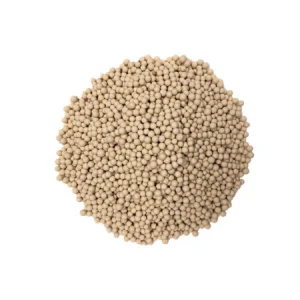
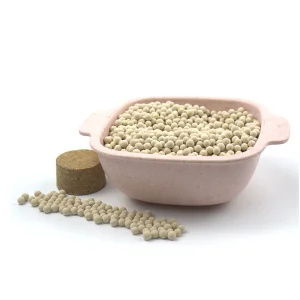
As a specialized manufacturer based in Pingxiang, Jiangxi—China's industrial ceramic hub since 2003—Pingxiang Zhongtai Environmental Chemical Packing Co., Ltd. eliminates intermediary trading markups. We deliver fully documented batches certified via laboratory tests, direct technical support from process engineers, and tailored custom formulations (bead size 1.6-2.5mm, 3.0-5.0mm, or custom extruded pellets).
Targeted adsorption strategies for oil refineries, petrochemical plants, air separation units, and environmental systems.
Challenge: Natural gas saturated with water vapour causes ice and hydrate formation inside cryogenic heat exchangers during Liquefied Natural Gas (LNG) processing.
Solution: Implementing dual or tri-bed Temperature Swing Adsorption (TSA) units packed with 4A or 3A molecular sieves. Achieves gas dryness down to <0.1 ppmv water dew point (-100°C), while resisting heavy hydrocarbon co-adsorption and liquid slugging risks.
Challenge: Ethylene and propylene feedstocks require deep moisture removal without triggering olefin polymerization (coking) inside the adsorbent pores.
Solution: Specially modified 3A Zeolite with strict 3 Å pore size control allows water passage into internal cavities while totally excluding ethylene (3.9 Å) and propylene (4.5 Å), extending adsorbent bed operational lifespan past 5–7 years.
Challenge: Ambient air contains CO2, H2O, and trace hydrocarbons that freeze solid inside cryogenic distillation columns.
Solution: Utilizing 13X APG molecular sieve beds in Front-End Purification (FEP) systems. High N2/O2 selectivity and exceptional CO2 dynamic adsorption capacity guarantee uninterrupted, ultra-pure industrial oxygen and nitrogen stream output.
Challenge: High-efficiency, small-footprint medical oxygen concentrators demand maximum N2 adsorption rate and high O2 recovery yield.
Solution: High-purity Lithium-X (Li-X) or 13X-HP molecular sieves with enhanced N2/O2 separation factors (up to 3.0 to 6.0), delivering continuous 93% ± 3% medical-grade oxygen under low operational pressures.
Comprehensive physical and chemical property comparison across standard commercial zeolite molecular sieves.
| Zeolite Type | Pore Size | Cation Type | Bulk Density | Water Adsorption (%wt) | Crush Strength (N) | Primary Industrial Service |
|---|---|---|---|---|---|---|
| Molecular Sieve 3A | ~ 3 Å | Potassium (K+) | 0.68 – 0.74 g/mL | ≥ 21.0% | ≥ 35 N (1.6-2.5mm) | Cracked gas, Ethylene, Ethanol dehydration, Insulated glass |
| Molecular Sieve 4A | ~ 4 Å | Sodium (Na+) | 0.66 – 0.72 g/mL | ≥ 21.5% | ≥ 38 N (1.6-2.5mm) | Closed gas/liquid drying, Refrigerant desiccant, Compressor air |
| Molecular Sieve 5A | ~ 5 Å | Calcium (Ca2+) | 0.65 – 0.70 g/mL | ≥ 21.5% | ≥ 40 N (1.6-2.5mm) | Normal/iso-paraffin separation, PSA hydrogen purification |
| Molecular Sieve 13X | ~ 10 Å | Sodium (Na+) | 0.62 – 0.68 g/mL | ≥ 23.0% | ≥ 35 N (1.6-2.5mm) | General gas sweetening, H2S & mercaptan removal, Solvent drying |
| 13X APG Zeolite | ~ 10 Å | Sodium (Na+) | 0.64 – 0.70 g/mL | ≥ 23.5% | ≥ 42 N (1.6-2.5mm) | Air separation unit (ASU) cryogenic purification (CO2 & H2O removal) |
| Lithium-X (Li-X) | ~ 10 Å | Lithium (Li+) | 0.60 – 0.65 g/mL | ≥ 24.0% | ≥ 30 N (1.6-2.5mm) | VPSA medical & industrial oxygen generators (Ultra-high N2 capacity) |
* Tests conducted according to ASTM & GB/T national standards. Custom specifications available upon project request.
Ensuring end-to-end traceability, strict moisture-barrier packaging, and compliance with global engineering standards.
Pingxiang Zhongtai operates under ISO 9001:2015 Quality Management and ISO 14001 Environmental Management Systems. Our products comply fully with EU REACH and RoHS regulations, allowing seamless import and installation across Europe, North America, and the Middle East.
Zeolite adsorbents react instantly with ambient moisture. To guarantee factory-fresh activation upon vessel loading, we ship in hermetically sealed 25 kg carton boxes with inner vacuum plastic bags, 150 kg airtight heavy-gauge steel drums, or 1000 kg jumbo bags with aluminum barrier liners.
Our engineering support team offers pre-fill loading advice, bed design verification, pressure drop calculation, and post-installation troubleshooting. We welcome factory visits and third-party inspection audits (SGS, BV, TUV) prior to shipment dispatch.
Previewing upcoming material advancements in binderless zeolites, MOF hybrid adsorbents, and low-carbon thermal synthesis.
Traditional molecular sieve beads contain 15% to 20% clay binder, which adds no adsorption capacity. Emerging binderless synthesis converts the clay binder into active zeolite crystal structure, increasing dynamic water and gas adsorption capacity by 15-20% per vessel loading unit.
Next-generation mass transfer beds will blend crystalline synthetic zeolites with tailored Metal-Organic Frameworks (MOFs). This hybrid approach creates custom pore networks designed specifically for post-combustion direct air capture (DAC) and ultra-trace contaminant removal.
Clear, engineering-focused answers regarding molecular sieve selection, tower packing, bed support, and export logistics.
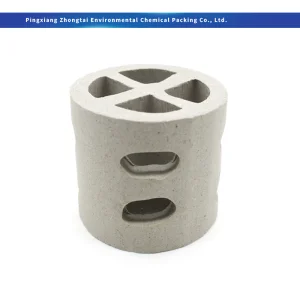
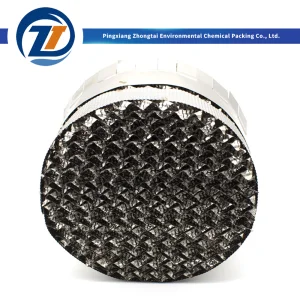
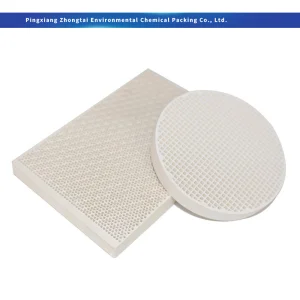
Explore our complete inventory of tower internals, structured packing, support media, and specialized adsorbents.
Connect directly with our engineering sales department for custom zeolite pore tuning, dynamic bed design verification, bulk volume pricing, and technical data sheets.
