
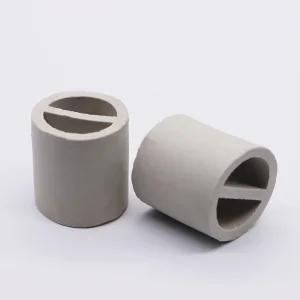
Engineered for high mass transfer, extreme acid corrosion resistance, and thermal durability in heavy chemical processes.
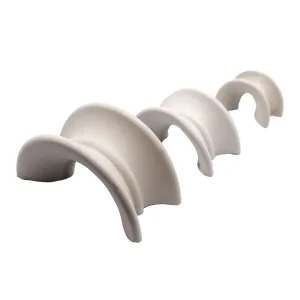
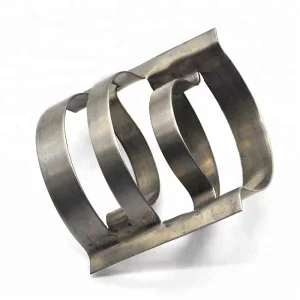
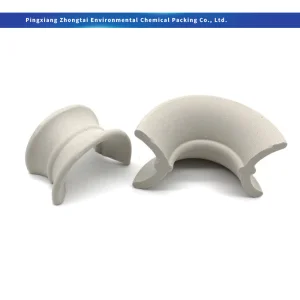
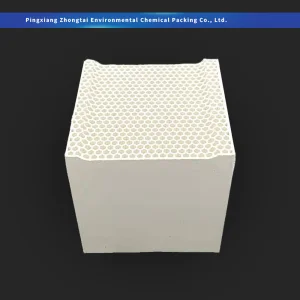
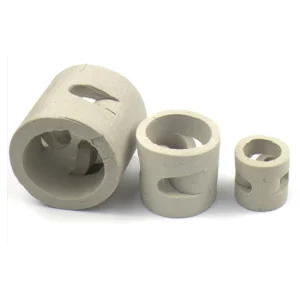
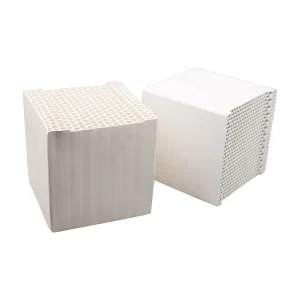
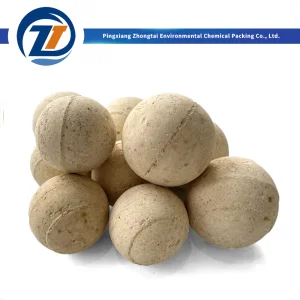
A rigorous metallurgical overview of alpha-phase corundum crystallization, cold isostatic pressing density optimization, and comminution wear kinetics.
Our alumina grinding media is synthesized using calcined industrial $\alpha$-Al₂O₃ powder micronized down to $D_{50} \le 1.2\,\mu\text{m}$. Sintered at temperatures ranging from 1580°C to 1640°C in high-temperature tunnel kilns, the internal microcrystalline lattice achieves an interlocking grain structure with zero intergranular glassy phase, preventing catastrophic micro-spalling during high-impact ball milling cycles.
For ball diameters from $\varnothing 30\text{mm}$ to $\varnothing 90\text{mm}$, we utilize Cold Isostatic Pressing (CIP) at uniform pressures exceeding 200 MPa. This produces uniform green density across three dimensions, eliminating the internal air voids, porosity differentials, and core layering that often plague conventional disk-rolled balls under severe shearing stress.
In wet ultrafine grinding of electronic slurries, lithium iron phosphate (LFP), and ceramic glazes, traditional forged or cast steel balls cause iron poisoning ($Fe_2O_3$), severely deteriorating dielectric and optical properties. Zhongtai high-alumina grinding balls release zero metallic impurities, providing superior whiteness and electrical insulation.
In industrial grinding circuits, over 70% of total comminution operational expense (OPEX) is consumed by electrical energy and media replenishment. Replacing steel balls or low-density pebbles with engineered alumina balls fundamentally shifts the plant's cost curve.
| Property Parameter | Natural Flint Pebbles | Forged Steel Balls | ZTAI 92% Alumina Ball | ZTAI 95% Alumina Ball |
|---|---|---|---|---|
| Bulk Density (g/cm³) | 1.45 – 1.60 | 4.50 – 4.85 | 2.25 – 2.40 | 2.35 – 2.50 |
| True Specific Gravity (g/cm³) | 2.60 | 7.85 | ≥ 3.65 | ≥ 3.70 |
| Mohs Hardness | 6.5 – 7.0 | 5.5 – 6.0 | 9.0 | 9.0 |
| Wear Rate (Self-Wear % / 24h) | 0.150% – 0.300% | 0.080% – 0.120% | ≤ 0.010% | ≤ 0.008% |
| Contamination Risk | Silica / Clay Impurities | Severe Iron ($Fe$) Poisoning | Negligible $\text{Al}_2\text{O}_3$ traces | Ultra-clean inert ceramic |
| Relative Mill Cycle Time | 100% (Baseline) | 65% (Fast, high wear) | 68% – 72% (Optimized) | 60% – 65% (Maximum throughput) |
The total charge weight of alumina grinding media is calculated based on effective mill inner volume ($V_{eff}$ in $\text{m}^3$), percentage filling degree ($J$, typically 40% to 45% for wet ball milling), and bulk packing density ($\rho_{bulk}$):
M_{media} = V_{eff} \times J \times \rho_{bulk} \times (1 \pm 0.05)
Because alumina balls feature a specific gravity of 3.65 g/cm³ compared to steel's 7.85 g/cm³, motor starting torque and ongoing current draw drop by 22% to 35%, preventing mill gearbox overload and sharply lowering monthly peak-demand electricity tariffs.
Comminution efficiency requires balanced point-contact energy (large balls for breaking coarse feed particles) and surface shear area (smaller balls for ultrafine slurries). A typical graded charge configuration for wet ball milling includes:
• $\varnothing 60\text{mm} - \varnothing 50\text{mm}$ (30% by weight): High kinetic impact force to break top-size feed granules.
• $\varnothing 40\text{mm} - \varnothing 30\text{mm}$ (40% by weight): Intermediate crushing and micro-fracture propagation.
• $\varnothing 20\text{mm} - \varnothing 13\text{mm}$ (30% by weight): Maximum specific surface area for fine grinding down to sub-micron target sizes.
Analyzing the strategic transition across Europe, North America, Southeast Asia, and South America from high-wear media to high-alumina advanced ceramics.
Global gigafactories producing $LiFePO_4$ (LFP), NMC precursors, and synthetic graphite cannot tolerate even fractional parts-per-billion (ppb) iron impurities. Zhongtai works closely with multinational battery chemical groups across South Korea, Europe, and China, providing specialized isostatic 95% alumina balls that eliminate thermal runaway risks caused by microscopic conductive metal contamination.
In mineral dressing (gold, copper, quartz, lithium hard-rock spodumene), mills are transitioning from hyper-chrome steel alloys to inert alumina ceramic media. This shift reduces Scope 1 and Scope 2 emissions associated with frequent alloy melting, and cuts energy dissipation from excessive steel ball mass.
Headquartered in Pingxiang, Jiangxi Province, Zhongtai benefits from China’s largest chemical packing and industrial ceramic cluster. With local supply of high-grade bauxite, calcined $\alpha$-alumina, kiln refractories, and automated CIP equipment, our plant ensures dependable pricing stability, tight lead times, and continuous high-volume production for international projects.
How our 68%, 75%, 92%, and 95% alumina ceramic grinding spheres are specified in diverse industrial environments.
For photovoltaic silica sand and spodumene lithium extraction, the finished product must maintain ultra-low iron levels ($Fe_2O_3 < 0.01\%$). Zhongtai 92% high-alumina media provides the necessary compressive strength and high hardness (Mohs 9) to grind abrasive silica without fracturing under severe impact.
Replaces imported pebbles in continuous and batch ball mills. Slashes grinding time by 25% to 35%, improves glaze rheology, narrows particle size distribution ($D_{90} < 10\,\mu\text{m}$), and yields pristine fired surfaces free of black spots and micro-pinholes.
Used in high-speed stirred bead mills and attritors where high shear forces and chemical resistance are mandatory. Our micro-bead series ($\varnothing 0.5\text{mm}$ to $\varnothing 3.0\text{mm}$) provides narrow size tolerances, mirror-polished surfaces, and complete chemical inertness in both acidic and basic solvents.
From 17% to 99% $\text{Al}_2\text{O}_3$, our high-density inert balls serve as bottom bed supports, top hold-down layers, and flow distributors in hydrodesulfurization, steam methane reforming, and ammonia synthesis, resisting thermal shock up to 1400°C with no silica leaching.
Full batch traceability, multi-stage certified testing, and complete export documentation for EPC engineering firms and chemical plants worldwide.
Every metric ton of alumina grinding media is linked to a batch record detailing raw material chemical assay (XRF analysis), isostatic compaction tonnage, sintering kiln temperature curves, bulk density, water absorption, and planetary mill wear test records.
Physical and mechanical properties are verified according to ASTM C373 (water absorption, bulk density, apparent porosity), ASTM C768 (ball wear loss), and ASTM C133 (cold crushing strength). Third-party inspections (SGS, BV, TÜV) are welcomed prior to factory dispatch.
Standard packing consists of 25kg double-walled reinforced polypropylene woven bags with internal polyethylene moisture liners, palletized into 1000kg/1200kg heavy-duty bulk jumbo bags on fumigation-free ISPM-15 heat-treated wooden pallets, secured with anti-UV stretch film wrap.
Continuous investment in nanocomposite microstructures, energy-efficient firing kilns, and circular recycling protocols.
Integrating stabilized yttria-tetragonal zirconia polycrystals (Y-TZP) into the $\alpha$-alumina lattice to generate transformation toughening ($K_{IC} > 5.5\,\text{MPa}\cdot\text{m}^{1/2}$). This design withstands aggressive impact forces in ultra-large mining ball mills without fracture.
Deploying closed-loop multi-zone infrared sensors and digital controllers to maintain temperature variations inside the sintering zone below $\pm 2^\circ\text{C}$, ensuring consistent crystal growth, eliminated porosity, and uniform wear properties.
Developing hydrogen/natural gas oxy-fuel hybrid firing systems to lower direct kiln CO₂ emissions, alongside industrial scrap recycling initiatives to reclaim spent alumina media into refractory castables and support aggregates.
In-depth engineering answers covering grading formulations, wear rate benchmarks, and mill conversion calculations.
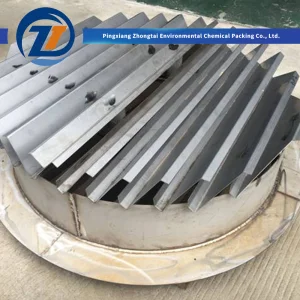
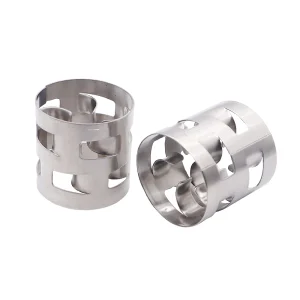
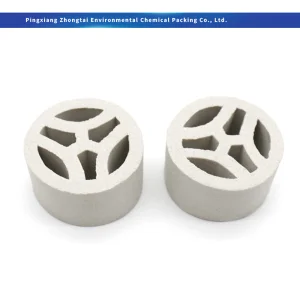
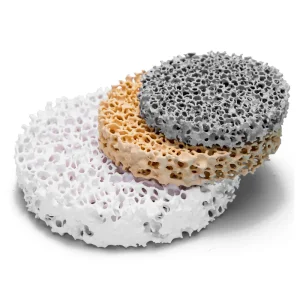
Complete fluid separation, acid stripping columns, molecular drying, and molten metal filtration components.
Connect directly with our chemical engineering team in Pingxiang. We deliver tailored mill charge simulations, technical data sheets (TDS), safety data sheets (SDS), and complimentary factory samples for qualified industrial procurement teams.
Consult with an Applications Engineer