Direct factory supply of certified mass transfer components, catalyst supports, and specialized chemical contactors.
Analyzing the global transition toward high-efficiency random packing in chemical separation, scrubbing, and environmental abatement.
In modern chemical processing, environmental engineering, and gas treatment, liquid-gas mass transfer columns serve as the primary unit operations. The choice of tower internals directly dictates operational efficiency, energy consumption, and capital expenditure. Among the array of random packings engineered over the past century, Plastic Pall Rings represent one of the most critical structural evolutions from classic Raschig ring geometry.
The global demand for high-performance thermoplastic tower packings has accelerated, driven by rigid environmental regulations governing volatile organic compound (VOC) emissions, acidic gas scrubbing (SOx, NOx, HCl, HF), carbon capture and sequestration (CCS), and large-scale industrial water treatment. Sourcing managers, process design engineers, and EPC (Engineering, Procurement, and Construction) contractors increasingly look to Chinese manufacturing hubs for engineered polymer internals that combine chemical resistance, mechanical longevity, and cost efficiency.
Information Gain Insight: The evolution from solid-wall Raschig rings to open-wall Pall rings increases gas-liquid contact area by over 50% while simultaneously reducing operational pressure drop by up to 40%. This hydraulic optimization translates directly into reduced blower power consumption and smaller column diameter footprints in new plant designs.
China's industrial chemical packing cluster, particularly rooted in historical industrial hubs like Pingxiang, Jiangxi, has evolved into a global supply powerhouse. Modern Chinese manufacturers utilize advanced automated injection molding machinery, high-purity virgin polymer resins, and strict batch-level quality controls to produce Plastic Pall Rings compliant with international standards such as ASTM, ISO, and REACH. This whitepaper provides a comprehensive engineering guide on Plastic Pall Ring selection, hydrodynamic modeling, chemical compatibility matrix, and procurement best practices.
Understanding the mechanical and physical principles that drive liquid distribution and low pressure drop in Plastic Pall Rings.
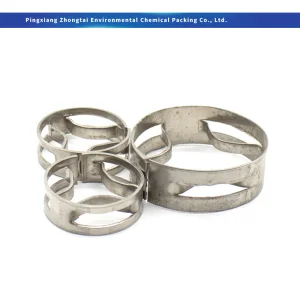
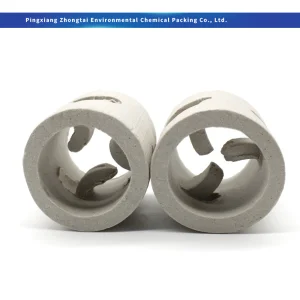
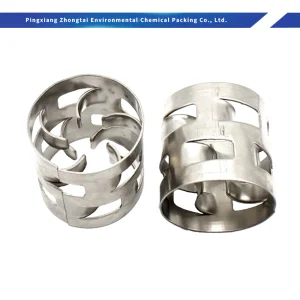
Plastic Pall Rings feature two rows of punched windows with internal fingers bent inward toward the center. This design creates internal contact points that continuously break and redistribute liquid droplets.
By opening up the cylindrical wall, the free volume inside the packed bed is maximized. This permits significantly higher vapor velocities before reaching the hydrodynamic flood point.
Continuous lateral fluid movement within the open lattice prevents liquid from channeling down column walls, ensuring uniform wetting across the entire bed cross-section.
To quantify the advantages of Plastic Pall Rings over standard random packings, chemical engineers analyze specific geometric properties including specific surface area ($m^2/m^3$), bulk density ($kg/m^3$), packing factor ($m^{-1}$), and voidage percentage. Below is a comparative technical baseline across common polymer sizes:
| Nominal Size (mm / inch) | Specific Surface Area ($m^2/m^3$) | Void Fraction (%) | Bulk Density (PP) ($kg/m^3$) | Packing Factor ($m^{-1}$) | Primary Hydraulic Duty |
|---|---|---|---|---|---|
| 16 mm (5/8") | 340 | 87% | 115 | 220 | High efficiency, low bed height scrubbing |
| 25 mm (1") | 225 | 90% | 85 | 175 | Standard chemical absorption & stripping |
| 38 mm (1.5") | 150 | 91% | 65 | 110 | High-throughput scrubbers, low pressure drop |
| 50 mm (2") | 110 | 92% | 50 | 80 | Large diameter towers, bio-filtration, degasifiers |
| 76 mm (3") | 75 | 94% | 42 | 55 | Ultra-low pressure drop, particulate-laden gas |
Selecting the optimal thermoplastic resin to ensure thermal tolerance, stress-crack resistance, and chemical inertness.
Plastic Pall Rings are manufactured from a range of engineering thermoplastics. Selecting the wrong material can result in rapid thermal degradation, environmental stress cracking, structural collapse, or polymer swelling. Leading Chinese manufacturers like Pingxiang Zhongtai provide specialized resin formulations engineered for specific industrial environments:
Max Operating Temperature: 90°C (PP) / 110°C (RPP)
Standard Polypropylene offers excellent cost-to-performance ratio for aqueous solutions, dilute acids, and alkaline scrubbers. Glass-fiber reinforced Polypropylene (RPP) improves structural rigidity and creep resistance under elevated temperatures and heavy bed load conditions.
Max Operating Temperature: 150°C
PVDF is an ultra-pure fluoropolymer designed for hyper-corrosive chemical environments involving wet chlorine, strong oxidizing acids (concentrated nitric, sulfuric), and organic solvents. It exhibits exceptional UV resistance and mechanical strength under harsh industrial cycles.
Max Operating Temperature: 80°C
HDPE offers superior low-temperature impact strength and excellent resistance to environmental stress cracking. It is widely specified in municipal water treatment degasifiers and ambient-temperature stripping towers.
Max Operating Temperature: 60°C (PVC) / 95°C (CPVC)
PVC and CPVC provide exceptional flame retardancy (UL 94 V-0 ratings) and outstanding resistance to strong halogenated chemicals and strong mineral acids, making them ideal for Chlor-Alkali production facilities.
Field-proven engineering integration across chemical manufacturing, power generation, and environmental purification.
In chemical plants producing H2SO4, HCl, and HNO3, plastic Pall rings facilitate intimate liquid-gas contact to absorb noxious fumes ($H_2S, SO_2, Cl_2, NH_3$). High voidage prevents clogging even when handling dirty scrubbing liquor containing light particulates.
Used extensively in air stripping towers to eliminate volatile organic contaminants (VOCs), ammonia ($NH_3$), or hydrogen sulfide ($H_2S$) from industrial wastewater streams prior to discharge or secondary filtration.
Integrated into pilot and full-scale amine absorption columns ($MEA, DEA, MDEA$) for post-combustion carbon capture (CCS), biogases upgrading, and natural gas sweetening.
Rigorous manufacturing controls ensuring zero mechanical failure under deep bed static loads and thermal cycling.
When specified for commercial mass transfer columns exceeding 10 meters in bed height, tower packings at the bottom of the vessel endure immense static load and compressive stresses. Leading Chinese suppliers adhere to rigorous quality inspection protocols to guarantee structural integrity:
Exploring advances in computational fluid dynamics, bio-based thermoplastics, and nano-reinforced composites.
As chemical processing industries push toward net-zero emissions and higher operational efficiency, the technology governing plastic random tower packing continues to advance along three key innovation vectors:
Using advanced 3D Computational Fluid Dynamics (CFD) modeling to refine the curvature, thickness, and spacing of internal fingers, reducing drag coefficients while maximizing micro-turbulence along liquid films.
Incorporating carbon nanotubes, graphene, or ceramic nano-fillers into thermoplastic matrices to double compressive strength and extend upper thermal operating limits by 15-20°C without adding significant weight.
Developing chemically resistant bio-based Polypropylene and Polyethylene synthesized from renewable bio-feedstocks, reducing the embedded carbon footprint of chemical plant construction.
Expert answers addressing hydrodynamic calculations, material selection, and site installation protocols.
Explore complete system solutions including molecular sieves, column trays, ceramic packings, and liquid distributors.