Explore our engineering-grade mass transfer components and chemical packing solutions manufactured in Pingxiang, China.
A comprehensive white paper detailing fluid surface physics, material chemistry selection, manufacturing quality control, and global procurement benchmark pricelists.
Plastic hollow balls (also known as floating spherical packing, hollow plastic spheres, Euro-Matic floating covers, or liquid surface insulation spheres) represent a critical breakthrough in process plant optimization, environmental protection, and energy conservation. By forming a continuous, flexible blanket across open liquid surfaces or providing low-density packing media within scrubbers and stripping towers, these hollow spheres address three major operational challenges: severe thermal heat dissipation, toxic volatile organic compound (VOC) emissions, and corrosive liquid evaporation loss.
Manufactured primarily from virgin thermoplastics—including Polypropylene (PP), High-Density Polyethylene (HDPE), Fluorinated Synthetic Polymers (PVDF), and Reinforced Polypropylene (RPP)—plastic hollow balls combine structural buoyancy, extreme chemical resistance, and high geometric uniformity. Unlike fixed solid covers or rigid structural roofs, floating hollow balls automatically adjust to changing liquid levels, accommodate mixing agitators and structural internal pipes, and allow unimpeded immersion and retrieval of metal plates or process equipment without requiring mechanical opening or venting systems.
Deploying a double-layer floating cover of 50mm polypropylene hollow balls reduces liquid evaporative loss by up to 91% to 95%, decreases heating energy consumption in open chemical tanks by 75% to 89%, and attenuates corrosive acid mist formation (such as H2SO4 or HCl) to levels below OSHA exposure limits—delivering a operational payback period of under 4.2 months in typical electro-winning and anodizing plants.
Drastically lowers radiant and convective thermal losses from heated process solutions (up to 110°C), minimizing steam boiler loads and reducing electric immersion heater power requirements.
Suppresses acid mist, odor emissions, and hazardous VOCs from open tanks, safeguarding plant structural steelwork and protecting worker health in hydrometallurgical processing.
Functions as effective random packing in gas-liquid absorption towers, providing high void fraction, low pressure drop, and generous surface area for mass transfer applications.
Selecting the optimal polymer matrix is critical to prevent environmental stress cracking, resin degradation, and chemical failure in aggressive chemical baths.
Our manufacturing plant in Pingxiang utilizes 100% prime virgin raw materials compounded with custom additive packages (including HALS UV stabilizers, anti-oxidants, and carbon black) to produce high-integrity hollow spheres. Below is the definitive engineering property comparison matrix for process plant evaluation:
| Polymer Material Grade | Density (g/cm³) | Max Continuous Temp (°C) | Tensile Yield Strength (MPa) | UV Weatherability Index | Chemical Resistance Profile | Relative Cost Index |
|---|---|---|---|---|---|---|
| Polypropylene (PP) | 0.90 – 0.91 | 100°C (212°F) | 31 – 35 | Moderate (Requires HALS) | Excellent in acids, alkalis, inorganic salts. Poor in strong oxidizers. | Baseline (1.0x) |
| High-Density PE (HDPE) | 0.95 – 0.96 | 80°C (176°F) | 22 – 29 | Outstanding (Carbon Black Grade) | Superior low-temp impact, excellent chemical resistance, highly flexible. | 1.05x |
| Reinforced PP (RPP) | 0.92 – 0.94 | 115°C (239°F) | 38 – 45 | Good | Enhanced dimensional stability and reduced creep under thermal stress. | 1.25x |
| Polyvinylidene Fluoride (PVDF) | 1.76 – 1.78 | 150°C (302°F) | 48 – 55 | Extreme / Immune | Immune to wet chlorine, concentrated nitric acid, ozone, and strong solvents. | 4.50x |
| Polytetrafluoroethylene (PTFE) | 2.15 – 2.20 | 260°C (500°F) | 25 – 35 | Extreme / Immune | Universal chemical inertness across all pH ranges (0–14) and strong organic solvents. | 8.00x |
Mathematical modeling of spherical packing geometry, hexagonal close packing efficiency, and evaporation kinetics.
When plastic hollow balls are introduced to a liquid surface, they naturally arrange themselves into a uniform, hexagonal close-packed geometric lattice. Mathematically, the theoretical maximum surface coverage ratio $C_r$ for a single layer of identical spheres is governed by the two-dimensional circle packing density:
By introducing a double layer of floating plastic hollow balls, the staggered arrangement fills the interstitial geometric gaps, raising effective liquid surface coverage to over 99.1%.
Heat dissipation from an open liquid bath occurs through three distinct heat transfer modes: evaporative latent heat loss ($Q_{evap}$), radiative heat transfer ($Q_{rad}$), and sensible convective loss ($Q_{conv}$). The total heat loss $Q_{total}$ is expressed as:
$$Q_{total} = Q_{evap} + Q_{rad} + Q_{conv}$$
Because evaporation accounts for up to 70% of total heat loss in baths operated between 50°C and 90°C, blocking the vapor-liquid interface creates an insulating stagnant air boundary layer inside each hollow sphere. The thermal conductivity of trapped air ($k \approx 0.026 \text{ W/m}\cdot\text{K}$) provides an ultra-low heat transfer coefficient, dramatically reducing electrical or steam heating consumption.
In outdoor applications—such as raw water reservoirs, tailing ponds, and municipal wastewater lagoons—floating spheres are subjected to wind drag and surface wave motion. Standard lightweight spheres can experience wind-driven drift. To prevent stack-up and rim overlap, our engineering team manufactures weighted floating spheres or optimized wall-thickness balls with low center of gravity. This design maintains stability in crosswinds exceeding 100 km/h without requiring costly structural windbreak netting.
Proven operational benefits delivered across chemical processing, metallurgy, environmental protection, and water infrastructure.
In copper, nickel, cobalt, and zinc electrowinning tankhouses, intense gas bubbling at the anodes releases hazardous sulfuric acid mist. Deploying polypropylene hollow balls creates a self-healing floating barrier that captures acid droplets, returning them to the bath while eliminating airborne acid mist by up to 98%.
Black UV-stabilized HDPE hollow spheres (often termed shade balls) prevent sunlight penetration into treated water reservoirs. This stops algae growth, eliminates carcinogenic bromate formation caused by chlorine-bromide sunlight interaction, and conserves millions of gallons of fresh water from evaporative loss annually.
In gas stripping and scrubbing towers, hollow plastic spheres serve as random tower packing. Their exceptional void fraction (>90%) provides ultra-low liquid pressure drop, preventing flooding while ensuring maximum gas-liquid interfacial contact area for scrubbing SO2, NH3, and acid vapors.
Heated chromic acid, phosphating, and hot water rinse tanks lose significant thermal energy to the surrounding building. Floating plastic spheres lower ambient shop temperatures, prevent toxic chromic acid fog formation, and extend bath chemistry life by minimizing evaporation-induced chemical concentration spikes.
Direct factory wholesale pricing based on standard Polypropylene (PP) resin grade (FOB Shanghai/Ningbo, China). Custom resin quotes available on request.
| Outer Diameter (mm / inch) | Wall Thickness (mm) | Unit Weight (g/pc) | Number of Balls per m² (Single Layer) | Surface Area (m²/m³) | Void Fraction (%) | Price Bracket (<50k pcs) (USD/1k pcs) | Price Bracket (>500k pcs) (USD/1k pcs) |
|---|---|---|---|---|---|---|---|
| 10 mm (3/8") | 0.6 ± 0.1 | 0.22 g | 11,600 pcs/m² | 600 m²/m³ | 84.0% | $12.50 / 1,000 pcs | $8.80 / 1,000 pcs |
| 19 mm (3/4") | 0.8 ± 0.1 | 0.95 g | 3,200 pcs/m² | 315 m²/m³ | 86.5% | $22.00 / 1,000 pcs | $16.50 / 1,000 pcs |
| 25 mm (1") | 1.0 ± 0.15 | 2.10 g | 1,850 pcs/m² | 240 m²/m³ | 88.0% | $34.00 / 1,000 pcs | $26.00 / 1,000 pcs |
| 38 mm (1.5") | 1.2 ± 0.15 | 5.40 g | 800 pcs/m² | 158 m²/m³ | 90.0% | $68.00 / 1,000 pcs | $52.00 / 1,000 pcs |
| 50 mm (2") | 1.4 ± 0.2 | 9.80 g | 460 pcs/m² | 120 m²/m³ | 91.5% | $115.00 / 1,000 pcs | $88.00 / 1,000 pcs |
| 70 mm (2.75") | 1.8 ± 0.2 | 22.50 g | 235 pcs/m² | 85 m²/m³ | 93.0% | $240.00 / 1,000 pcs | $185.00 / 1,000 pcs |
| 100 mm (4") | 2.2 ± 0.25 | 55.00 g | 115 pcs/m² | 60 m²/m³ | 94.5% | $520.00 / 1,000 pcs | $410.00 / 1,000 pcs |
| 150 mm (6") | 3.0 ± 0.3 | 165.00 g | 50 pcs/m² | 40 m²/m³ | 96.0% | $1,450.00 / 1,000 pcs | $1,180.00 / 1,000 pcs |
1. Prices listed above are baseline FOB China quotes for standard clear/natural Polypropylene (PP).
2. Material Add-ons: Add +10% for UV Black Carbon Black HDPE, +25% for Fire-Retardant RPP, and contact our engineering team for high-purity PVDF and PTFE pricing.
3. Custom Packaging: Standard packing includes woven super-sacks (1.0 m³) or reinforced cartons. Custom palletizing or retail labeling is accommodated upon request.
Ensuring zero fluid penetration, consistent wall thickness, and zero sink-rate failure in industrial tanks.
At our Pingxiang production facility, plastic hollow balls are manufactured using two primary processing routes: Rotary Blow Molding for large spheres (>70mm) and Precision Injection Hemispherical Ultrasonic Welding for heavy-wall chemical packing spheres (<50mm).
Every batch undergoes pressurized water immersion testing at 0.2 MPa hydrostatic pressure to verify seam integrity, guaranteeing zero liquid infiltration during prolonged submergence.
Automated ultrasonic wall thickness gauges continuously inspect sphere concentricity, maintaining tolerances within ±0.15mm to ensure consistent floating equilibrium.
Developing bio-based polyolefin resins, permanent anti-static conductive plastic spheres for explosive environments, and micro-grooved surface textures for enhanced mass transfer.
Full documentation compliance for seamless customs clearance and environmental integration worldwide.
Pingxiang Zhongtai Environmental Chemical Packing Co., Ltd. supplies industrial process media to over 60 countries across North America, Europe, Asia-Pacific, and the Middle East. All products adhere to rigorous chemical safety and material purity protocols:
100% compliant with EU Regulation (EC) No 1907/2006. Free from heavy metals, SVHCs, and phthalates.
Food-grade Polypropylene resin suitable for direct water contact and food processing applications.
Certified raw materials for drinking water components and municipal reservoir cover applications.
Audited manufacturing operations ensuring batch-to-batch consistency and full material traceability.
Explore our complete product lineup engineered for extreme temperature, filtration, and mass transfer duties.
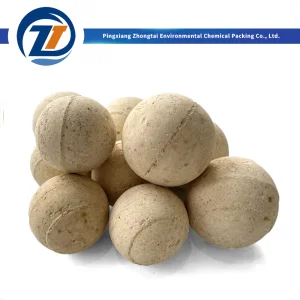
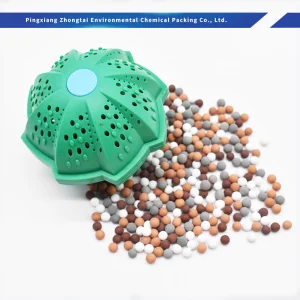
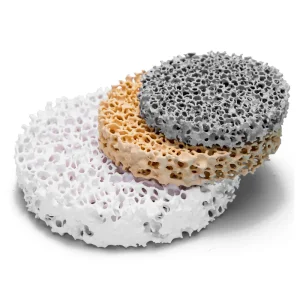
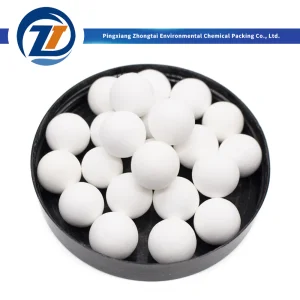
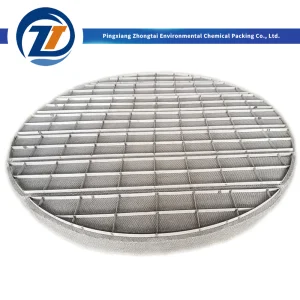
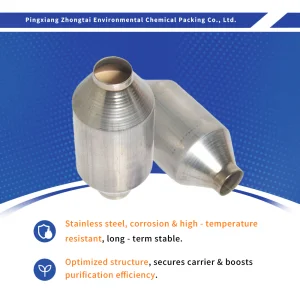
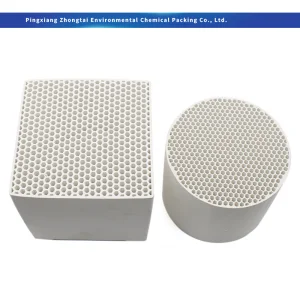
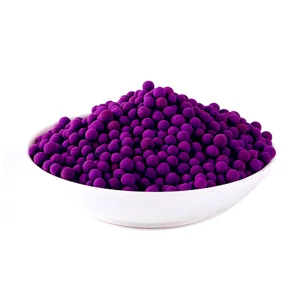
Established in 2003, delivering high-performance industrial ceramics, chemical packing, molecular sieves, and environmental media from Pingxiang City, Jiangxi Province, China.
Expert answers addressing sizing, wind resistance, chemical compatibility, and lead times for global project engineers.
