Factory-direct molecular sieves, structured random tower packings, and technical industrial ceramics produced under strict statistical process control (SPC) within our Pingxiang manufacturing complex.
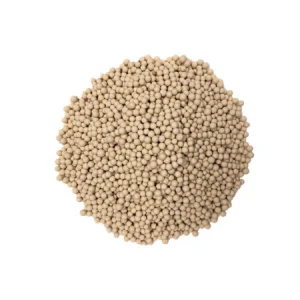
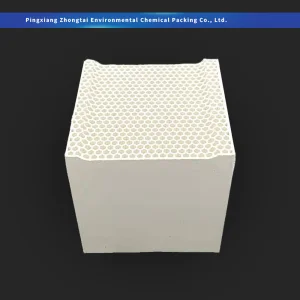
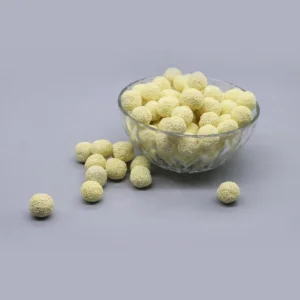
Molecular Sieve Type 4A is an alkali aluminosilicate belonging to the cubic crystalline Linde Type A (LTA) structural framework. Synthesized under controlled hydrothermal conditions at our Pingxiang facilities, Type 4A possesses an effective nominal pore opening of 4 Angstroms (0.4 nm), defined chemically by the unit cell formula Na₁₂[(AlO₂)₁₂(SiO₂)₁₂]·xH₂O.
The 4A crystalline network comprises a three-dimensional interconnecting pore system composed of truncated octahedra (sodalite cages) joined in a cubic array to create central alpha cavities of 11.4 Å diameter. The entrance aperture is governed by eight-membered oxygen rings partially occluded by exchangeable sodium (Na⁺) cations.
This geometric configuration provides an insurmountable steric barrier for molecules with critical kinetic diameters greater than 4.0 Å (such as propane, butane, benzene, or carbon tetrachloride), while permitting rapid intracrystalline diffusion of smaller polar molecules, specifically water (H₂O, 2.65 Å), hydrogen sulfide (H₂S, 3.6 Å), and carbon dioxide (CO₂, 3.3 Å).
Unlike amorphous silica gel or activated alumina whose moisture uptake relies primarily on non-specific capillary condensation, Zeolite 4A operates through localized electrostatic interaction. The high concentration of framework aluminum creates a negative charge framework balanced by accessible extra-framework sodium counter-ions.
These charge densities create intense electric field gradients inside the alpha cage, exhibiting powerful dipole-dipole and quadrupole affinities. Consequently, Zeolite 4A maintains high water adsorption capacities (exceeding 18 wt% to 22 wt%) even at critically low relative humidities (<10% RH) and elevated operating temperatures where alternative desiccants experience total thermal desorption.
Industrial packed towers subject adsorbent beads to profound dynamic stress, including hydrostatic bed head pressure, cycle-induced pneumatic pulsing, and thermal expansion strains during hot gas regeneration. Inferior molecular sieves degrade rapidly into micron-sized powder, triggering premature bed channeling, soaring differential pressure (ΔP), and downstream compressor contamination.
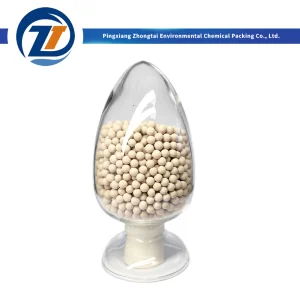
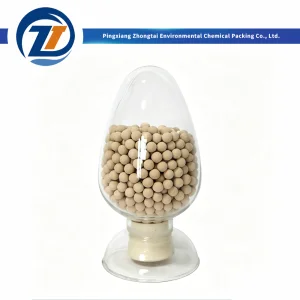
Pingxiang Zhongtai utilizes proprietary high-purity attapulgite and kaolin clay binders coupled with precision disk-granulation and ultra-high-temperature rotary calcination kilns. This yields uniform spherical beads exhibiting crush strengths exceeding 35 N to 85 N per bead and attrition rates below 0.1 wt%.
| Property Parameter | Unit | Zeolite 4A (1.6 - 2.5 mm Beads) | Zeolite 4A (3.0 - 5.0 mm Beads) | Test Standard Method |
|---|---|---|---|---|
| Nominal Pore Diameter | Ångström (Å) | 4.0 (0.4 nm) | 4.0 (0.4 nm) | X-Ray Crystallography / BET |
| Bulk Density (Tamped) | g / mL | 0.70 – 0.74 | 0.68 – 0.72 | ASTM D4180 |
| Crush Strength (Individual Bead) | N / bead | ≥ 35.0 | ≥ 80.0 | ASTM D4179 |
| Static Water Adsorption (25°C, 60% RH) | wt % | ≥ 21.50 | ≥ 21.50 | ASTM D2854 / Gravimetric |
| Water Dew Point Suppression | °C | Down to -80°C (< 1 ppmv) | Down to -75°C (< 1 ppmv) | Chilled Mirror Hygrometry |
| Attrition Loss Rate | wt % | ≤ 0.10 | ≤ 0.10 | ASTM D4058 / Ball Mill |
| Residual Moisture Content (as packed) | wt % | ≤ 1.0 (LOI @ 550°C) | ≤ 1.0 (LOI @ 550°C) | ASTM D2216 / Thermogravimetry |
| Regeneration Temperature Window | °C | 200 – 315 | 200 – 315 | Process Thermal Profile |
Every shipment manufactured at our Pingxiang plant is accompanied by lot-traceable inspection certificates verifying crush strength, static adsorption capacity, and LOI loss under ISO 9001:2015 audited protocols, eliminating third-party broker risks.
Zeolite 4A is the backbone desiccant for mission-critical industrial gas separation, pneumatic systems, cryogenic separation units, and static commercial enclosures across North America, Europe, the Middle East, and Asia.
In liquefied natural gas (LNG) trains and pipeline natural gas processing, pipeline moisture must be reduced below 0.1 ppmv to preclude the formation of solid methane hydrates and ice plugs within cryogenic cold boxes (-160°C).
Molecular Sieve 4A beads installed in dual-bed Temperature Swing Adsorption (TSA) towers capture trace moisture without co-adsorbing valuable C₂–C₆+ hydrocarbons or methane, delivering ultra-deep dehydration with negligible hydrocarbon carryover during thermal stripping.
Modern cryogenic ASU facilities demand complete upstream removal of ambient humidity and carbon dioxide from atmospheric feed air before liquefaction. In cryogenic distillation columns, trace water freezes instantly, creating devastating blockages in brazed aluminum plate-fin heat exchangers.
Our 4A molecular sieve beds work in tandem with 13X-APG layers in molecular sieve adsorbers, serving as the frontline bulk moisture barrier to stabilize ASU cold box operations with continuous dew points below -70°C.
In architectural and structural fenestration, insulating glass units rely on specialized 4A molecular sieve matrices embedded within tubular aluminum or composite spacer bars.
The precise 4.0 Å pore size prevents the co-adsorption of atmospheric nitrogen and argon gas fill, avoiding atmospheric pressure differentials that cause pane deflection, edge-seal mechanical fatigue, and glass implosion during seasonal temperature swings.
Stationary HVAC systems, domestic chillers, and automotive air conditioning loops utilizing refrigerants (such as R-134a, R-1234yf, and natural hydrocarbon blends) require continuous trace water scavenging to prevent hydrofluoric and hydrochloric acid generation.
Our high-crush 4A filter-drier cores ensure complete neutralization of acid catalysts, eliminating copper plating and compressor valve failure over 15+ year operational lifespans.
The global adsorbent market has shifted structurally. International engineering contractors and refinery operators are bypassing multi-tier brand distributors to secure direct relationships with established Chinese manufacturing hubs.
Pingxiang, Jiangxi Province, stands as China’s recognized historical capital for chemical packing and industrial ceramics. Our manufacturing ecosystem integrates localized raw material sourcing—including ultra-pure sodium aluminate and premium sodium silicate (waterglass)—directly adjacent to advanced synthesis plants.
This territorial integration eliminates inter-provincial intermediate transport overheads, hedges against regional energy fluctuations, and guarantees total control over raw slurry stoichiometry and hydrothermal crystallization purity.
Traditional Western brands levy substantial markups for legacy trademark licensing and multi-layer distributor margins. In large-scale capital projects requiring 100 to 500 metric tons of Type 4A molecular sieves, procurement premiums strain operational budgets.
Direct factory procurement through Pingxiang Zhongtai delivers 30% to 45% CAPEX reduction without sacrificing physical or thermodynamic performance, providing equal cyclic longevity and certified compliance with international EPC specifications.
Because zeolite molecular sieves are intensely hygroscopic, uncompromised barrier packaging is crucial during oceanic transit. Our Pingxiang facility utilizes automated packaging systems delivering nitrogen-purged steel drums (140 kg / 150 kg net) with reinforced rubber gasket seals.
For mega-volume bulk handling, we supply heavy-duty polypropylene supersacks (1000 kg net) featuring integrated aluminum-foil multilayer vacuum barrier liners, guaranteeing an initial Loss on Ignition (LOI) < 1.0 wt% upon port delivery.
Exporting to petrochemical clusters across North America, Rotterdam, Singapore, and Jubail demands uncompromising adherence to global environmental, chemical, and quality directives.
Our synthesized Zeolite 4A is fully registered under the European Union REACH Regulation (EC No 1907/2006), certified free of Substances of Very High Concern (SVHC). Furthermore, all production batches comply with RoHS Directives, guaranteeing negligible heavy metal impurities (lead, mercury, cadmium, hexavalent chromium) for clean industrial emissions.
Batch validation operates strictly per ASTM standards: ASTM D4179 for individual bead crushing strength, ASTM D4058 for dust and attrition measurement, ASTM D2854 for tamped bulk density, and ASTM D2216 for loss on drying. Detailed laboratory test certificates accompany every single production batch.
Our operations adhere to an integrated management system audited annually for ISO 9001 (Quality Management), ISO 14001 (Environmental Stewardship), and ISO 45001 (Occupational Health & Safety). Production processes incorporate automated continuous monitoring to minimize particulate emissions and maximize energy recovery.
Beyond standard 1.6–2.5 mm (8×12 mesh) and 3.0–5.0 mm (4×8 mesh) spheres, Zhongtai formulates custom bead diameters, extrudates (pellets: 1/16" and 1/8"), and ultra-low-dust powders for specialized polymer compounding, polyurethane resin dehydration, and paint formulating matrices.
Correct column loading, fluidization avoidance, and precise thermal swing regeneration procedures are essential to achieving a 5-to-8 year service life from your Zeolite 4A catalyst beds.
Improper dumping of molecular sieve beads causes particle segregation, variable bed voids, and subsequent vapor channeling. We recommend mechanical "dense loading" systems (e.g., rotary distributor heads) to achieve flat, horizontal layers across the tower cross-section.
This technique increases loaded bulk density by 8% to 12% over simple gravity dumping, eliminating settling voids and lowering bed fluidization risks under high gas velocities.
Molecular Sieve 4A requires dry stripping purge gas (typically dry nitrogen, methane, or dry feed gas with dew point < -40°C) heated between 200°C and 315°C (390°F–600°F). The bed temperature must be brought up in controlled stages: an initial boil-off plateau (110°C–130°C) to vaporize bulk free water, followed by a ramp to peak regeneration temperature.
Excessive heating rates (> 2.5°C/min) with wet purge gas provoke hydrothermal steaming, permanently degrading zeolite crystallinity.
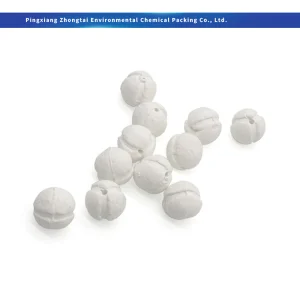
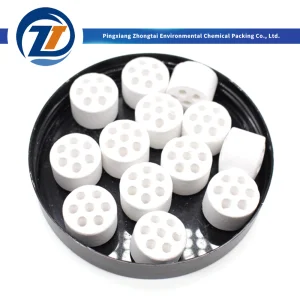
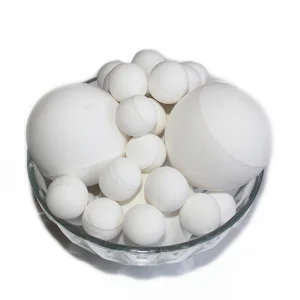
To protect the adsorbent beds from catastrophic pneumatic surging, our high-purity inert ceramic balls (standard 17–23% Al₂O₃ or 99% high-alumina) should be installed at both bottom support and top hold-down zones.
A graded bottom support structure (typically 1-inch, 1/2-inch, and 1/4-inch ceramic balls) ensures uniform liquid/gas distribution and prevents migration of sieve beads into downstream collection screens.
Addressing global decarbonization mandates and energy reduction targets, Pingxiang Zhongtai is advancing next-generation molecular sieve formulations and cleaner manufacturing processes.
Conventional molecular sieves contain 15% to 20% inert clay binder, which contributes to physical bead structure but offers zero selective adsorption capacity.
Zhongtai's R&D line is commercializing "binderless" Type 4A spherical adsorbents, wherein the clay binder is post-chemically converted via secondary caustic crystallization into pure LTA zeolite structure. This yields an immediate 18% to 22% increase in dynamic working adsorption capacity per cubic meter of column volume, allowing plants to downsize vessel dimensions or lengthen cycle times.
Decarbonization of high-temperature calcination is a primary factory priority. Our Pingxiang facility has modernized its rotary firing lines with recuperative gas heating, closed-loop waste heat recirculation, and digital air-fuel stoichiometric control.
These advances reduce the carbon footprint per ton of finished molecular sieve by 28% compared to industry averages, supporting Scope 3 emission reduction targets for global energy multi-nationals.
Intracrystalline diffusion resistance represents a bottleneck in high-throughput gas drying columns. Zhongtai engineers are synthesizing hierarchical 4A zeolites that combine classical 4 Å micropores with mesoporous transport pathways (2 nm – 50 nm).
This architecture drastically accelerates kinetic adsorption rates, sharpens mass transfer breakthrough fronts, and decreases the length of the Unused Bed Depth (LUB) during high-velocity separation duties.
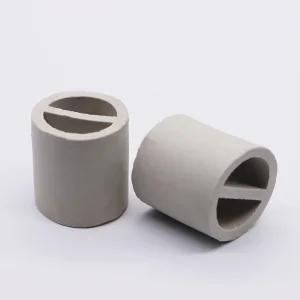
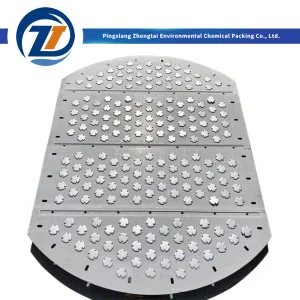
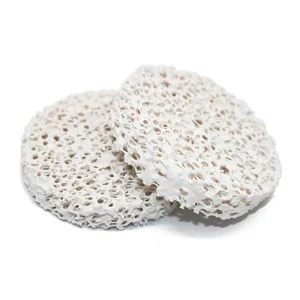
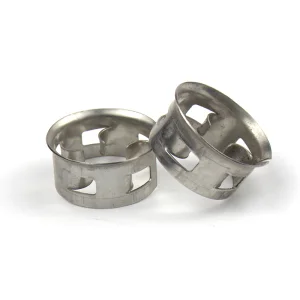
Discover complementary high-performance media manufactured by Pingxiang Zhongtai for refinery reactors, gas treatment columns, and wastewater purification infrastructure.
Critical operational parameters, dynamic capacity verifications, and procurement logistics detailed by our technical application team.
