Engineered for high thermal capacity, minimal backpressure, and superior thermal-shock resistance under continuous thermo-chemical stresses.
Aligning thermal regenerative technologies with the European Industrial Emissions Directive (IED 2010/75/EU) and national clean air roadmaps.
The industrial landscape of Bulgaria—anchored by major production corridors such as the Trakia Economic Zone (Plovdiv), the Burgas Chemical and Petrochemical Hub, and heavy metallurgy clusters in Pernik and Ruse—is undergoing a rapid technological transformation. Driven by stringent European Commission decarbonization targets and Best Available Techniques (BAT) reference documents (BREFs), local manufacturing facilities are aggressively revamping their thermal oxidation and industrial gas handling infrastructures.
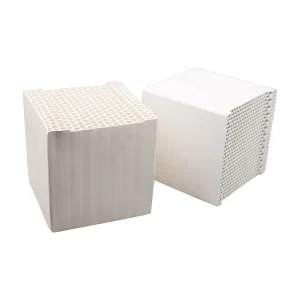
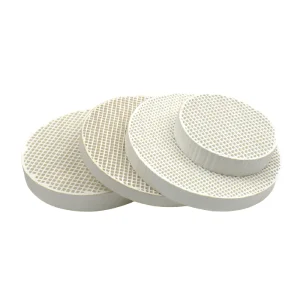
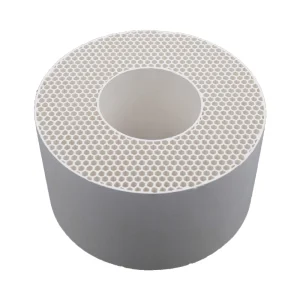
Honeycomb ceramics play a foundational role in this transition. By acting as the primary heat recovery core in Regenerative Thermal Oxidizers (RTO) and Regenerative Catalytic Oxidizers (RCO), cordierite and cordierite-mullite monolithic structures achieve thermal recovery efficiencies exceeding 95–97%. This enables massive energy savings by combusting Volatile Organic Compounds (VOCs) with minimal supplemental natural gas, reducing operating expenditures amid fluctuating European energy prices.
Zhongtai manufactures customized monolithic honeycomb ceramics engineered to withstand the extreme cyclic thermal shocks typical of Bulgarian industrial production. Whether addressing sticky solvent exhausts from packaging and polymer converting plants near Sofia, or sulfurous flues in coastal petrochemical facilities, our cell matrices are formulated to prevent cracking, maintain low structural pressure drops, and resist particulate blinding.
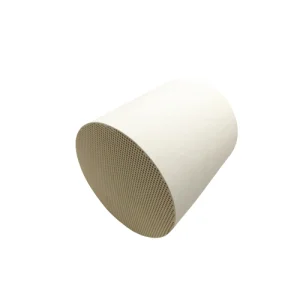
Furthermore, Bulgaria's position as a cross-continental logistics artery creates heavy demand for robust Diesel Particulate Filters (DPF) and Diesel Oxidation Catalyst (DOC) substrates for off-road agricultural, mining, and freight fleets operating under Euro VI and Stage V exhaust criteria. Our tightly controlled pore distributions, balanced thermal expansion coefficients (CTE), and optimized washcoat adhesion deliver measurable operational life extensions.
Precision synthetic formulations optimized for high volumetric heat capacity, mechanical integrity, and catalytic washcoat adherence.
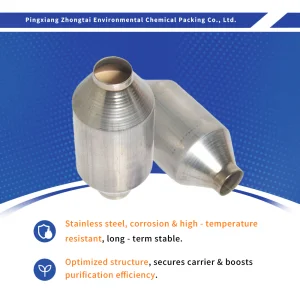
Engineered for high-frequency thermal cycling. The exceptionally low coefficient of thermal expansion (CTE) mitigates mechanical spalling during sharp temperature transitions, making it the premier choice for RTO heat storage beds and automotive catalytic converters.
Formulated for severe operational regimes where higher refractoriness and alkali-gas corrosion resistance are non-negotiable. Widely specified across metallurgical roasting, ceramic kiln recuperators, and chemical process furnaces requiring structural resilience up to 1350°C.
Manufactured with 85% to 92%+ Al₂O₃ matrices, these monoliths resist intense acid atmospheres, sulfur condensates, and aggressive chemical feedstocks commonly present in Claus sulfur recovery units and oil hydrotreating catalyst support beds.
Specific field configurations addressing localized industrial process duties and regulatory requirements.
High-speed printing and laminating operations generate broad spectrum VOCs (ethanol, ethyl acetate). Our 40-cell and 50-cell RTO blocks maximize thermal efficiency, maintaining self-sustaining combustion chambers even at low VOC concentrations (1.5-2.0 g/Nm³).
Chlorinated and petrochemical off-gas treatment requires high acid resistance. Zhongtai supplies specialized mullite honeycomb ceramic matrices that mitigate acid dew-point corrosion, ensuring long media life and minimal bed pressure drops.
High particulate and fluctuating flue gas volumes demand robust regenerative burner media. Our high-alumina cellular blocks resist dust slagging, allowing easy pneumatic backwash cleaning and thermal recovery cycles up to 1300°C.
Tracking the trajectory of emissions purification and heat recovery over the 2025–2030 horizon.
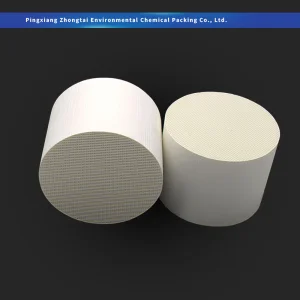
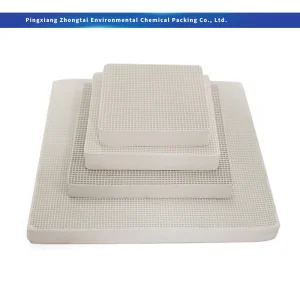
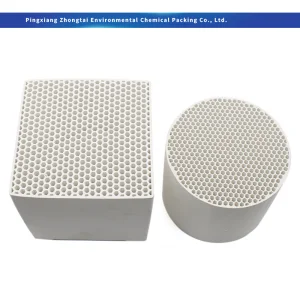
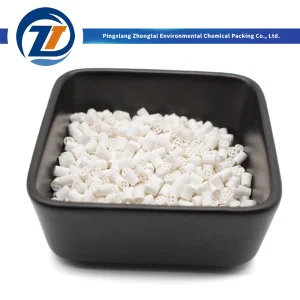
Comprehensive monolithic configurations available for custom batch extrusion, sizing, and worldwide containerized export.
Direct technical criteria for specifying honeycomb ceramics, logistics to Bulgaria, and bed optimization.
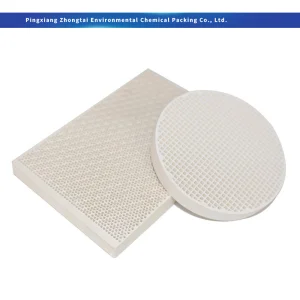
Cell density selection represents an engineering balance between heat transfer efficiency and pressure drop. 40 CPSI is the European industry benchmark for airstreams carrying condensable organic matter or low-level particulates, providing wide channels (approx. 3.2 mm pitch) that resist clogging. 50 CPSI and 60 CPSI offer significantly higher specific surface area (>950 m²/m³) and volumetric thermal efficiency, making them superior for clean VOC exhaust streams (e.g., printing and coil coating), allowing plants to shrink bed depth while maintaining >95% heat recovery.
Thermal shock resistance is governed by the matrix mineral composition and its Coefficient of Thermal Expansion (CTE). Zhongtai cordierite honeycombs feature a strictly managed CTE of 1.0–1.5 × 10⁻⁶ / K (between 20°C and 1000°C). Our synthetic firing protocol promotes high internal micro-cracking networks that arrest thermal stress propagations without sacrificing crushing strength (radial compressive strength ≥12 MPa; axial compressive strength ≥2.5 MPa).
Containerized shipments depart from Ningbo or Shenzhen ports bound for the Port of Varna or Port of Burgas, with sea transit typically averaging 28 to 35 days. For inland destinations like Sofia or Plovdiv, customs clearance is completed at the port with coordinated multimodal rail/truck haulage to your site. Products are secured in reinforced, fumigated wooden crates lined with moisture barriers and shock-absorbing edge protections.
For applications involving sulfur-bearing emissions or halogenated VOCs, standard cordierite may suffer phase transition over long exposure cycles. In these environments, we recommend our Cordierite-Mullite or High-Alumina (≥90% Al₂O₃) formulations, which demonstrate negligible acid solubility (<0.5% in boiling sulfuric acid) and complete resistance to structural softening up to 1350°C.
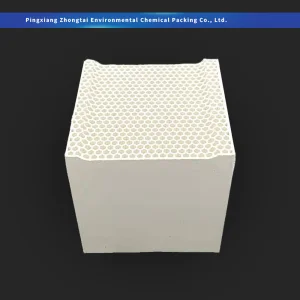
Yes. While standard industry blocks are 150 × 150 × 150 mm or 150 × 150 × 300 mm, our precision wire-cutting and specialized extrusion tooling accommodate custom cross-sections, segmented arcs, and custom heights to match existing Durr, Eisenmann, Anguil, or Megtec OEM grid housings.
