Engineered to deliver optimum fluid dynamics, exceptional chemical resistance, and repeatable gas-liquid mass transfer efficiency across industrial scrubbing, stripping, and distillation operations.
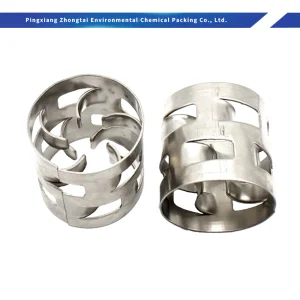
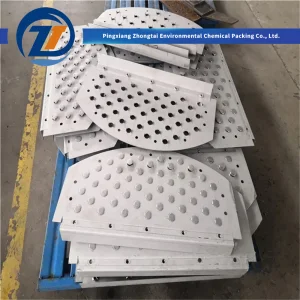
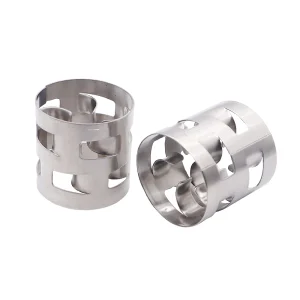
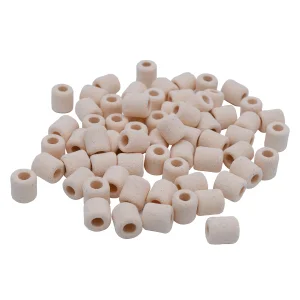
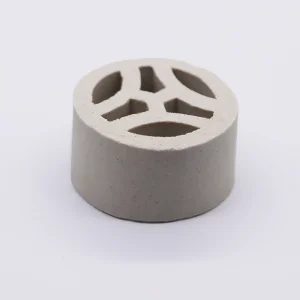
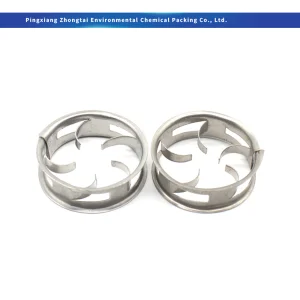
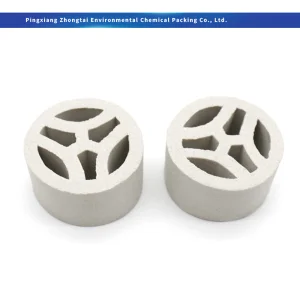
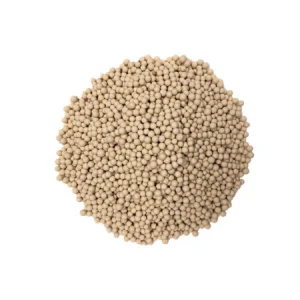
An authoritative analysis of aluminosilicate microstructural density, countercurrent fluid dynamics, and two-film gas-liquid kinetics in high-temperature, highly corrosive environments.
Invented by German chemist Fritz Raschig, the Raschig ring established the cornerstone of modern random tower packing. Defined by equal external diameter and axial height ($H = D$), this hollow cylinder design balances mechanical structural arching with high interstitial void space, preventing catastrophic bed settling under heavy liquid loads.
Our ceramic Raschig rings are engineered from high-purity kaolin clays, feldspathic fluxes, and quartz matrices sintered at strictly controlled kiln temperatures between $1280^\circ\text{C}$ and $1350^\circ\text{C}$. This vitrification produces a dense, non-porous mullite crystal skeleton resistant to aggressive chemical leaching.
Unlike metal packings susceptible to localized pitting, or polymeric media prone to plasticizer oxidation and thermal creep above $100^\circ\text{C}$, ceramic Raschig rings exhibit over 99.8% resistance to boiling mineral acids, rendering them ideal for sulfuric, nitric, and hydrochloric services.
Comprehensive engineering specifications complying with ASTM C515 and HG/T 21556.3 industrial standards. Use these baseline values to verify hydraulic loading, capacity limits, and pressure-drop profiles.
| Nominal Size ($D \times H \times T$) | Pieces per $m^3$ | Bulk Density ($kg/m^3$) | Geometric Surface Area ($a, m^2/m^3$) | Void Fraction ($\varepsilon, \%$) | Dry Packing Factor ($F_p, m^{-1}$) | Min. Crush Strength (kN/pc) |
|---|---|---|---|---|---|---|
| 15 × 15 × 2.0 mm | ∼ 330,000 | 680 – 720 | 350 | 71% | 580 | ≥ 1.85 |
| 25 × 25 × 3.0 mm | ∼ 53,500 | 560 – 610 | 215 | 74% | 285 | ≥ 3.20 |
| 38 × 38 × 4.0 mm | ∼ 15,500 | 530 – 570 | 140 | 76% | 175 | ≥ 5.50 |
| 50 × 50 × 5.0 mm | ∼ 6,800 | 500 – 540 | 110 | 78% | 115 | ≥ 8.80 |
| 76 × 76 × 8.0 mm | ∼ 2,050 | 480 – 520 | 75 | 80% | 72 | ≥ 14.50 |
| 100 × 100 × 10 mm | ∼ 850 | 460 – 500 | 55 | 81% | 52 | ≥ 22.00 |
| 150 × 150 × 15 mm | ∼ 260 | 440 – 480 | 38 | 83% | 35 | ≥ 40.00 |
Understanding the balance between effective wetted surface area ($a_e$), pressure drop ($\Delta P$), and height equivalent to a theoretical plate (HETP) in ceramic packed towers.
Mass transfer rates ($N_A = K_L a_e (C_i - C_L)$) depend on maintaining high interfacial surface area ($a_e$) across the dry geometric area ($a$). Because vitrified industrial ceramics possess a natural surface micro-texture, ceramic Raschig rings exhibit exceptional liquid film spread even at low liquid irrigation densities ($L < 5\,m^3/(m^2\cdot h)$).
Tower diameter sizing hinges on the gas loading factor ($F_s = u_g \sqrt{\rho_g}$). Operating conventional ceramic Raschig rings at 65% to 75% of the Sherwood flooding point yields optimal mass transfer efficiency while safeguarding columns from entrainment carryover and sudden differential pressure spikes.
Calculating the overall height of packing ($Z = \text{HTU} \times \text{NTU}$) requires accurate Height Equivalent to a Theoretical Plate (HETP) data. Depending on column diameter, gas velocity, and liquid viscosity, ceramic Raschig rings deliver highly reliable HETP values:
Operating inside major chemical facilities worldwide, our ceramic tower packings protect multi-million-dollar infrastructure from severe acidic breakdown, chemical oxidation, and thermal stress.
In double-contact double-absorption (DCDA) sulfuric acid plants, drying and absorption towers run continuously with concentrated acid ($93\% \text{ to } 98.5\% \text{ H}_2\text{SO}_4$) at operating temperatures from $80^\circ\text{C}$ to over $125^\circ\text{C}$. Ceramic Raschig rings provide complete acid passivity, preventing tower fouling and packing disintegration.
Wet chlorine gas ($\text{Cl}_2$) saturated with water vapor forms a hyper-corrosive mixture of hydrochloric and hypochlorous acids. Ceramic packing remains entirely inert, outperforming titanium packings in dry halogen swings and preventing embrittlement common to polypropylene.
Incineration quenching columns face sudden temperature transitions from $950^\circ\text{C}$ to saturated dew points alongside acidic mist ($\text{HCl}$, $\text{HF}$, $\text{SO}_2$). Large-diameter ceramic Raschig rings serve as thermal quench packing and high-efficiency particulate scrubbers without thermal spalling.
High-pressure absorption columns in ammonia oxidation and nitric acid plants require random packings that resist severe oxidative degradation. Ceramic Raschig rings facilitate the countercurrent absorption of nitrogen dioxide ($\text{NO}_2$) into process water to yield commercial nitric acid.
Petrochemical sweetening, crude amine regeneration, and sour water stripping towers demand random packings resistant to hydrogen sulfide ($\text{H}_2\text{S}$), carbon dioxide ($\text{CO}_2$), and volatile phenols. Ceramic rings ensure stable hydraulics without stress-corrosion cracking.
In addition to serving as random tower packings, large ceramic Raschig rings serve as high-void catalyst hold-down media and flow distribution layers atop fixed catalyst beds, protecting sensitive catalysts from mechanical crushing and direct gas impingement.
Strategic analysis for EPC contractors, plant turnaround buyers, and supply chain managers seeking stable quality, reduced freight costs, and predictable delivery windows.
While specialty nickel alloys (Hastelloy C-276, Inconel 625) offer thin-wall packaging advantages, their raw material costs fluctuate wildly and remain vulnerable to hydrochloric acid pitting. Ceramic Raschig rings deliver a 75% to 85% initial CapEx saving while providing indefinite operational lifespans under hot acid conditions.
Ceramic freight requires rigorous structural protection. We ship via heavy-duty UV-stabilized 1.0 – 1.2 MT FIBC jumbo bags or multi-wall poly-lined craft cartons stretch-wrapped onto heat-treated, fumigated ISPM-15 wooden pallets, keeping transit chipping below 0.1% across international ocean voyages.
Located in Pingxiang, Jiangxi — known as the chemical packing capital of China — our factory operates within immediate reach of regional kaolin deposits, advanced natural gas tunnel kilns, and experienced ceramic engineers, ensuring consistent lead times and direct pricing.
From raw kaolinite batching to automated de-airing vacuum pugmills and final destructive crush testing, every production batch is logged to ensure full compliance with international standards.
High-grade kaolin, clay fluxes, and alumina powders are wet ball-milled to achieve sub-micron particle distribution. Slurries undergo magnetic iron separation and filter-press dewatering to ensure an absolute iron oxide ($\text{Fe}_2\text{O}_3$) concentration below 1.0%, eliminating localized catalytic acid attack points.
Dewatered ceramic pug is processed through high-vacuum extrusion pugmills operating under −0.098 MPa vacuum pressure. This degassing step prevents micro-voids, laminations, and internal air pockets. Automated rotary wire cutters trim cylinders to precise 1:1 diameter-to-height tolerances.
Parts pass through computer-monitored tunnel kilns on continuous firing curves reaching $1320^\circ\text{C}$. Final batch inspection confirms acid resistance (>99.8% in boiling sulfuric acid per ASTM C515), crushing strength verification across 30 samples per lot, and third-party testing via SGS or TÜV.
Direct technical answers addressing packing selection, installation guidelines, chemical limitations, and international logistics.
Ceramic Intalox saddles provide higher capacity and lower pressure drop in clean gas-liquid systems; however, ceramic Raschig rings deliver significantly higher crush strength and structural rigidity. In deep packing beds (>6 meters) or applications prone to vibration, thermal shocks, or heavy particulate deposition, Raschig rings resist compression and breakage more effectively.
Ceramic packing withstands virtually all organic and mineral acids across broad concentration and temperature spectrums. The two critical exceptions are Hydrofluoric Acid ($\text{HF}$), which dissolves the silicate/mullite matrix, and hot concentrated caustic alkalis ($\text{NaOH}, \text{KOH}$ above $10\%$ at elevated temperatures), which gradually leach silica.
Two standard wet installation protocols are used: (1) Water Floatation Method: Fill the column with water above the support plate and gently dump packing into the liquid cushion to absorb impact. (2) Chute/Sock Dumping: For dry installations, lower canvas sock chutes into the bed and discharge packing with drop heights never exceeding 50 to 80 cm.
Standard sizes (25mm, 38mm, 50mm) in quantities up to 100 cubic meters are typically maintained in warehouse inventory or manufactured within 7 to 10 business days. Custom wall thicknesses, higher alumina formulations (such as 99% $\text{Al}_2\text{O}_3$), or large project volumes (over 500 $m^3$) require 2 to 3 weeks for kiln scheduling and production runs.
Yes. International buyers routinely commission independent inspections through SGS, Bureau Veritas, or TÜV to verify dimensional tolerances, chemical compositions, and compressive crush strengths prior to shipment. Customers are also welcome to visit our manufacturing facilities in Pingxiang, Jiangxi.
Dry ceramic Raschig rings exhibit bulk densities ranging between 460 and 720 $kg/m^3$, depending on nominal ring diameter. Support plate engineering must also account for dynamic operating liquid holdup (typically an additional 12% to 20% of dry weight) plus potential emergency liquid flooding loads when calculating structural support safety factors.
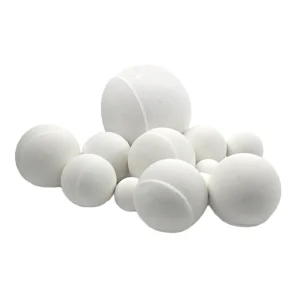
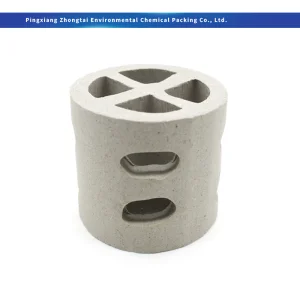
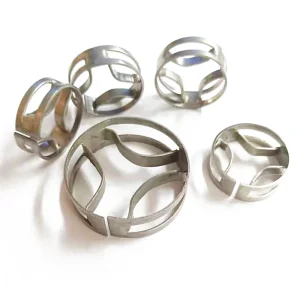
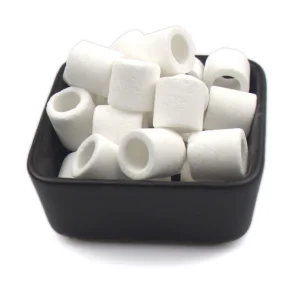
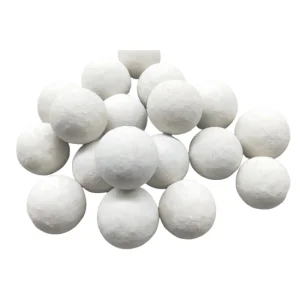
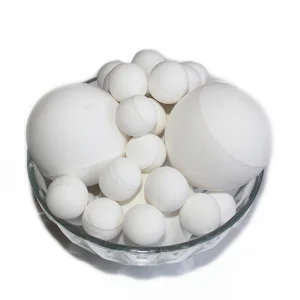
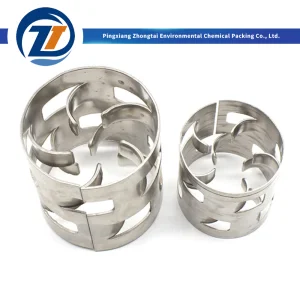
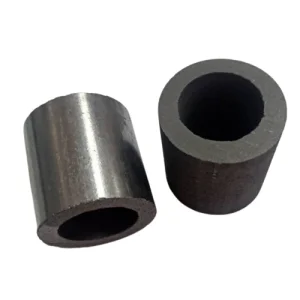
Explore our extended series of chemical-resistant partition rings, high-alumina grinding balls, carbon graphite packing, and inert catalyst bed support media.
Consult with our process engineers on column hydraulic calculations, pressure drop estimates, custom packaging, and sample shipments. We reply in English with complete technical data sheets and competitive wholesale export pricing.
