Factory-direct high-alumina, ceramic foam, molecular sieve, and metal tower packings optimized for high-temperature and harsh fluid dynamics.
Strategic Insights into Supply Chains, Material Formulations, and Catalyst Bed Support Technologies Across Modern Process Industries.
Modern petroleum refining (hydrotreating, hydrocracking, catalytic reforming) requires robust bed support media capable of sustaining hydrostatic crushing pressures over 35 MPa without mechanical degradation or silica contamination.
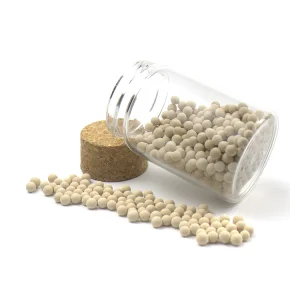
While standard 17–23% $\text{Al}_2\text{O}_3$ inert ceramic spheres serve general gas/liquid distribution, 99%+ $\alpha$-alumina oxide balls are now mandated in steam methane reformers (SMR) and ethylene oxide reactors to eliminate silica leaching.
In ultra-fine mineral processing and technical ceramics, 92% to 95% high-density alumina grinding balls have replaced traditional forged steel balls to eliminate iron contamination during wet and dry ball milling operations.
Technical Insight on Silica Leaching Risk: In high-temperature steam environments (above 400°C), residual silica ($\text{SiO}_2$) in low-grade ceramic balls leaches out and deposits on active catalyst beds downstream. This leads to premature pressure drop spikes ($\Delta P$) and catastrophic poisoning of precious metal catalysts (Pt/Pd). Sourcing high-purity (≥99.5% $\text{Al}_2\text{O}_3$) alumina oxide balls is the single most effective preventive measure for refinery uptime.
How Pingxiang's Century-Old Chemical Ceramics Heritage Delivers Unmatched Cost Efficiency, Quality Assurance, and Scalable Export Capabilities.
Pingxiang, Jiangxi is world-renowned as China's capital for chemical packing and industrial ceramics. Direct access to premium calcined bauxite, high-purity alpha-alumina powders, and specialized kaolin clays allows direct control over chemical stoichiometry. Our automated spray-drying and cold isostatic pressing (CIP) systems ensure consistent roundness, uniform grain size distribution, and zero internal voids across production runs exceeding 50,000 metric tons annually.
Operating continuous 100-meter automated tunnel kilns fired by natural gas at temperatures up to 1750°C provides precise thermal profiling. This process achieves complete phase conversion to crystalline $\alpha$-alumina (corundum phase), maximizing Mohs hardness (up to 9), mechanical impact strength, and chemical resistance against concentrated inorganic acids (hydrochloric, sulfuric, nitric) up to high temperatures.
Comparative physical, chemical, and thermal properties for procurement engineers and process plant designers.
| Property Parameter | Standard Inert (17–23% $\text{Al}_2\text{O}_3$) | Medium Alumina (65–75% $\text{Al}_2\text{O}_3$) | High Alumina Grinding (92% $\text{Al}_2\text{O}_3$) | High Purity Inert (99%+ $\text{Al}_2\text{O}_3$) |
|---|---|---|---|---|
| Crystalline Phase | Mullite + Glass Phase | Mullite + Corundum | Alpha-Corundum ($\alpha$-$\text{Al}_2\text{O}_3$) | Pure Corundum ($\alpha$-$\text{Al}_2\text{O}_3$) |
| Bulk Density ($\text{g/cm}^3$) | 1.35 – 1.45 | 1.80 – 2.10 | 3.60 – 3.68 | 2.00 – 2.20 (Inert) / 3.90 (Solid) |
| Water Absorption (%) | < 3.0% | < 1.0% | ≤ 0.02% | ≤ 0.20% |
| Mohs Hardness | 6.5 – 7.0 | 7.5 – 8.0 | 9.0 | 9.0 |
| Cold Crush Strength (19mm) | > 2.5 kN/ball | > 5.0 kN/ball | > 12.0 kN/ball | > 8.5 kN/ball |
| Max Working Temp (°C) | 1050°C | 1350°C | 1550°C | 1650°C – 1750°C |
| Silica Content ($\text{SiO}_2$) | 70 – 75% | 20 – 30% | ≤ 5.5% | ≤ 0.20% (Ultra-Low Silica) |
| Primary Application | Standard Catalyst Bed Support | Refinery Secondary Beds | Ball Mill Fine Wet Grinding | SMR, Ammonia, Ethylene Oxide |
Real-world deployment dynamics of alumina ceramic spheres in oil refineries, fertilizer synthesis, and ceramic processing plants.
In high-pressure hydrodesulfurization (HDS) reactors, improper bed grading leads to gas channeling and rapid pressure drop buildup. A typical recommended layer structure uses top-to-bottom size graduation:
In primary and secondary steam reformers running at temperatures exceeding 1000°C under 3.5 MPa steam pressure, standard ceramic balls release free silica into the synthesis gas line. The silica vaporizes and condenses in cooler downstream waste heat boilers and synthesis catalyst pores, causing irreversible fouling. Sourcing 99.5% high-purity alumina oxide balls guarantees zero silica volatilization, protecting heat exchanger efficiency and extending catalyst bed lifespan by up to 30%.
Rigorous Testing, International Packaging Standards, and Factory Auditing for Global Engineering Procurement Contractors (EPCs).
Every manufacturing lot undergoes batch testing strictly following ASTM C510 (crush strength of spherical ceramic media), ASTM C373 (water absorption & bulk density), and chemical assay via X-Ray Fluorescence (XRF) to certify $\text{Al}_2\text{O}_3$ and $\text{Fe}_2\text{O}_3$ fractions.
To withstand transoceanic transport and high-moisture sea environments, goods are packed in heavy-duty 1000kg PP woven jumbo bags with moisture-proof inner liners, reinforced steel drums (205L), or ISPM-15 compliant fumigated wooden crates.
Full support for independent third-party inspections (SGS, TÜV, Bureau Veritas) prior to dispatch. Individual bag/drum labeling ensures 100% batch traceability back to kiln firing logs and raw material chemical certificates.
Decarbonization, Green Hydrogen Catalyst Support, and Energy-Efficient Thermal Recovery.
As the global energy sector pivots toward green hydrogen electrolysis and power-to-X synthetic fuels, catalyst support spheres must withstand high dynamic pressure cycling and hydrogen embrittlement. Ultra-dense $\alpha$-alumina spheres provide the required structural integrity.
Pingxiang manufacturing bases are actively adopting clean energy firing techniques, converting traditional kilns to natural gas-oxycombustion and electric hybrid heating to drastically reduce Scope 1 and Scope 2 carbon footprints per ton of finished ceramic media.
Chemical plant operators are increasingly demanding high-durability alumina media capable of surviving chemical wash cycles and thermal regeneration without degradation, reducing total lifecycle operational expenditure (OPEX).
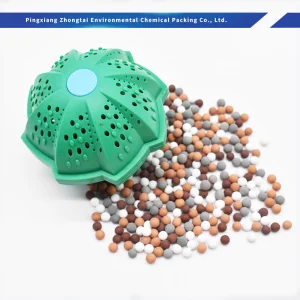
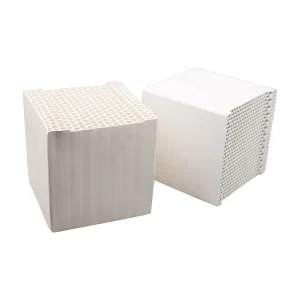
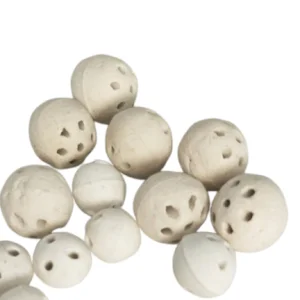
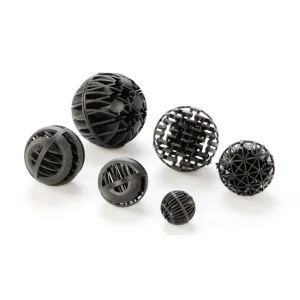
Complete line of environmental ceramics, plastic bio-media, high-flux metal packings, and catalytic support accessories.
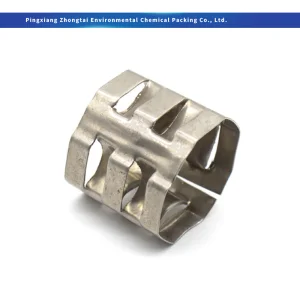
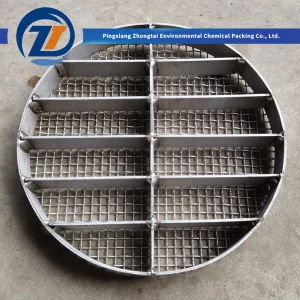
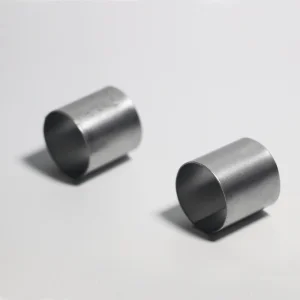
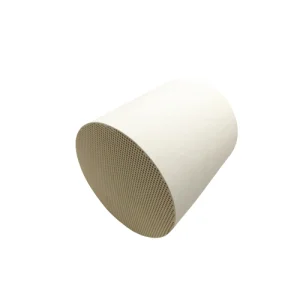
Detailed technical answers to common questions regarding alumina oxide ball selection, bed loading, and quality assurance.
Inert ceramic balls (typically containing 17% to 99% $\text{Al}_2\text{O}_3$) are designed specifically as catalyst support and covering media in chemical reactors and absorption towers. Their primary function is to provide physical support, withstand thermal shocks, distribute fluids evenly, and prevent catalyst bed migration, without reacting with process gases or liquids.
High-alumina grinding balls (typically containing 92% to 99% $\text{Al}_2\text{O}_3$) are engineered for ultra-high hardness (Mohs 9), high bulk density (≥3.60 $\text{g/cm}^3$), and low wear loss (≤0.01%). They are used as grinding media inside ball mills to crush raw materials like glaze, minerals, quartz, and electronic ceramics through high-impact kinetic force.
The choice depends primarily on operating temperature, presence of high-pressure steam, and downstream catalyst sensitivity to silica ($\text{SiO}_2$):
Standard engineering practice dictates using a 2:1 ratio rule between adjacent layers to prevent smaller particles from sifting into larger void spaces below. A typical reactor bed arrangement from top to bottom includes:
Every batch of alumina spheres produced in our Pingxiang facility undergoes hydraulic compression testing on an automated press per ASTM C510 standards. Samples are tested individually to measure the peak compressive force (in kN or lbs/ball) required to fracture the sphere. Additional quality controls include measuring water absorption, bulk density, thermal shock resistance (heating to 800°C followed by cold water quenching), and X-Ray Fluorescence chemical composition analysis.
We provide multiple heavy-duty export packaging options engineered to withstand sea freight and site storage:
Yes. In addition to standard solid inert spheres (ranging from 1mm up to 50mm diameter), we produce Porous Alumina Ceramic Balls designed with controlled macro-porosity (20% to 45% porosity) for specialized catalyst carrier and filtration duties. Custom chemical formulations (e.g., specific silica, titania, or zirconia modifications) can be custom-compounded and fired to meet proprietary engineering specifications.
