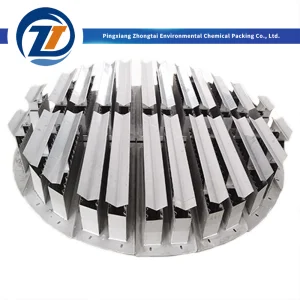
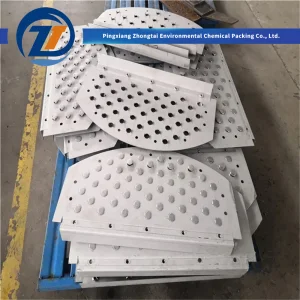
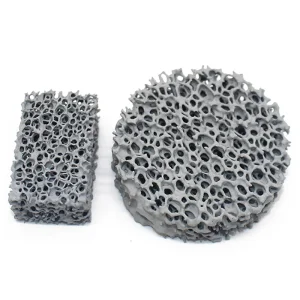
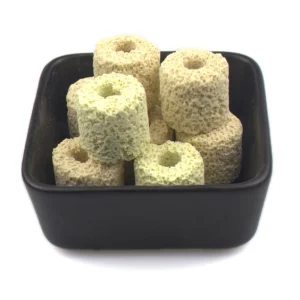
Explore our specialized chemical packing, structured tower internals, and high-performance molecular sieves manufactured under ISO 9001:2015 quality standards.
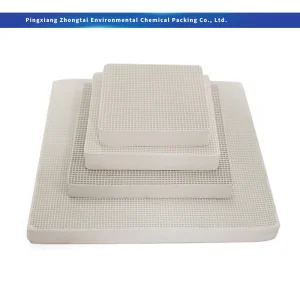
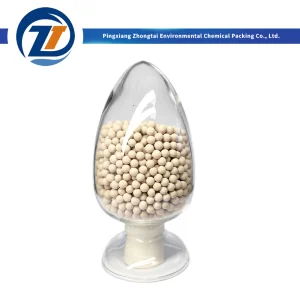
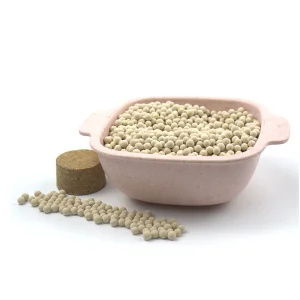
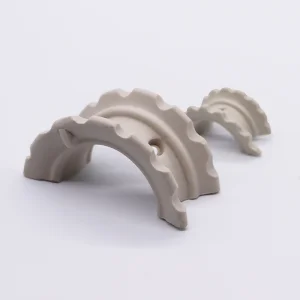
Understanding the structural advantages of NaX synthetic faujasite in high-severity industrial separation beds.
In modern chemical process engineering, 13X Molecular Sieve Desiccant represents the sodium form of the Type X synthetic zeolite framework (Faujasite - FAU structure). Characterized by an effective nominal pore opening of approximately 10 Angstroms (1.0 nm), 13X molecular sieves possess the largest pore volume among standard alkali metal aluminosilicates. The chemical unit cell composition is precisely defined as:
Na86[(AlO2)86(SiO2)106] · xH2O
SiO₂ / Al₂O₃ Molar Ratio ≈ 2.3 – 2.5 | Nominal Cage Pore Opening: 10 Å
Unlike Type 3A, 4A, or 5A molecular sieves which belong to the LTA (Linde Type A) crystal structure with supercage apertures between 3 Å and 5 Å, the FAU structure of 13X features a 12-membered ring system giving access to a spacious supercage with a diameter of 13 Å. This physical geometry allows 13X to adsorb all molecules capable of being trapped by 3A, 4A, and 5A sieves, while additionally co-adsorbing larger molecular species such as aromatic hydrocarbons, branched chain species, organic sulfur compounds (mercaptans, thiophenes), and carbon dioxide (CO₂).
The high static and dynamic water adsorption capacity of 13X desiccant (typically reaching ≥ 27.0 wt% at 25°C and 75% Relative Humidity) stems from the high density of accessible Na+ cations located at Site I', Site II, and Site III within the faujasite supercage. These cations create localized electrostatic fields that induce strong dipole and quadrupole interactions with polar molecules (such as H₂O, H₂S, and NH₃) as well as quadrupolar molecules like CO₂.
During continuous bed operations, the Mass Transfer Zone (MTZ) for 13X is sharp and narrow, enabling deep drying to gas dew points below -80°C (-112°F). This rapid mass transfer kinetics minimizes premature breakthrough in dual-bed Temperature Swing Adsorption (TSA) and Pressure Swing Adsorption (PSA) systems.
| Desiccant / Adsorbent Type | Pore Diameter (Å) | Bulk Density (g/mL) | Equilibrium Water Capacity (25°C, 75% RH) | Primary Industrial Co-Adsorbates | Thermal Regeneration Temp Range |
|---|---|---|---|---|---|
| 13X Molecular Sieve (NaX) | ~10.0 Å | 0.62 – 0.68 | ≥ 27.0 wt% | H₂O, CO₂, H₂S, Mercaptans, Aromatics | 200°C – 310°C (392°F – 590°F) |
| 4A Molecular Sieve (NaA) | ~4.0 Å | 0.68 – 0.72 | ≥ 21.5 wt% | H₂O, CO₂, NH₃, H₂S | 200°C – 250°C (392°F – 482°F) |
| 5A Molecular Sieve (CaA) | ~5.0 Å | 0.69 – 0.73 | ≥ 21.5 wt% | H₂O, n-Paraffins, CO₂ | 200°C – 250°C (392°F – 482°F) |
| Activated Alumina (γ-Al₂O₃) | 20 – 50 Å (Macroporous) | 0.68 – 0.75 | ≥ 14.0 wt% (at 60% RH) | H₂O (Free water droplets, macro-moisture) | 160°C – 220°C (320°F – 428°F) |
| Silica Gel (Type A) | 20 – 30 Å | 0.70 – 0.80 | ≥ 30.0 wt% (at 90% RH) | H₂O (Non-cryogenic, standard air drying) | 120°C – 150°C (248°F – 302°F) |
Key structural shifts in energy transition, clean gas processing, and healthcare infrastructure shaping global procurement strategies.
As liquefied natural gas (LNG) production expands globally to support cleaner transition energy, feed-gas specifications require CO₂ concentration levels below 50 ppmv and H₂O levels below 0.1 ppmv to eliminate cryogenic heat-exchanger freeze-out. 13X molecular sieves serve as the primary adsorbent in the Acid Gas Removal Unit (AGRU) polishers and front-end dehydration beds worldwide.
The surge in electrolyzer deployments and biomass gasification facilities has escalated requirements for ultra-pure hydrogen fuel cell gas. 13X molecular sieve beds are extensively deployed in Temperature Swing Adsorption (TSA) units to remove trace oxygenates, moisture, and carbon oxides, ensuring fuel-cell grade purity (ISO 14687 Grade D compliance).
Post-pandemic healthcare infrastructure modernization and industrial steel/glass oxygen enrichment projects demand high-efficiency Nitrogen/Oxygen separation. Modified 13X molecular sieves (including Lithium-exchanged 13X-HP variants) provide enhanced N₂ Henry’s law selectivity, enabling compact, low-power-consumption PSA/VPSA oxygen concentrators.
Inside Pingxiang Zhongtai’s continuous automated synthesis facility: Delivering structural purity, mechanical crush strength, and uncompromised supply security.
Located in Pingxiang, Jiangxi Province—China’s epicenter for chemical packing and industrial ceramics—our facility utilizes direct pipeline feeding of high-purity sodium silicate and aluminum hydroxide. This vertical integration isolates global enterprise buyers from intermediate cost volatility while guaranteeing consistent SiO₂/Al₂O₃ molar stoichiometry.
Our 120-meter automated continuous tunnel kilns utilize closed-loop SCADA temperature tracking across multi-stage hydrothermal crystallization, binder compounding, and thermal activation (450°C – 600°C). This guarantees uniform bead shape factor, eliminates micro-fissures, and elevates mechanical crush strength to > 85 N/bead for 3-5mm sizes.
To prevent atmospheric hydration during transoceanic transit, all wholesale orders are packed in airtight 55-gallon steel drums (150 kg net) with inner sealed polyethylene liners, double-bagged 25 kg carton boxes, or nitrogen-blanketed 1000 kg super sacks on ISPM-15 compliant heat-treated pallets.
How procurement managers and chemical engineering teams can evaluate wholesale suppliers to eliminate catastrophic vessel dusting and early bed degradation.
While initial purchasing cost per metric ton is a baseline metric, real plant profitability depends on Bed Service Life and Energy Consumption during Thermal Regeneration.
Inferior molecular sieves with weak clay binder systems suffer from rapid binder degradation under thermal cycling (250°C to 25°C every 8 hours). This results in void fraction clogging, elevated bed pressure drop ($\Delta P$), increased compressor power consumption, and premature bed replacement down to 18 months.
Zhongtai’s engineered attapulgite/kaolin binder technology retains crystal structural integrity over 4,000+ thermal regeneration cycles, reliably extending bed operating lifetimes past 5 to 7 years in benchmarked petrochemical installations.
Detailed operational parameters for core processing industries utilizing wholesale 13X molecular sieve beads and pellets.
Process Objective: Simultaneous co-removal of ambient moisture (H₂O), carbon dioxide (CO₂), acetylene (C₂H₂), and trace hydrocarbons prior to cryogenic distillation columns.
Configuration: Dual-bed PSA or TSA system.
Operating Pressures: Adsorption at 0.5 – 0.9 MPa; Regeneration at ambient pressure with heated dry nitrogen purge (180°C – 220°C).
Recommended Product Form: 13X Spherical Beads (3.0 – 5.0 mm or 1.6 – 2.5 mm) for minimal flow restriction and maximum dynamic bed capacity.
Process Objective: Dehydration of wet natural gas streams to prevent hydrate formation in pipelines while selectively removing sour gas components (H₂S, mercaptans R-SH, and COS).
Configuration: Multi-bed TSA arrangement operating under high feed pressures (up to 8.0 MPa).
Performance Metric: Effluent water down to < 0.1 ppmv; H₂S co-adsorption capacity maintained without catalyst poisoning or side-reaction mercaptan conversion.
Recommended Product Form: High crush-strength 13X Cylindrical Pellets (1/16 inch / 1.6mm) or 1/8 inch (3.2mm).
Process Objective: Deep dehydration of liquid feedstock including LPG, butane, propane, aromatics (benzene, toluene, xylene), and refined olefin cuts before catalytic isomerizers or polymerization reactors.
Engineering Note: Requires careful bed packing using high-density loading methods (such as sock loading or dense loading) to avoid liquid channelling.
Recommended Product Form: 13X 1.6mm – 2.5mm Spherical Beads to optimize liquid mass transfer coefficients.
Process Objective: Selective adsorption of Nitrogen (N₂) over Oxygen (O₂) from clean compressed air to yield medical-grade oxygen output (93% ± 3% concentration).
Configuration: Rapid-cycle Pressure Swing Adsorption (PSA) or Vacuum Pressure Swing Adsorption (VPSA).
Key Advantage: Fast desorption kinetics during depressurization cycle guarantees low power consumption and high N₂ working capacity.
Recommended Product Form: Specialized 13X-HP / 13X-O2 High-Purity Beads (0.4 – 0.8 mm or 1.6 – 2.5 mm).
Expert technical answers regarding regeneration procedures, structural stability, storage guidelines, and supplier evaluation.
Explore our full catalog of liquid distributors, valve trays, random packings, and specialized biological filtration media.