Engineered by Pingxiang Zhongtai Environmental Chemical Packing Co., Ltd. for maximum hydrodynamic performance and process longevity.
An authoritative analysis of molecular sieve dehydration mechanics, pore size selectivity, and adsorption kinetic equilibrium.
In industrial organic chemical synthesis and fuel ethanol refining, separating water from ethanol represents one of the most energy-intensive thermodynamic challenges. At atmospheric pressure (101.3 kPa), ethanol and water form a constant-boiling azeotropic mixture at approximately 95.63% ethanol by weight (97.2% by volume), boiling at a constant temperature of 78.15°C. Conventional fractional distillation cannot breach this thermodynamic boundary to produce anhydrous ethanol (>99.5% purity) because the vapor phase and liquid phase compositions become identical.
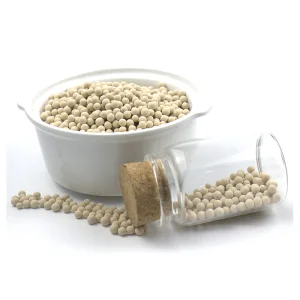
Historically, chemical refineries employed ternary azeotropic distillation using entrainers such as benzene, cyclohexane, or ethylene glycol. However, these traditional methods suffer from high parasitic thermal energy demand, environmental toxicity, heavy capital expenditure, and trace chemical contamination in the final ethanol output. The modern standard across global bio-ethanol and industrial chemical plants relies on Vapor-Phase Pressure Swing Adsorption (PSA) utilizing synthetic 3A molecular sieves (crystalline potassium-aluminosilicates).
The chemical formula of 3A molecular sieve zeolite is typically expressed as:
$\text{K}_{n} \text{Na}_{12-n} [(\text{AlO}_2)_{12} (\text{SiO}_2)_{12}] \cdot x\text{H}_2\text{O} \quad (n \approx 4 \text{ to } 6)$
By substituting sodium ions ($\text{Na}^+$) in Type 4A zeolite with larger potassium ions ($\text{K}^+$) through ion exchange, the effective cage aperture is restricted from 4Å down to 3Å. This structural tuning ensures zero co-adsorption of ethanol, maximizing working water capacity and eliminating side reactions such as catalytic ethanol dehydration to diethyl ether or ethylene under elevated operating temperatures.
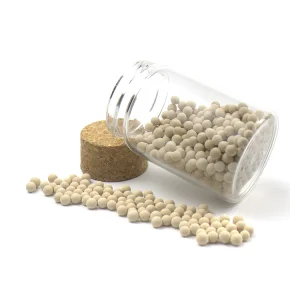
Direct technical comparison across standard commercial mesh sizes manufactured for ethanol dehydration plants.
| Technical Parameter | Spherical (3-5 mm / 4-8 Mesh) | Spherical (1.6-2.5 mm / 8-12 Mesh) | Extrudate (1.6 mm & 3.2 mm Pellets) |
|---|---|---|---|
| Primary Application | Deep beds in massive bio-ethanol PSA vessels | Fast-cycle PSA / VSA ethanol dehydration beds | High-velocity vapor flow industrial columns |
| Bulk Density (g/mL) | 0.68 – 0.74 | 0.70 – 0.76 | 0.66 – 0.72 |
| Crush Strength (N/bead or particle) | ≥ 85 N / bead | ≥ 45 N / bead | ≥ 35 N / pellet |
| Static Water Adsorption (25°C, RH 60%) | ≥ 21.5 wt% | ≥ 21.5 wt% | ≥ 20.5 wt% |
| Ethanol Co-Adsorption Ratio | < 0.2 wt% (Negligible) | < 0.2 wt% (Negligible) | < 0.25 wt% (Negligible) |
| Attrition Rate (% weight) | ≤ 0.05% | ≤ 0.08% | ≤ 0.10% |
| Regeneration Temperature Range | 200°C – 250°C (392°F – 482°F) | 200°C – 250°C (392°F – 482°F) | 200°C – 250°C (392°F – 482°F) |
| Residual Moisture (Package Export) | ≤ 1.0 wt% | ≤ 1.0 wt% | ≤ 1.0 wt% |
How high-performance 3A molecular sieves reduce steam consumption by up to 40% in commercial biorefineries.
Industrial bio-ethanol plants run continuous cyclic operations. Bed A operates in adsorption mode under pressure (typically 0.2 to 0.4 MPa vapor feed), removing water molecules down to <0.1% moisture. Simultaneously, Bed B undergoes thermal purge and vacuum regeneration. Pingxiang Zhongtai’s high thermal stability 3A zeolite maintains its crystal frame through millions of swing cycles.
Replacing older benzene/cyclohexane entrainer distillation columns with 3A molecular sieve beds drops process energy demands significantly. The superheated ethanol-water vapor feed (115°C–130°C) directly enters the molecular sieve vessel. Condensation heat from regenerated vapor streams is recaptured for pre-evaporation, delivering up to 40% thermal energy efficiency gains.
Repeated contact with high-temperature steam can degrade poor-quality zeolites, leading to binder breakdown, structural collapse, and dust carryover. Zhongtai's kaolin-clay synthesized binder system ensures ultra-low attrition (<0.05%), preserving bed pressure drop ($\Delta P$) over 3 to 5 years of continuous operational life.
Why leading ethanol distilleries across North America, South America, Europe, and Asia choose Chinese 3A zeolite suppliers.
Governments worldwide enforce renewable fuel standards (RFS) requiring gasoline blending with anhydrous fuel ethanol. Water content must strictly remain under 0.5% wt (ASTM D4806) to prevent phase separation in automotive engines. 3A molecular sieves represent the only economically viable technology to achieve this scale reliably.
Pharmaceutical formulations, sanitizers, and botanical extraction processes demand 99.9% pure alcohol free from chemical entrainers. Benzene contamination from legacy distillation methods is strictly banned under United States Pharmacopeia (USP) and European Pharmacopoeia (EP) guidelines. Molecular sieve physical adsorption guarantees pure, non-toxic processing.
Pingxiang, Jiangxi Province is recognized as China's industrial ceramic and packing capital. By sourcing directly from integrated manufacturers like Pingxiang Zhongtai, global EPC contractors and biorefineries reduce chemical adsorbent procurement budgets by 25–40% without compromising technical performance.
Engineered formulations suited for diverse ethanol feedstocks and specialized solvent recovery tasks.
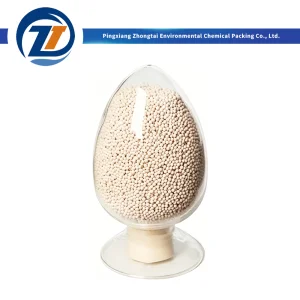
Large-scale continuous dry-mill and wet-mill corn ethanol facilities processing 50 to 100+ million gallons annually. Uses 3-5mm beads in massive multi-bed configurations to handle continuous vapor flows.
Common in Brazil, India, and Southeast Asia. Molecular sieves engineered to withstand minor organic acid vapors and trace aldehydes resulting from cane juice fermentation.
Recycle drying of cold-ethanol solvent streams used in botanical oil extractions. 3A sieves restore recovered ethanol from 92% back to 99.9% purity at low temperatures.
Ultra-clean 3A sieves washed and calcined to prevent micro-particle shedding, delivering ultra-dry anhydrous solvents for microelectronics rinsing.
Advancements in zeolite synthesis driving the next decade of decarbonized bio-refining.
Eliminating traditional 20% clay binder content by converting inert clay directly into active crystalline zeolite framework. Yields 15–20% higher dynamic water capacity per vessel volume.
Utilizing multi-cation exchange algorithms ($\text{K}^+ / \text{Na}^+ / \text{Ca}^{2+}$ ratios) to create hyper-uniform pore openings of exactly 2.9Å for ultra-fast water diffusion kinetics.
Integrating vapor pervaporation polymeric membranes with downstream 3A molecular sieve polishers to optimize energy profiles for zero-carbon ethanol plants.
Nanoscale surface modifications that prevent organic fouling, tar deposition, and coking when handling crude unrectified fermentation vapors.
How Pingxiang Zhongtai Environmental Chemical Packing Co., Ltd. ensures zero-defect batch delivery globally.
Every batch of 3A zeolite adsorbent undergoes automated mixing, extrusion/spheronization, low-temperature drying, and high-temperature calcination under strict ISO digital quality control systems.
Shipments are verified in our laboratory for Crush Strength (ASTM D4179), Attrition and Dusting (ASTM D4058), Bulk Density (ASTM D4180), and Water Adsorption Capacity (ASTM E1893).
To prevent atmospheric pre-adsorption during ocean transit, our sieves are packed in 25 kg air-tight steel drums with inner vacuum plastic liners, or 1000 kg moisture-proof super sacks with bottom discharge spouts.
Detailed technical responses compiled by Senior Process Engineers at Zhongtai Packing.
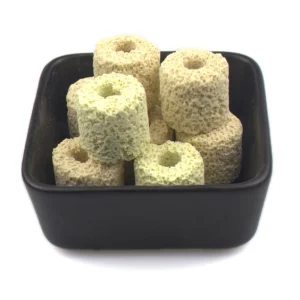
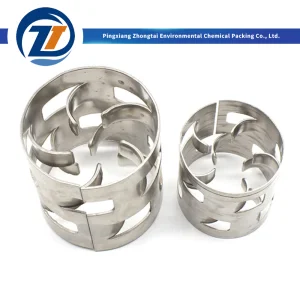
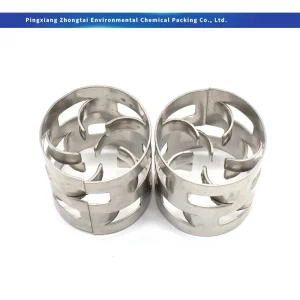
Explore our full line of random tower packings, ceramic support balls, and environmental filtration media.

Our technical engineering team in Pingxiang provides detailed vessel charge sizing, pressure drop calculations, and sample evaluations for ethanol biorefineries worldwide.