Engineered random packings, catalyst bed supports, and synthetic zeolites manufactured under ISO 9001 certified batch-level control.
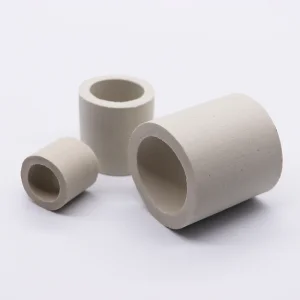
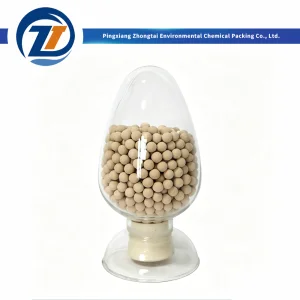
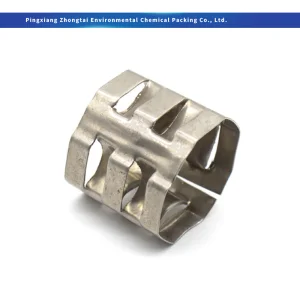
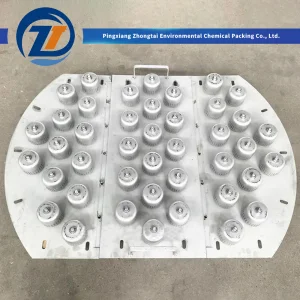
Strategic deployment of ceramic conjugate rings in modern mass transfer columns, acid recovery plants, and extreme corrosive environments.
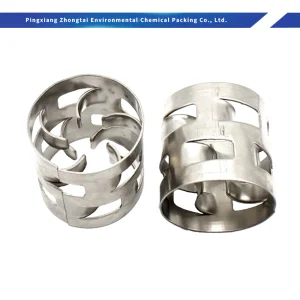
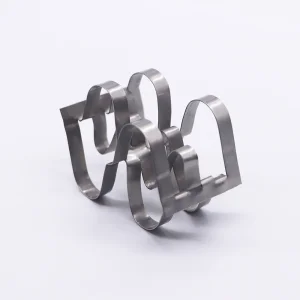
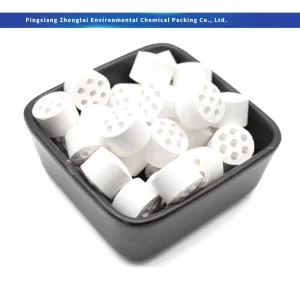
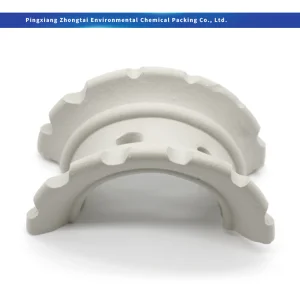
In modern chemical processing, fractional distillation, and corrosive absorption columns, the choice of random tower packing dictates the thermodynamic efficiency, continuous operating run-lengths, and capital expenditure of the entire production plant. The Ceramic Conjugate Ring represents a major evolutionary leap beyond traditional cylindrical Raschig rings and conventional saddles. Engineered with an aerodynamic wavy profile, an internal cross-ribbed skeleton, and curled edges, the conjugate ring eliminates static liquid stagnation zones, prevents premature flooding, and promotes continuous boundary-layer renewal on both inner and outer surfaces.
Globally, stringent environmental regulations regarding acid mist abatement, $SO_2$ scrubbing, and VOC capture have driven massive revamping projects across North America, Europe, the Middle East, and the Asia-Pacific region. Chemical processing units demand tower internals that can withstand aggressive oxidative acids—such as boiling sulfuric ($H_2SO_4$), concentrated nitric ($HNO_3$), and hydrochloric acid ($HCl$)—where metallic packings pit, stress-crack, or oxidize, and polymer media melt or decompose. China, and specifically the Pingxiang industrial cluster in Jiangxi Province, produces over 70% of the world's chemical porcelain random and structured packings. Supported by proprietary kaolinite clay reserves, automated tunnel kilns with precise multi-zone firing curves, and established testing standards like ASTM C515 and HG/T 4369, Chinese manufacturers provide the global market with unparalleled cost-to-performance efficiency and supply chain scalability.
Pingxiang's end-to-end industrial ecosystem ensures consistent raw silicate sourcing, continuous batch milling, and computerized shuttle kilns, eliminating transatlantic and transpacific lead-time bottlenecks.
Constructed from high-vitrified feldspathic aluminosilicate porcelain, ceramic conjugate rings offer chemical inertness against almost all inorganic and organic acids except hydrofluoric ($HF$).
The conjugated profile combines the structural rigidity of a ring with the hydrodynamic flow channels of a saddle, drastically mitigating gas-channelling along column shell walls.
Decoupling mass transfer mechanisms: Why conjugate geometry outperforms standard cylindrical and saddle packings.
In packed tower operation, the ultimate goal is maximizing the effective interfacial area ($a_e$) between the rising gas stream and descending liquid film while minimizing pressure drop ($\Delta P$). In first-generation Raschig rings, liquid tends to cling to the inner wall, forming stagnant thick films with low mass-transfer rates, while vapor bypasses through voids, causing premature flooding. Even second-generation Berl and Intalox saddles, while improving gas passage, frequently suffer from "nesting"—where identical saddles interlock, drastically collapsing the bed void fraction and creating localized liquid puddles.
The Ceramic Conjugate Ring addresses these phenomena through a symmetrical curved-flange profile with an internal arch-like partition. When vapor flows through the packed bed, the conjugate ring splits the gas into vortex streams, creating high-frequency micro-turbulence that repeatedly strips away the liquid boundary layer. This enhances the liquid-phase mass transfer coefficient ($k_L$) and gas-phase mass transfer coefficient ($k_G$). Furthermore, because the curved outer flanges maintain point-to-point contact rather than surface-to-surface stacking, conjugate rings prevent bed nesting, ensuring a stable, reproducible bulk density throughout tall commercial beds.
| Packing Type | Nominal Size (mm) | Geometric Surface Area ($m^2/m^3$) | Void Fraction ($\%$) | Bulk Density ($kg/m^3$) | Relative $\Delta P$ (mbar/m) | Relative HETP Efficiency |
|---|---|---|---|---|---|---|
| Ceramic Conjugate Ring | 50 | 115 – 130 | 74 – 78 | 520 – 580 | 1.8 – 2.4 (Lowest) | Baseline + 35% (Optimal) |
| Ceramic Intalox Saddle | 50 | 110 – 120 | 70 – 74 | 560 – 620 | 2.6 – 3.2 | Baseline + 20% |
| Ceramic Pall Ring | 50 | 100 – 115 | 72 – 76 | 540 – 600 | 2.4 – 3.0 | Baseline + 18% |
| Ceramic Raschig Ring | 50 | 90 – 95 | 68 – 72 | 650 – 720 | 3.8 – 5.1 (Highest) | Baseline Standard |
| Ceramic Conjugate Ring | 38 | 145 – 165 | 72 – 76 | 580 – 640 | 2.2 – 3.1 | High Theoretical Stages |
| Ceramic Intalox Saddle | 38 | 140 – 150 | 68 – 72 | 630 – 690 | 3.2 – 4.1 | Moderate High Stages |
Precision aluminosilicate porcelain compounding engineered to endure severe mechanical loads and extreme thermal cycles.
Standard industrial grade: 17–23% $Al_2O_3$, 70–75% $SiO_2$. Extremely dense microcrystalline structure ideal for general acid drying and scrubbing operations.
Reinforced grade: 30–45% $Al_2O_3$. Formulated for elevated crush strength in deep beds (>12 m) and severe pressure pulsations in gas-stripping columns.
Specialized low-expansion ceramic for severe thermal fluctuations ($\Delta T > 250^\circ\text{C}$). Eliminates spalling and structural fractures in incinerators and RTO units.
Every lot undergoes automated crush testing, water absorption testing (<0.5%), and 48-hour sulfuric acid boiling tests per ASTM C279 specifications.
Field-proven performance inside world-scale chemical synthesis, fertilizer production, and environmental scrubbing towers.
In modern double-absorption sulfuric acid plants, drying towers and $SO_3$ absorption columns operate under aggressive conditions: 93–98.5% concentrated sulfuric acid at temperatures between 75°C and 125°C. Traditional packings frequently experience high gas-side pressure drop, leading to huge blower energy consumption and acid mist carryover that ruins downstream heat exchangers.
Zhongtai Engineering Solution: By replacing standard 76mm ceramic Raschig rings with 50mm Ceramic Conjugate Rings, plants achieve a 40% reduction in tower differential pressure while increasing the gas throughput capacity by 22%. The enhanced wetting characteristics eliminate dry spots, preventing local acid vaporization.
Acid gas removal systems utilizing physical or chemical solvents (such as cold methanol or formulated amines like MDEA) require robust mass transfer to strip high concentrations of $H_2S$ and $CO_2$ under severe pressures (30–65 bar). Trace presence of chlorides, organic sulfur, and organic acids promotes stress-corrosion cracking in conventional stainless-steel internals.
Zhongtai Engineering Solution: High-purity chemical porcelain conjugate rings provide absolute immunity to sulfide stress cracking ($SSC$) and chloride pitting. Their superior radial dispersion profile distributes the heavy solvent evenly across cross-sections up to 6 meters in diameter, maintaining high purification targets (<1 ppm $H_2S$).
Hazardous waste incinerators, pigment manufacturing plants, and metallurgical smelters generate off-gases laden with moist chlorine ($Cl_2$), hydrochloric acid ($HCl$), and sulfur dioxide ($SO_2$) at temperatures above 180°C. Standard polypropylene and PVDF packings warp or degrade under thermal spikes, while exotic alloys like Hastelloy C-276 represent prohibitive capital expenses.
Zhongtai Engineering Solution: Ceramic conjugate rings bridge the gap between temperature resilience and chemical resistance. Their self-cleaning, open geometry resists particulate fouling and scale build-up from dirty scrubber water, drastically extending plant uptime between chemical clean-in-place ($CIP$) routines.
The convergence of carbon capture, computational fluid dynamics (CFD), and next-generation ceramic formulations (2025–2035).
As the international process industries transition toward net-zero targets, the demand for high-efficiency mass-transfer media has shifted from conventional refining toward massive Carbon Capture, Utilization, and Storage (CCUS) complexes and green hydrogen syngas purification. In these giant post-combustion capture towers (often exceeding 10 meters in diameter), saving even 1 mbar of gas pressure drop translates into millions of dollars in annual fan electrical power savings.
Development of laser-etched and micro-porous surface coatings that promote super-wettability, forcing liquid films to spread into sub-millimeter thickness for higher interfacial mass transfer area.
Integration of machine-learning multiphase hydrodynamic simulations to tailor localized ring dimensions and wall thicknesses based on specific tower height segments and vapor-liquid loading gradients.
Conversion of factory high-temperature shuttle and tunnel kilns to green-hydrogen and electric plasma heating, slashing the embodied carbon footprint of exported chemical ceramics by >85%.
Direct incorporation of nano-catalyst precursors (e.g., transition metal oxides) inside the ceramic ring matrix, enabling single-stage reactive absorption and catalytic decomposition inside mass transfer beds.
A procedural engineering guide for process engineers, column designers, and EPC procurement managers.
Select nominal ring size based on the ratio of tower diameter to packing dimension ($D/d$). Ensure $D/d > 10\text{–}12$ to prevent wall channeling. Utilize exact experimental packing factors ($F_p$) in Generalized Pressure Drop Correlations (GPDC) to pinpoint the hydraulic flooding velocity ($u_{flood}$) with a typical safety operating margin of 70–80%.
Even the most efficient conjugate packing fails if liquid is poorly distributed. Specify gravity-trough or pressurized pan liquid distributors providing at least 100 to 150 pour points per square meter. The bottom packing support plate must possess at least 85% free open area to avoid creating an artificial hydraulic bottleneck beneath the bed.
Always load ceramic packings using the "wet dumping" method (filling the column partially with water or non-corrosive liquid prior to loading) or utilizing lowering buckets with decelerator flaps. This eliminates ring breakage during the drop. Cap tall beds with ceramic hold-down grids to prevent ring dislodgement during process surges.
Detailed technical answers for chemical plant designers, purchasing managers, and process operations teams.
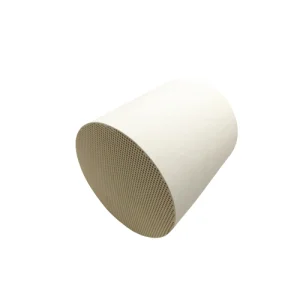
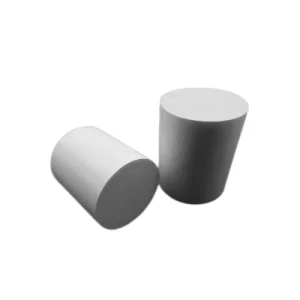
Explore our full manufacturing suite spanning metallic packings, high-duty honeycomb ceramics, and hydraulic proppants.