Precision-engineered ceramic balls, random packings, and structured internals for extreme process environments.
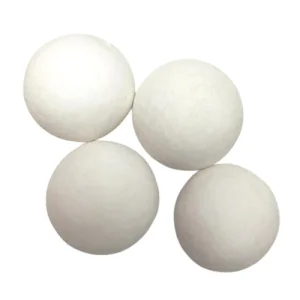
In the global chemical process industries (CPI), the bed support media positioned beneath expensive catalyst layers represents a critical single point of protection. Ceramic balls—specifically inert alumina spheres—serve as covering and bed support media for catalysts in reactors, hydrotreaters, reformers, and absorption columns. China has emerged as the dominant global manufacturing hub for industrial ceramic media, with the cluster in Pingxiang, Jiangxi Province, standing at the apex of material science innovation, raw material control, and continuous thermal processing.
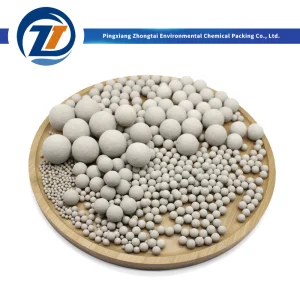
Modern ball ceramic manufacturing in China has transitioned from empirical hand-crafting to ultra-precise, digitalized sintering processes. High-grade bauxite and high-purity synthetic alumina powder ($\alpha$-$\mathrm{Al_2O_3}$) are cold-isostatically pressed or wet-pelletized under high pressure, followed by high-temperature sintering in automated tunnel kilns reaching up to 1750°C. The resultant products demonstrate exceptional mechanical crush strength, high thermal shock resistance, chemical inertia against aggressive acid-base matrices, and ultra-low silica leaching levels required by modern refining standards.
The primary function of an inert ceramic sphere is to withstand grueling hydrodynamic forces, thermal cycling, and chemical degradation inside fixed-bed reactors. Key performance metrics are directly tied to phase composition during firing. In 99% high-alumina formulations, the complete transformation of precursor powders into stable, fully dense Alpha-Alumina ($\alpha$-$\mathrm{Al_2O_3}$) phase eliminates free silica ($\mathrm{SiO_2}$). Free silica is vulnerable to high-temperature steam leaching, which leads to downstream equipment fouling and catalyst poisoning in steam reformers and ammonia synthesis units.
For standard medium-alumina ceramic balls (17% to 30% $\mathrm{Al_2O_3}$ content), raw kaolinitic clays and feldspars undergo solid-state reactions to yield a tightly bound mullite ($\mathrm{3Al_2O_3\cdot 2SiO_2}$) and glass-phase matrix. Chinese chemical packing engineering has optimized this grain boundary structure, lowering water absorption to below 0.5% while achieving uniform microstructural density free of internal void flaws.
Ideal for cost-effective catalyst support in standard hydroprocessing, chemical absorption towers, and acid drying units where silica sensitivity is low.
Delivers elevated crush strength and thermal resilience for high-pressure gas scrubbers, shift converters, and heavy chemical reactors.
Engineered for high wear environments, severe thermal shock applications, and heavy ball mill wet/dry ultrafine grinding media duty.
Zero silica leaching. Designed specifically for steam reforming, ethylene production, high-temperature secondary reformers, and platinum-group metal support.
Factory-direct pricing estimates, physical chemical compositions, and engineering design parameters for international procurement teams.
| Alumina Grade ($\mathrm{Al_2O_3}$) | Bulk Density ($\mathrm{g/cm^3}$) | Water Abs. (%) | Crush Strength (1/2" Ball) | Max Temp (°C) | Price Est. Range (FOB USD/MT) |
|---|---|---|---|---|---|
| 17% - 23% Standard Inert | 1.35 - 1.45 | < 1.0% | > 2.5 kN/particle | 1100°C | $280 - $420 / MT |
| 23% - 30% Medium Alumina | 1.40 - 1.55 | < 0.5% | > 3.8 kN/particle | 1250°C | $400 - $580 / MT |
| 92% High Alumina Grinding/Support | 2.10 - 2.25 | < 0.05% | > 12.0 kN/particle | 1550°C | $950 - $1,350 / MT |
| 99%+ Ultra-High Purity $\alpha$-Alumina | 2.20 - 2.40 | < 0.02% | > 18.0 kN/particle | 1750°C | $1,450 - $2,100 / MT |
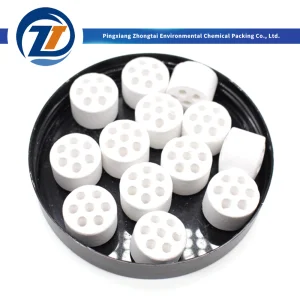
| Perforated / Porous Ceramic Sphere | 1.10 - 1.25 | Variable | > 2.0 kN/particle | 1200°C | $650 - $980 / MT |
* Note: Prices vary dynamically based on raw material market index (bauxite/calcined alumina rates), order volume, particle size gradient ($3\mathrm{mm}$ to $50\mathrm{mm}$), packaging types (jumbo bags, wooden drums, steel drums), and specific ASTM/ISO testing protocols requested.
Engineered media solutions deployed in critical chemical processing units across 60+ countries worldwide.
In Hydrodesulfurization (HDS), Hydrocracking, and Catalytic Reforming units, 99% $\alpha$-alumina balls serve as top hold-down beds to distribute vapor-liquid flow evenly and protect catalyst beds from pressure-drop spikes caused by particulate accumulation.
Ethylene plants rely on high-purity ceramic balls within acetylene hydrogenators and dryer beds. Zero-silica formulations prevent silica migration to downstream polymerizers, maintaining catalyst activity over extended multi-year run campaigns.
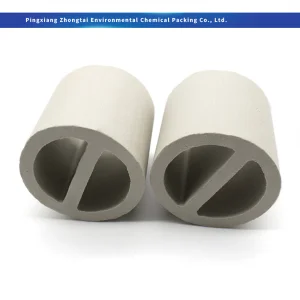
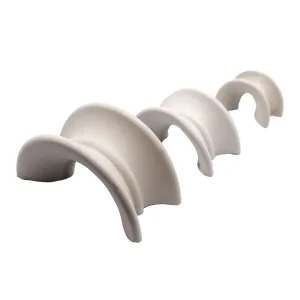
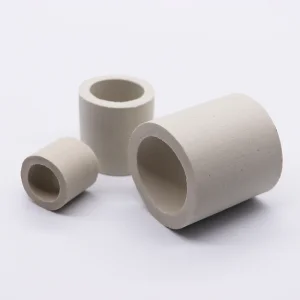
Acid-resistant ceramic Lessing rings, Intalox saddles, and ceramic balls operate reliably in primary absorption and drying towers, resisting violent attacks from $98\%$ concentrated $\mathrm{H_2SO_4}$ and oleum at temperatures exceeding $200^\circ\mathrm{C}$.
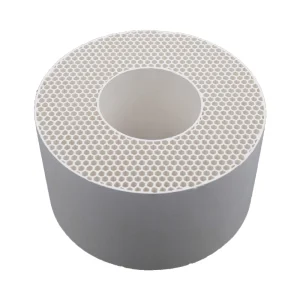
High-capacity honeycomb ceramics and ceramic saddles act as heat exchangers in Regenerative Thermal Oxidizers (RTO). Achieving thermal recovery efficiency up to 95%, they dramatically reduce fuel consumption in industrial off-gas treatment.
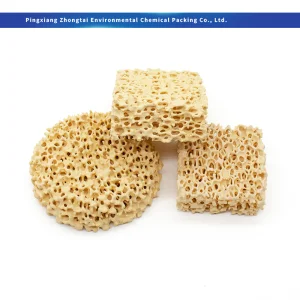
High-porosity alumina, silicon carbide (SiC), and zirconia ceramic foam filters remove non-metallic inclusion oxides from molten aluminum, iron, and steel castings, eliminating micro-defects in precision metallurgical components.
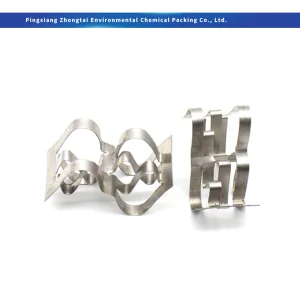
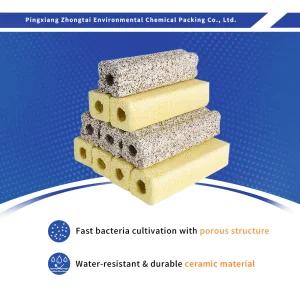
Specialized dechlorination ceramics, nitrifying bio-filter media, and plastic/metal random packings drive gas stripping, degassing, and biological filtration across municipal and industrial water treatment installations.
The concentration of raw mineral resources and chemical ceramic expertise in Pingxiang, Jiangxi, creates an unassailable supply chain advantage. Pingxiang's chemical packing cluster accounts for a substantial share of global industrial ceramic production. Modern Chinese manufacturers located within this ecosystem have integrated digital automation across every step of production.
Isostatic Pressing & Automated Granulation: Micro-grain alumina powder undergoes automated spray drying to create ultra-spherical granules with optimized binder distribution. Automated multi-cavity cold isostatic pressing (CIP) ensures equal multi-directional compaction, producing green ceramic spheres with completely uniform density, eliminating structural micro-cracks before kiln entry.
Continuous Digital Tunnel Kilns: Temperature profiles across pre-heating, sintering (up to 1750°C), and controlled cooling zones are regulated via PLC feedback loops using infrared radiation sensors. This strict thermal control prevents thermal gradient stress, guaranteeing that every batch achieves specified physical density and zero open porosity.
Every production lot undergoes rigorous laboratory testing adhering to strict international standards prior to dispatch:
Direct proximity to Ningbo, Shanghai, and Shenzhen ports enables seamless export logistics. Products are secured in heavy-duty double-walled cartons, poly-lined moisture-proof jumbo bags, or steel-banded fumigated wooden cases designed to withstand ocean transit and rough site handling.
Procuring ceramic media and column internals for large-scale engineering, procurement, and construction (EPC) projects requires more than off-the-shelf product delivery. Leading Chinese manufacturers provide end-to-end technical support services tailored to global plant operators.
Engineering simulation of packed bed hydraulics, calculation of flooding velocities, pressure drop ($\Delta P$), and liquid holdup for custom mass transfer columns.
Graded catalyst bed support schemes utilizing layered ceramic spheres (e.g., $1/8" \to 1/4" \to 1/2" \to 1" \to 2"$) to minimize bed pressure drop while maximizing fluid distribution.
Material safety certification ensuring products are completely free of hazardous heavy metals, meeting strict European Union chemical import standards.
Seamless integration with international inspection agencies (SGS, BV, Intertek, TÜV) for pre-shipment sampling, dimensional verification, and crush testing.
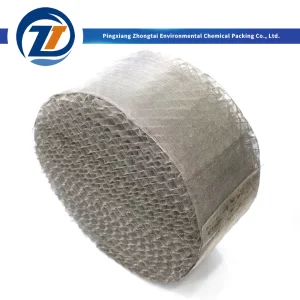
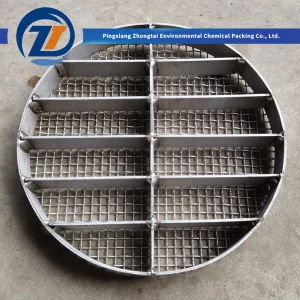
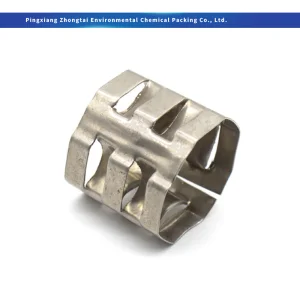
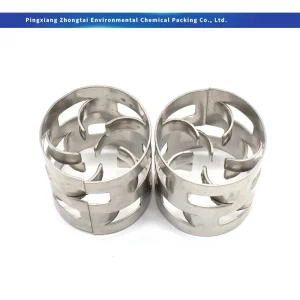
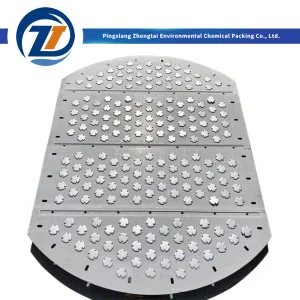
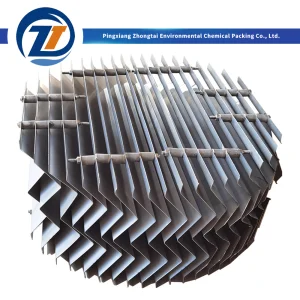
Explore our full line of metal packings, mist eliminators, catalyst supports, and bio-filtration solutions.
Deep-dive solutions for chemical engineers, procurement heads, and plant maintenance directors.
