Manufactured under strict statistical process control within our Pingxiang manufacturing base, delivering comprehensive corrosion-proof solutions for scrubbing, dehydration, and bed support.
Exploring the physical chemistry of high-silica, low-flux ceramics engineered to resist destructive industrial acids and thermal cyclic exhaustion.
In modern high-temperature chemical synthesis, hydrometallurgy, petrochemical refining, and sulfuric acid manufacturing, the degradation of reaction vessels due to acidic corrosion presents one of the most critical threats to process uptime, structural integrity, and environmental safety. Acid-proof brick (also designated acid-resistant brick or chemical masonry tile) forms the primary sacrificial or permanent impervious barrier against mineral acids, oxidizing agents, and aggressive solvent environments. Founded in 2003 within Pingxiang, Jiangxi Province—widely acknowledged as China's premier cluster for advanced chemical packing and industrial ceramics—Pingxiang Zhongtai Environmental Chemical Packing Co., Ltd. has spearheaded the evolution from rudimentary red shale pavers to highly engineered, fully vitrified silica-alumina ceramic units.
The anti-corrosive efficacy of acid-proof brick is intrinsically governed by its mineralogical composition and the degree of vitrification achieved during kiln sintering. Standard industrial brick fails in aggressive chemical environments because of open capillary porosity, unbound basic oxides ($CaO, MgO$), and high iron oxide ($Fe_2O_3$) content that react vigorously with sulfuric, hydrochloric, and nitric acids. By contrasts, high-performance acid-proof bricks engineered by specialized Chinese manufacturers utilize raw formulations comprising 68% to 76% silicon dioxide ($SiO_2$), 22% to 28% aluminum oxide ($Al_2O_3$), and strictly curtailed alkali fluxes ($Na_2O + K_2O < 3.5\%$, with $Fe_2O_3 \le 1.0\%$).
As the international process sector transitions toward larger single-train facilities—such as 10,000-metric-ton-per-day sulfuric acid alkylation trains, phosphoric acid digesters, and high-pressure acid leach (HPAL) autoclaves for battery nickel extraction—the physical demands placed on acid-proof brick have shifted. Bricks are no longer merely passive chemical liners; they are structural components subjected to hydraulic surging, abrasive solid slurries, cyclic thermal shocks ($\Delta T > 150^\circ\text{C}$), and massive hydrostatic loads. Understanding the nuanced differences in material grades, dimensions, and jointing dynamics is essential for engineering procurement teams globally.
Micro-crystalline mullite structures embedded in pure vitreous silica ensure complete chemical impermeability against $H_2SO_4$, $HCl$, $HNO_3$, and dynamic chlorinated gases at extreme process temperatures.
Low linear thermal expansion coefficients ($\alpha_{20-1000^\circ\text{C}} \le 5.2 \times 10^{-6}/\text{K}$) prevent catastrophic surface spalling and interlaminar cleavage during rapid plant restarts and thermal cycling.
Cold compressive strength exceeding 100–120 MPa empowers multi-course vertical column masonry and floor pavements subject to heavy vehicular wheel loads, forklift traffic, and autoclave agitations.
A multi-standard engineering comparative matrix for EPC contractors, process engineers, and plant procurement managers specifying chemical masonry.
| Standard Parameter | ASTM C279 (Type I) | ASTM C279 (Type II) | ASTM C279 (Type III) | DIN 28062 (Group 1) | GB/T 8488 (Class I) |
|---|---|---|---|---|---|
| Primary Intended Service | Severe thermal shock with chemical resistance | Standard chemical service, moderate thermal shock | Maximum chemical resistance, lowest absorption | High chemical resistance & abrasion resistance | Severe industrial acid duty & tower masonry |
| Acid Solubility (Sulfuric Acid Boil) | ≤ 2.50% | ≤ 4.00% | ≤ 1.50% | ≤ 1.20% | ≤ 1.00% |
| Apparent Porosity / Absorption | ≤ 8.0% | ≤ 6.0% | ≤ 1.0% | ≤ 1.5% | ≤ 0.50% |
| Cold Crushing Strength (CCS) | ≥ 34.5 MPa (5000 psi) | ≥ 55.2 MPa (8000 psi) | ≥ 82.7 MPa (12000 psi) | ≥ 80.0 MPa | ≥ 100.0 MPa |
| Modulus of Rupture (Flexural) | ≥ 10.3 MPa | ≥ 12.5 MPa | ≥ 15.0 MPa | ≥ 14.0 MPa | ≥ 16.5 MPa |
| Thermal Shock Resistance | ΔT = 180°C (No fissure) | ΔT = 140°C (No fissure) | ΔT = 120°C (No fissure) | Pass DIN 51068 | ≥ 20 Quench Cycles (200°C to Water) |
| Vitrification Quality Grade | Special Thermal | Industrial Standard | High Vitrification | European Norm | Premium Ultra-Dense |
Specifying engineers must differentiate between ASTM C279 Type I, Type II, and Type III when issuing technical requisitions. Where continuous boiling acid and high vapor velocity exist—such as in the drying and final absorption towers of sulfur-burning $H_2SO_4$ facilities—Type III or GB/T 8488 Class I vitrified bricks are non-negotiable. Their sub-1.0% water absorption ensures that micro-capillary suction cannot draw acid behind the masonry lining into contact with intermediate polyurea or elastomeric fluoropolymer membranes.
Conversely, for carbon monoxide-rich blast furnace off-gas scrubbers or thermal incinerator quench sections experiencing abrupt shutdown-induced cold drafts, Type I ceramics with specialized grog formulations provide the requisite modulus of elasticity to absorb tensile strains without planar shear failure.
Examining field-deployed masonry architectures across petrochemical, hydrometallurgical, fertilizer, and environmental infrastructure.
Drying towers, inter-pass absorption towers (IPAT), and oleum strippers operating continuously with 93% to 99.2% $H_2SO_4$ at 70°C to 125°C. Resists oleum vapor degradation and catastrophic sulfation expansion.
High-pressure acid leaching (HPAL) autoclaves processing nickel-cobalt laterite ores, copper refineries, and gold cyanidation plants utilizing dual-course brickwork over vulcanized butyl rubber membranes.
Continuous hydrochloric ($HCl$) and mixed hydrofluoric/nitric ($HF/HNO_3$) steel pickling baths, regenerating acid retention sumps, rinse stations, and neutralization pits subjected to mechanical gouging.
Wet flue gas desulfurization (WFGD) absorbers, wet electrostatic precipitator (WESP) bases, and industrial chimney flues handling sulfurous condensing acids ($H_2SO_3$), fly ash abrasion, and gas quench shock.
A critical technical parameter in vessel lining design is the dual-barrier membrane-brick synergy. Acid-proof masonry is porous at the microscopic molecular level and depends on specialized chemical-resistant mortars (potassium silicate, furane resins, vinyl esters, or novolac epoxies) for joint integrity. Consequently, the brickwork serves as a thermal insulating barrier and mechanical armoring shield that drops the process temperature from up to 250°C down to below 70°C at the vessel shell wall, shielding the flexible elastomeric or composite membrane backing from premature thermal oxidation.
Precision tolerance control ($\pm 1.0\text{ mm}$) ensures zero-joint slippage across cylindrical tower linings, spherical dished heads, and self-supporting packing domes.
Dimensions: 230 × 114 × 65 mm (9" × 4.5" × 2.5"), 230 × 114 × 76 mm (9" × 4.5" × 3"), and metric 200 × 100 × 50/65 mm. Ideal for vessel floor paving, tank sidewalls, bund walls, and floor trenches.
Engineered tapering (e.g., 230 × 114 × 65/55 mm, 230 × 114 × 65/45 mm) designed for cylindrical tower shells from 1.5 m to 12.0 m internal diameter. Eliminates wide mortar joints, achieving a tight 2 mm resin gap.
Custom formed radius blocks for tower nozzle throats, manways, gas inlet bullnoses, and agitator baffle entries. Designed with interlocking tongue-and-groove or chamfered edges to deflect tangential fluid shear forces.
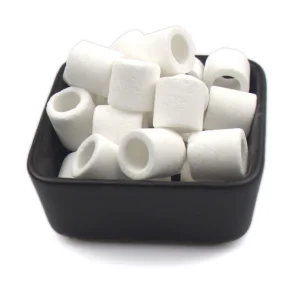
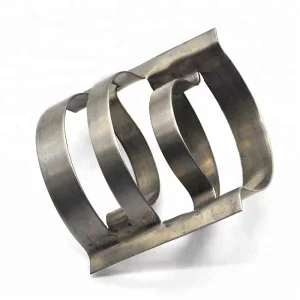
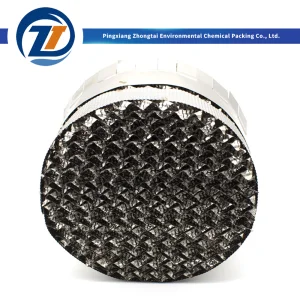
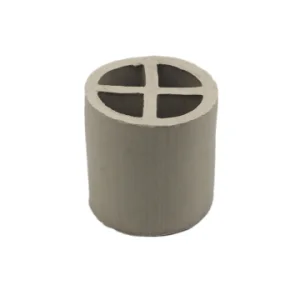
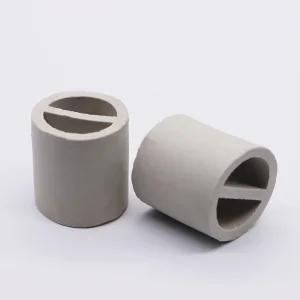
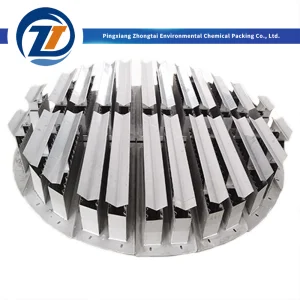
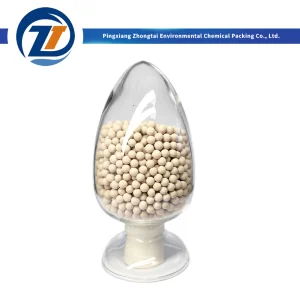
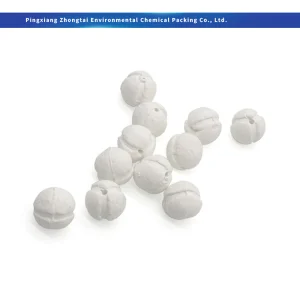
In addition to structural brick units, modern chemical plants require complete mass-transfer support domes built from specialized acid-proof ceramic materials. Ceramic arch beams and multi-slotted cross partition rings work harmoniously with acid-resistant masonry to sustain hundreds of metric tons of random or structured packing without compressive structural deformation or localized gas channeling.
Ensuring batch-level traceability, zero dimensional deviance, and robust fumigated sea freight packaging for multi-continent delivery.
Samples from every firing car undergo laboratory pulverization to 4.75 mm–6.3 mm granules, followed by 48-hour continuous boiling in 78% reagent grade $H_2SO_4$ to certify mass loss is consistently below 1.0%.
Uniaxial compressive strength evaluation using calibrated 300-ton hydraulic presses per EN 993-5 / ASTM C67 confirms cold crush values exceeding 100 MPa across all critical face orientations.
Packed on heat-treated ISPM-15 compliant solid fumigated wooden pallets, inter-layered with corrugated cushioning, shrink-wrapped in 200-micron waterproof film, and reinforced with heavy polymer/steel strapping.
Every shipment is accompanied by complete EN 10204 Type 3.1 Mill Test Certificates, documenting the chemical breakdown by X-ray fluorescence (XRF), volumetric water absorption via vacuum saturation, and dimensional tolerance inspections. With verified third-party audit reports from SGS, TÜV, and Intertek, global buyers mitigate risk across critical project milestones.
Pioneering advancements in low-porosity geopolymers, thermal-conductive masonry, and hydrogen-fired low-carbon kilns.
Post-sintering impregnation with colloidal silica sols seals sub-micron surface pores, depressing total open porosity to less than 0.15% for supercritical carbon dioxide ($sCO_2$) scrubbing units.
Integrating 15% to 30% alpha-SiC micro-particulates to heighten thermal conductivity, enabling rapid heat removal across exothermal chlorination reactors without localized thermal stresses.
Replacing coal-gas producers with hydrogen-natural gas dual-fuel tunnel kilns, decreasing embedded carbon footprints by up to 42% in alignment with EU CBAM (Carbon Border Adjustment Mechanism) directives.
Authoritative technical answers to common queries submitted by global EPC contractors, chemical maintenance directors, and plant owners.
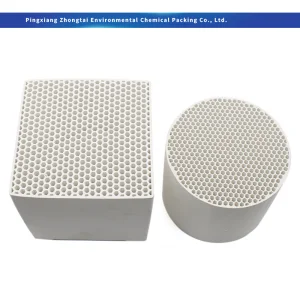
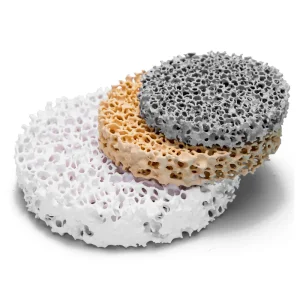
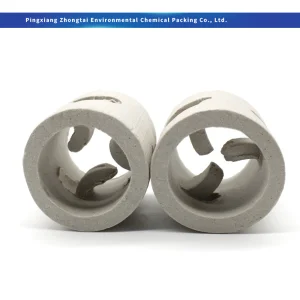
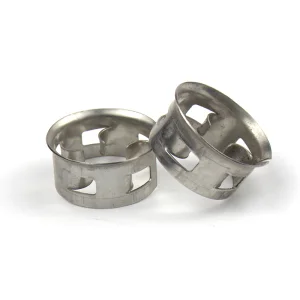
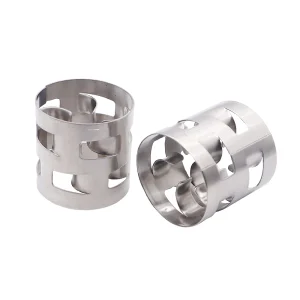
Engineered for high mass-transfer efficiency, low pressure drop, and severe thermal and chemical operating environments.
Connect directly with Pingxiang Zhongtai's chemical ceramic engineering division. Submit your column diameters, operating acid concentrations, design temperatures, and pressure spectra for complete refractory lining calculations and certified factory-direct quotations.
