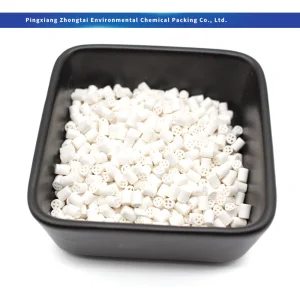
Explore our high-performance column packings, catalyst bed support matrices, and refractory media manufactured under strict ISO 9001 quality supervision in Pingxiang, China.
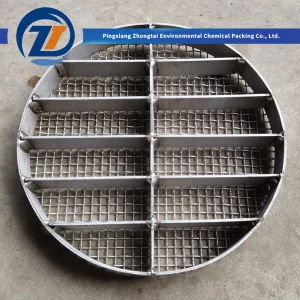
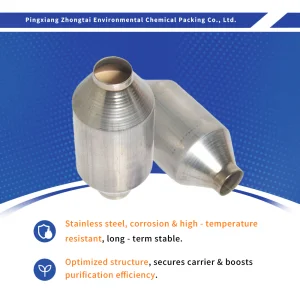
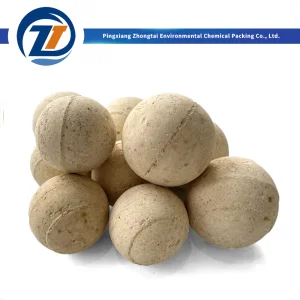
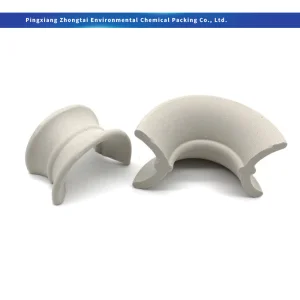
Within the rigorous discipline of chemical mass transfer and reactive separation columns, the Ceramic Intalox Saddle Ring remains an indispensable benchmark among random tower packings. Combining an open, continuous arched geometry with parabolic curvatures, this design resolves the historic operational compromise between interfacial wetted surface area and gas-phase hydraulic resistance.
In modern industrial facilities—spanning mega-scale sulfuric acid ($H_2SO_4$) alkylation plants, sulfur dioxide ($SO_2$) absorption towers, chlorine gas drying columns, and acid gas scrubbing systems—the ceramic Intalox saddle functions where metal packings suffer corrosive stress cracking or galvanic oxidation, and engineered plastics degrade through thermal softening or chemical embrittlement. Pingxiang, Jiangxi Province, China, represents the undisputed global epicenter of technical ceramic production, consolidating rich kaolin reserves, energy infrastructure, automated tunnel kilns, and ISO-certified chemical engineering laboratories into a streamlined manufacturing corridor.
The aerodynamic contour of the Ceramic Intalox Saddle represents a major departure from early cylindrical Raschig rings. The open, scalloped contour prevents nesting and wall compaction within packed columns, preventing premature liquid channeling, stagnant boundary layers, and catastrophic localized flooding.
By delivering void fractions ($\varepsilon$) spanning 70% to 78%, Ceramic Intalox Saddles drastically minimize vapor friction coefficients. Gas streams ascend through smooth parabolic channels, reducing compressor power consumption and system-wide parasitic pressure losses across deep beds.
Liquid films do not pool in dead zones. The dual-surface saddle design promotes continuous internal-external liquid film renewal via the Onda mass-transfer model, ensuring dynamic droplet detachment and thin falling-film distribution across turbulent counter-current gas flows.
Sintered from homogeneous, de-aired silicate clay bodies at 1280°C–1320°C, the resulting mullite crystal network exhibits exceptional mechanical crush load resistance. Columns exceeding 15 meters in continuous packed bed depth operate safely without lower-tier compaction or structural fracturing.
| Nominal Size (mm) | Dimensions (mm) | Bulk Density ($kg/m^3$) | Specific Surface Area ($m^2/m^3$) | Free Volume / Voidage ($\%$) | Dry Packing Factor $F_p$ ($1/m$) | Static Crush Strength ($kN/pc$) |
|---|---|---|---|---|---|---|
| 16 mm (5/8") | 16 × 12 × 2.0 | 650 – 710 | 355 | 70% | 390 | > 2.2 |
| 25 mm (1") | 25 × 19 × 2.5 | 580 – 620 | 255 | 73% | 215 | > 4.5 |
| 38 mm (1.5") | 38 × 28 × 3.5 | 540 – 580 | 165 | 75% | 130 | > 7.8 |
| 50 mm (2") | 50 × 38 × 4.5 | 500 – 540 | 115 | 77% | 90 | > 12.0 |
| 76 mm (3") | 76 × 58 × 6.5 | 460 – 500 | 85 | 79% | 52 | > 18.5 |
Ceramic Intalox Saddles provide continuous chemical stability in hostile operational environments that rapidly destroy conventional metals and synthetic polymers. The following core industrial scenarios detail their operational implementation:
Deployed within Drying Towers, Intermediate Absorption Towers (IAT), and Final Absorption Towers (FAT). Resists boiling oleum and 98% concentrated acid attack, delivering uniform gas absorption with zero particulate silica loss.
Applied in wet chlorine absorption, hydrochloric acid ($HCl$) synthesis, and hydrogen sulfide striping towers. The ceramic matrix remains unaffected by wet chlorine gas, chlorine dioxide, and aggressive oxidizing organics.
Functions as structured or dumped heat exchange support media in Regenerative Thermal Oxidizers (RTOs). The high specific heat capacity and low thermal expansion coefficient resist rapid thermal shock cycles from 200°C to 1050°C.
Critical in sour gas amine scrubbing, carbon capture, and flue gas desulfurization (FGD). The non-stick, vitrified ceramic skin minimizes particulate deposition, scale encrustation, and microbial fouling.
Selecting the proper random or structured packing requires evaluating process temperature, chemical aggressiveness, allowable pressure drop per theoretical stage (HETP), and overall capital expenditure (CAPEX). Review this comparative performance breakdown:
| Packing Media | Material Class | Corrosion Tolerance | Max Temp (°C) | Relative Capacity | Relative CAPEX | Primary Industrial Service |
|---|---|---|---|---|---|---|
| Ceramic Intalox Saddle | Aluminosilicate Ceramic | Exceptional (all acids except HF) | 1100°C | Moderate to High | Low - Moderate | Sulfuric/Nitric acid absorption, corrosive scrubbers, RTO |
| Ceramic Raschig Ring | Stoneware Ceramic | High | 1000°C | Low (high pressure drop) | Very Low | Legacy towers, low-cost acid treatment |
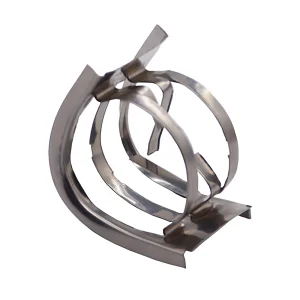
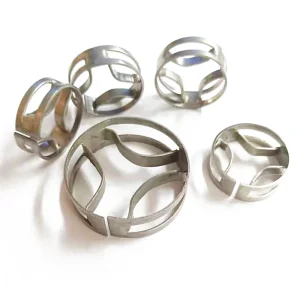
| Metal Pall Ring | 304/316L / Carbon Steel | Moderate (susceptible to acid pitting) | 400°C - 600°C | High | Moderate | Hydrocarbon fractionation, vacuum distillation |
| Metal Intalox Saddle | Austenitic Alloys / Hastelloy | Grade-dependent | 450°C - 700°C | Very High | High to Very High | Refinery vacuum columns, high-throughput strippers |
| Plastic Super Saddle | PP / PVDF / PTFE | High against caustic/water | 90°C - 140°C | High | Low | Ambient bio-scrubbers, municipal wastewater degassing |
| Structured Wire Mesh | SS316L / Titanium | Grade-dependent | 300°C - 450°C | Maximum (lowest HETP) | Very High | Fine chemicals, pharmaceutical vacuum towers |
Modern industrial ceramic manufacturing requires precise silicate engineering, strictly eliminating manual batch inconsistencies through automated extrusion, computerized thermal profiling, and batch-level physical testing.
Screened kaolin, feldspar, and silica are wet-milled in high-capacity alumina ball mills to reach sub-45 micron fineness, followed by high-gradient electromagnetic de-ironing to restrict $Fe_2O_3$ levels below 0.8%.
Continuous twin-screw vacuum pug mills extract micro-air pockets at -0.098 MPa, eliminating internal laminations and micro-pores. Extruded saddles maintain uniform wall thicknesses and consistent dimensional profiles.
Loaded onto automated tunnel kiln cars spanning 120+ meters, the green bodies undergo controlled preheating, vitrification at 1300°C, and rapid crystal stabilization, producing an impervious, highly vitrified mullite-quartz matrix.
Every shipment is verified under ASTM C515 and ASTM C279 specifications. Independent batch assays log water absorption, bulk density, compressive crushing strength, and boiling sulfuric acid resistance before export clearance.
A frequent vulnerability in sourcing ceramic tower packing is transit breakage from inadequate maritime packaging. As an established global exporter based in Pingxiang, our direct-to-port logistics protocols protect material integrity from kiln discharge to plant installation:
Constructed with high-strength woven polypropylene, heavy-duty bottom discharge spouts, and cross-corner lifting loops. Reinforced interior baffle walls preserve pallet footprint stability, maximizing shipping container utilization.
Multi-ply corrugated export cartons protect smaller sizing units (16mm and 25mm). Unitized on IPPC heat-treated, fumigated timber or polymer pallets, fully protected with waterproof multi-layer stretch shrink wrap.
Each container features certified bills of lading, detailed packing lists, Certificates of Origin (CO/Form E/Form A), and comprehensive Factory Batch Test Certificates detailing chemical composition, crush tolerance, and voidage.
Direct engineering answers to technical queries, design calculations, and procurement specifications.
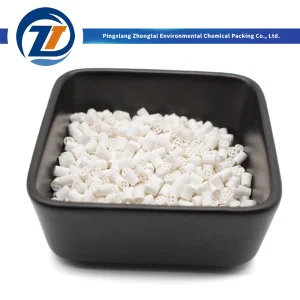
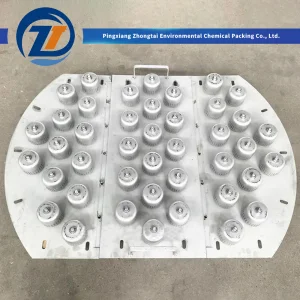
Complete your unit operations with high-purity alumina catalyst beds, biological filter rings, heavy-duty fractionation trays, and industrial adsorption media.
Connect with Pingxiang Zhongtai's chemical process engineers for hydrodynamic calculations, hydraulic pressure drop projections, HETP optimization, and factory-direct pricing for your plant turnaround schedule.