Explore high-performance chemical contactors, engineered molecular sieves, and functional bio-reactive media manufactured in our precision facility.
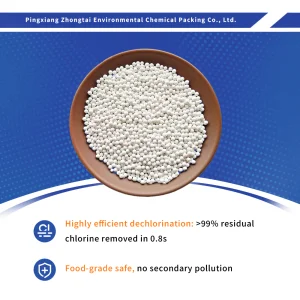
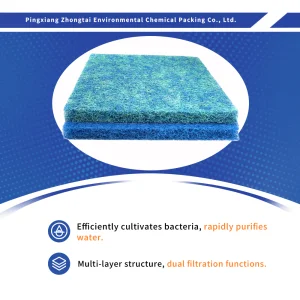
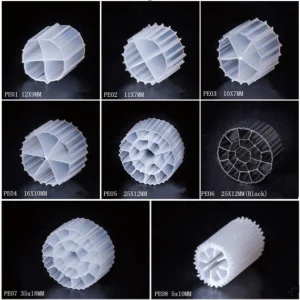
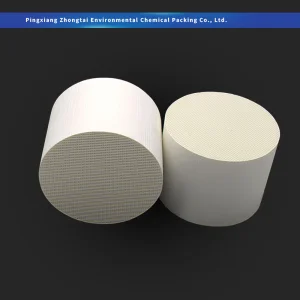
Leveraging Pingxiang’s multi-decade industrial ceramics cluster to supply precision sinter-engineered functional balls worldwide.
Tourmaline ceramic balls represent a vital convergence of mineral physics, thermodynamic sintering, and hydraulic catalysis. Fabricated via proprietary combinations of trigonal borosilicate crystal minerals ($Na(Mg,Fe,Li,Al,Mn)_3Al_6(BO_3)_3Si_6O_{18}(OH,F)_4$), sub-micron kaolin clays, diatomaceous earth, and high-purity inorganic metal oxides, these functional ceramics possess permanent intrinsic dipole moments.
Unlike transient electrostatic carriers, a high-density tourmaline ceramic bead generates a spontaneous 0.06 mA surface bio-electric microcurrent alongside persistent Far-Infrared Radiation (FIR) wavelength resonance. When exposed to dynamic aqueous streams, the mechanical interaction hydrolyzes dipole water clusters from bulk macro-aggregates ($120\text{–}150\text{ Hz}$ $^{17}O\text{-NMR}$ line widths) down to bio-available micro-clusters ($<60\text{ Hz}$), releasing hydronium and hydroxyl radicals that suppress oxidation-reduction potential (ORP), stabilize negative ion concentrations, and regulate aqueous equilibrium.
Direct factory benchmarking across physical dimensions, negative ion emission ratings, active mineral fractions, and bulk metric ton volumetric packaging.
| Nominal Grade | Grain Size (mm) | Active Mineral (%) | Anion Output (ions/cc) | Bulk Density (g/cm³) | Crush Strength (N/pellet) | Indicative Price (USD/MT FOB) |
|---|---|---|---|---|---|---|
| Standard Industrial (TC-IND-01) | 1.5 – 2.5 mm | 15% – 20% | 800 – 1,200 | 1.35 – 1.45 | ≥ 180 N | $1,180 – $1,420 |
| Potable Water Core (TC-POT-02) | 3.0 – 4.0 mm | 25% – 30% | 1,500 – 2,200 | 1.38 – 1.48 | ≥ 220 N | $1,350 – $1,650 |
| High-Intensity FIR (TC-FIR-03) | 4.5 – 6.0 mm | 35% – 40% | 2,800 – 3,500 | 1.40 – 1.50 | ≥ 260 N | $1,580 – $1,920 |
| Ultra-Active Bio (TC-BIO-04) | 7.0 – 9.0 mm | 45% – 50% | 4,000 – 6,000+ | 1.42 – 1.52 | ≥ 310 N | $1,850 – $2,350 |
| High-Flow Hydroponic (TC-AGR-05) | 10.0 – 15.0 mm | 20% – 25% | 1,200 – 1,800 | 1.32 – 1.42 | ≥ 380 N | $1,220 – $1,500 |
| Heavy Column Support (TC-ENG-06) | 18.0 – 25.0 mm | 20% – 30% | 1,000 – 1,500 | 1.30 – 1.40 | ≥ 550 N | $1,280 – $1,600 |
Full Container Load (FCL 20GP = 20-22 MT) procurement benefits from direct factory batch rebates, fixed raw-material calcination indices, and centralized Pingxiang logistics clearing.
Every commercial batch conforms to NSF/ANSI Standard 42/61 toxicology parameters, ensuring zero carcinogenic leaching, heavy metal pass-through (Pb < 0.001 mg/L, Cd < 0.0005 mg/L), and stable mineral dissolution.
Beyond standard stock diameters (2mm, 4mm, 6mm), our multi-deck mechanical sieving drums accommodate micronized micro-beads (0.5–1.2mm) down to deep-bed filtration macro-spheres (30mm).
How strict global micro-contaminant standards and circular engineering are transforming commercial mineral bead demand.
Industrial cooling towers and municipal RO permeate conditioning circuits are replacing volatile corrosion inhibitors with electro-polar tourmaline beds that curb biofilm development without generating halogenated by-products.
The consumer water wellness sector has pivoted from static granular activated carbon (GAC) to multi-stage mineral beds that emit negative ions, lower surface tension by 8–12 dynes/cm, and increase intracellular hydration velocity.
Procurement teams reject low-temperature bonded beads susceptible to crumbling and turbidity spikes. High-density, high-temperature calcination (>1150°C) is mandatory to eliminate attrition fines in high-velocity columns.
Turnkey cartridge manufacturers specify co-sintered matrices integrating tourmaline with far-infrared maifan stone, negative potential magnesium alloys, and dechlorination sulfite cores for compact single-vessel processing.
Inside our Pingxiang manufacturing core: algorithmic raw material processing, computer-governed thermal profiles, and sub-micron quality validation.
Pingxiang, Jiangxi Province, holds an uncontested global position as the capital of industrial chemical ceramic packing and functional mineral media. Our modern Factory 4.0 facility leverages this integrated supply radius to overcome common historical challenges of variable mineral purity, uneven sphericity, and mechanical crushing failures.
Raw schorl and dravite tourmaline minerals are magnetically pre-separated to remove unbound ferromagnetic impurities. The refined ores are fed into high-energy wet horizontal stirred mills along with plasticizer clays until laser diffraction confirms a particle size distribution of D90 < 2.5 μm. This micro-pulverization maximizes the specific geometric surface area, exposing thousands of active polar crystal faces per square millimeter of finished sphere.
Slurry blends are micro-atomized in continuous fluid-bed pelletizing rotators. Digital droplet control maintains real-time moisture equilibrium (11–13%), producing uniform spherical green bodies with exceptional internal structural density. Multi-tier vibratory sieves segregate off-spec grains back to slurry tanks, keeping particle dimensional tolerances within ±0.25 mm.
The green media undergoes a computerized 36-hour thermal curve across automated multi-burner roller hearth kilns. Graduated preheating (300°C–600°C) eliminates trapped constitutional moisture, followed by peak sintering at 1120°C–1220°C. This exact threshold achieves optimal mullite vitrification without collapsing the tourmaline's asymmetric polar crystalline lattice. Controlled air-quench chilling then locks in mechanical hardness, yielding crush ratings exceeding 200–550 Newtons per sphere.
| Batch QC Parameter | Testing Methodology | Factory Benchmark | Pass/Fail Impact |
|---|---|---|---|
| Negative Ion Generation | Solid-State Air Ion Counter (COM-3010PRO) | 1,000 – 6,500+ ions/cc | Disqualifies below contract baseline |
| Far-Infrared Emissivity | Infrared Spectrophotometer (8–14 μm band) | ≥ 0.90 (90% blackbody relative) | Guarantees bio-cluster water breakdown |
| Single-Point Crush Strength | Servo-Hydraulic Pellet Hardness Tester | ≥ 180 – 550 N/pellet (by size) | Prevents column compaction under hydraulic head |
| Tumbling Attrition Loss | Rotary Drum Abrasion Test (ASTM D4058) | ≤ 0.08 wt% loss after 100 hrs | Prevents downstream filter blinding and turbidity |
| Toxic Metals Dissolution | ICP-MS Inductively Coupled Plasma Assay | ND (Pb < 1ppb, Cd < 0.5ppb, As < 1ppb) | Mandatory for NSF/FDA Potable Release |
Detailed performance metrics across international process conditions, from municipal drinking plants to industrial cooling water circuits.
Target: RO Permeate Remineralization & Cluster Refinement
Installed inside post-membrane polishing canisters. Acidic, demineralized RO water (pH 5.8–6.3) cascades across a 3–5mm tourmaline bead bed with an Empty Bed Contact Time (EBCT) of 45–90 seconds. The contact stream stabilizes pH between 7.4–8.2, decreases oxidation-reduction potential (ORP) by 100–250 mV, and reduces water cluster diameter for smooth mouthfeel.
Target: Biofilter Optimization & Ammonia Oxidation
Integrated directly into high-density nursery hatcheries upstream of moving bed biofilm reactors (MBBR). The permanent 0.06 mA microcurrent stimulates the enzymatic activity of nitrifying bacteria (Nitrosomonas and Nitrobacter), accelerating un-ionized ammonia ($NH_3\text{-N}$) breakdown rates by 18–26% under cold-water conditions.
Target: Surfactant Reduction & Surface Tension Lowering
Used in industrial flow-through wash tunnels. Tourmaline ceramic beds reduce the bulk surface tension of incoming process water from ~72 dynes/cm down to 60–63 dynes/cm. This elevated wetting power permits detergent surfactant cuts of 30–45% while maintaining strict soil and grease removal standards.
Target: Static Charge Neutralization & Odor Control
Packed into randomized mass-transfer wet scrubbers. Recirculated spray water running through tourmaline media generates a continuous stream of negatively charged micro-droplets and hydroxide ions, neutralizing gaseous volatile organic compounds (VOCs) and particulates.
Target: Nutrient Translocation & Pathogen Suppression
In closed-loop Dutch gutter hydroponic facilities, water structured through tourmaline columns shows increased solubility of iron chelates (Fe-EDDHA) and mono-potassium phosphate, cutting salt scale in drip emitters and speeding root absorption.
Target: Skin Barrier Hydration & Micro-Bubble Baths
Commercial onsen spas pass thermal hot spring inputs through deep sub-micron tourmaline cartridges to promote micro-bubble cavitation, delivering dissolved far-infrared frequencies that dilate peripheral capillaries.
Evaluating physical, chemical, and catalytic mechanisms against common filtration minerals.
| Functional Media | Primary Active Mechanism | Primary Operating Duty | Operational Lifespan | Regeneration Protocol |
|---|---|---|---|---|
| Tourmaline Ceramic Ball | Spontaneous permanent dipole, FIR (8-14μm), 0.06mA current | Water clustering, pH elevation, negative ion enrichment | 24 – 36 Months | Simple hydraulic backwash or diluted citric acid wash |
| Calcium Sulfite ($CaSO_3$) Ball | Instantaneous chemical reduction ($Cl_2 + CaSO_3 \to CaCl_2 + CaSO_4$) | Ultra-fast de-chlorination (>99% in sub-second contact) | 6 – 12 Months (Sacrificial) | Non-regenerable; consumable consumable media |
| Maifan Stone Ball | Microporous ionic release ($SiO_2, Al_2O_3, Fe_2O_3, K_2O, Na_2O$) | Micro-nutrient mineral enrichment, heavy metal cation sponge | 12 – 18 Months | Dilute acid strip & high-temp bake out |
| Magnesium ORP Ball | Galvanic redox reaction ($Mg + 2H_2O \to Mg(OH)_2 + H_2$) | Hydrogen micro-bubble saturation, strong negative ORP (-400mV) | 3 – 6 Months (Sacrificial) | Weak acid rinse to dissolve passivated oxide coatings |
| Granular Activated Carbon (GAC) | Van der Waals physical/chemical pore adsorption | Chlorine, trihalomethanes (THMs), VOC, odor absorption | 6 – 12 Months | Thermal steam stripping (Industrial) or replacement |
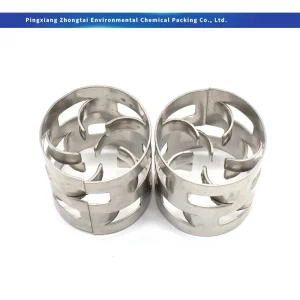
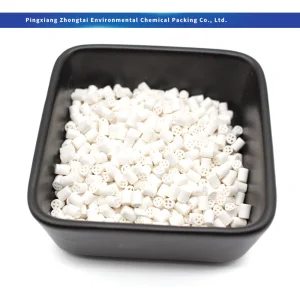
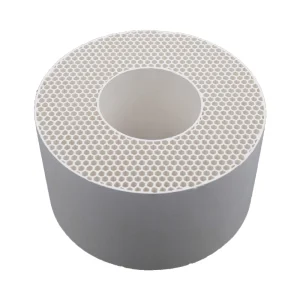
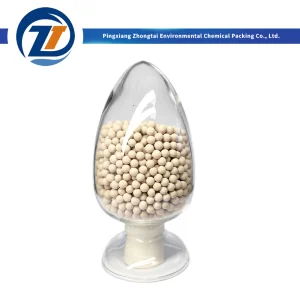
Advanced chemical engineering media, alumina catalyst supports, and thermal storage solutions from Pingxiang Zhongtai.
Clear, technical explanations covering chemical durability, packing densities, export logistics, and OEM manufacturing customization.
Our standard formulations comprise 25%–40% micronized natural tourmaline mineral powder ($Na(Mg,Fe,Li,Al)_3Al_6[Si_6O_{18}](BO_3)_3(OH,F)_4$), 30%–45% refined porcelain clay and kaolinite, 15% diatomite silica flux, and balanced trace minerals including zinc, magnesium, and calcium silicates to optimize mechanical sintering density.
Every commercial batch is tested with calibrated COM-3010PRO solid-state air ion testers in a shielded chamber, recording baseline counts per cubic centimeter. Far-infrared emissivity across the 8–14 μm spectral band is certified using FTIR spectrometers, requiring ≥0.90 emissivity versus a blackbody reference standard.
For vessels with bed depths exceeding 2.5 meters, we recommend our TC-FIR-03 or TC-ENG-06 grades (crush ratings ≥260–550 N/pellet). This avoids stress cracking, fines formation, and hydraulic channeling under sustained hydrostatic heads and cyclical backwash cycles.
Yes. We routinely adjust mineral ratios, firing temperatures, porosity indices, and physical coloration (natural grey-black, terracotta, speckled, or white-porcelain finishes). Custom spherical diameters from 1.0mm to 30.0mm can be manufactured under customer-specific NDAs.
Contact time governs efficiency. For domestic drinking cartridges, an Empty Bed Contact Time (EBCT) of 30–60 seconds is recommended. For high-volume municipal or aquaculture polishing, an EBCT of 15–30 seconds provides sufficient far-infrared exposure and micro-current hydrolysis without excessive pressure drop.
Standard export packaging includes 25 kg double-wall woven polypropylene sacks with sealed polyethylene moisture liners, palletized and stretch-wrapped on ISPM-15 heat-treated or plastic pallets (1.0–1.2 MT per pallet). Heavy-duty 1,000 kg FIBC bulk tote bags are also available for bulk column installations.
Supply our application engineers with your vessel dimensions, target water chemistry, and volume requirements for quick turnaround quotes.
500g – 2.0kg laboratory evaluation samples dispatched via DHL/FedEx with comprehensive batch test certificates, ICP-MS analysis, and particle size distribution curves.
Provide your fluid velocity ($m/h$), bed diameter ($mm$), and pressure drop limits ($\Delta P$ bar). Our engineering desk calculates the ideal sphere diameter and packing depth.
Direct rail and maritime container logistics via Shenzhen, Ningbo, and Shanghai ports. Comprehensive export paperwork including CO, Form E, Bill of Lading, and certified packing lists.
