Precision-engineered ceramic, metal, and polymeric internals designed for chemical absorption, stripping, and high-efficiency distillation operations.
In-depth technical breakdown of random packing behavior, hydrodynamic stability, pressure drop calculations, and phase contact boundary dynamics.
Distillation column efficiency relies fundamentally on maximizing liquid-vapor interfacial contact while maintaining low pressure drop ($\Delta P$). Random tower packing serves as an unstructured matrix that promotes continuous surface renewal and turbulence across the liquid film. Key efficiency metrics are governed by the Height Equivalent to a Theoretical Plate (HETP).
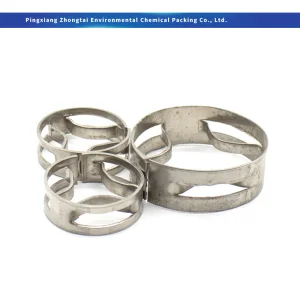
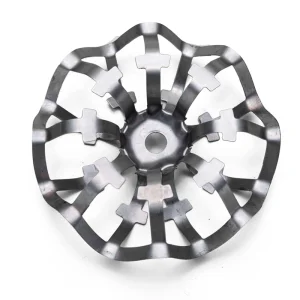
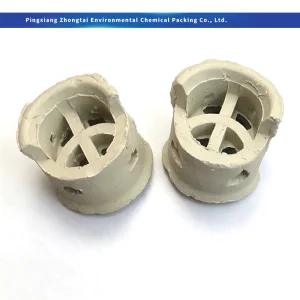
Modern Chinese random packing manufacturing has evolved beyond traditional Raschig geometry. By introducing open-work structures, internal flanges, and wave-contoured edges—such as in Pall Rings, Cascade Mini Rings (CMR), and Super Mini Rings (SMR)—manufacturers effectively reduce liquid holdup and channel formation, yielding lower HETP values (ranging from 300 mm to 600 mm depending on column diameter and vapor velocity).
Determining the operational boundary of a packed distillation tower requires precise computation of the flooding point. Operating near 70% to 80% of the calculated flood velocity optimizes operational throughput without causing liquid entrainment or column instability.
Leading Chinese manufacturers leverage advanced finite element fluid simulations and physical cold-model testing columns (up to 2.5 meters in diameter) to validate packing factors ($a_p/\epsilon^3$), assuring global buyers of precise operational prediction in field operations.
Selecting optimal chemical resistance, mechanical crush strength, and thermal tolerance across critical process environments.
| Material Class | Specific Alloy / Grade | Max Temp (°C) | Corrosion Resistance | Mechanical Strength | Primary Industrial Application |
|---|---|---|---|---|---|
| Metallic Packing | Stainless Steel 304L / 316L | 400°C - 800°C | Moderate to High (Organic Acids, Solvents) | Very High (Resists Impact & Compressive Load) | Petroleum Refining, Vacuum Distillation, Amine Sweetening |
| Special Metallurgy | Hastelloy C-276 / Titanium Gr. 2 | > 900°C | Extreme (Wet Chlorine, Sulfuric & Nitric Mixtures) | Exceptional | Fine Chemical Synthesis, Hazardous Waste Scrubbers |
| Acid-Proof Ceramic | Chemical Porcelain (17-23% Al₂O₃) | 1000°C | Total (Except Hydrofluoric Acid & Hot Caustic) | High Compressive / Low Tensile | Sulfuric Acid Production, Chlorine Drying Towers |
| High Alumina Ceramic | 92% - 99.5% Al₂O₃ Ceramic | 1600°C | Universal Chemical Inertness | Extreme Crush Strength (> 250 kN/particle) | Catalyst Bed Support, Steam Reformers, Hydroprocessing |
| Thermoplastic Packing | PP, RPP, PVDF, PFA | 100°C - 150°C | High against Alkalies, Acids & Salt Solutions | Moderate (Subject to Creep under High Bed Height) | Flue Gas Desulfurization (FGD), Water Treatment, Stripping |
Choosing the correct random packing material prevents premature bed collapsing due to stress corrosion cracking (SCC) or intergranular degradation. Metallic packing undergoes precise bright annealing to eliminate residual stress from cold stamping.
Effective mass transfer requires high surface area and uniform liquid film spread. Surface modifications such as micro-grooving, chemical etching, and textured perforations drastically increase liquid film retention and prevent dry-spotting.
Deep-packed columns generate immense static compressive loads. Chinese ceramic factories utilize isothermal iso-static pressing and high-temperature tunnel kiln sintering to guarantee high bulk crushing strength without structural breakage.
Unpacking the structural economic, technical, and supply chain efficiencies offered by China's central chemical packing production hub.
Pingxiang, located in Jiangxi Province, stands as the undisputed chemical packing manufacturing epicenter of China. Over decades, this region has concentrated high-grade kaolin clay reserves, technical ceramic formulation laboratories, automated metal stamping plants, and polymer resin compounders into a unified industrial ecosystem.
By sourcing raw materials locally and utilizing continuous natural gas tunnel kilns operating 24/7, China Random Packing Distillation Column Manufacturers achieve unmatched thermal efficiency and cost competitiveness. The complete absence of multi-layer supply chain markups directly benefits international procurement officers looking for factory-direct pricing without compromise on metallurgical or chemical integrity.
Modern metal tower packing production requires progressive high-speed stamping dies capable of forming complex open-window geometries (such as SMR, Conjugate Rings, and Metal Tellerettes) with sub-millimeter tolerances. Chinese manufacturing facilities feature automated high-speed punch presses operating at hundreds of strokes per minute.
Custom tool manufacturing is handled in-house, enabling rapid engineering adjustments when client towers require non-standard aspect ratios, customized wall thicknesses (from 0.3mm up to 2.5mm), or special alloy modifications.
Fulfilling the rigorous compliance demands of international EPC contractors, refinery operators, and industrial chemical conglomerates.
Every shipment is accompanied by complete Material Test Reports (MTRs) certifying chemical composition via X-ray fluorescence (XRF) and positive material identification (PMI). Mechanical property validation includes tensile, yield, hardness, and specific bulk density analysis.
Factories regularly facilitate pre-shipment inspections (PSI) conducted by international verification bodies such as SGS, TÜV Rheinland, Bureau Veritas, and Intertek. Standard inspection protocols encompass dimensional checks, crush testing, wall thickness uniformity, and packing density audits.
To prevent transportation damage during transpacific or transatlantic voyages, products are packaged in heavy-duty fumigation-free wooden cases, reinforced jumbo bags, or steel drums loaded onto heat-treated ISPM-15 compliant pallets. Direct rail and port connections ensure rapid loading out of Shanghai, Ningbo, or Shenzhen ports.
From petrochemical refining towers to environmental VOC scrubbers, explore how targeted random packing geometries optimize specific unit operations.
In atmospheric crude distillation units (CDU), vacuum distillation units (VDU), and demethanizer towers, liquid loading is exceptionally high while operational uptime must extend beyond 36-month turnaround cycles. Stainless steel 316L Pall Rings and SMR Super Mini Rings are widely specified to minimize entrainment, prevent fouling buildup, and maintain low pressure drop under variable vapor loads.
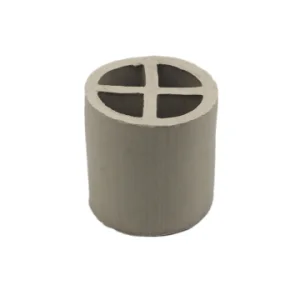
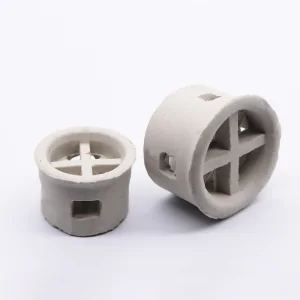
Gas absorption towers handling hot concentrated sulfuric acid ($98\%\ H_2SO_4$) at temperatures exceeding $180^\circ\text{C}$ present severe corrosive challenges that ruin standard metals. Acid-resistant Ceramic Intalox Saddles, Cascade Rings, and Cross Rings provide complete chemical immunity while optimizing liquid distribution across massive tower diameters.
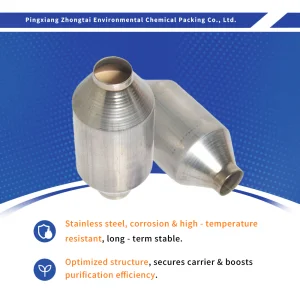
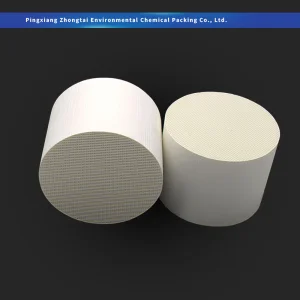
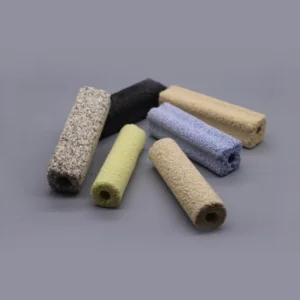
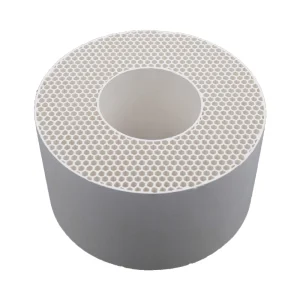
Industrial printing, automotive painting, and chemical plants generate volatile organic compound (VOC) emissions regulated by strict environmental mandates. Specialized Honeycomb Ceramic Storage Media and Catalytic Converter Substrates store and transfer thermal energy within Regenerative Thermal Oxidizers (RTO), recovering up to 95% of thermal energy while destroying hazardous emissions.
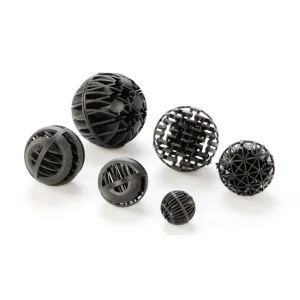
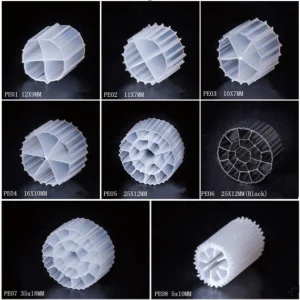
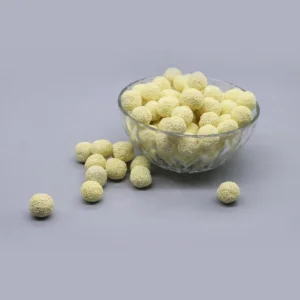
Water degassing, air stripping of ammonia, and municipal wastewater treatment require light, chemical-proof, and high surface area packing media. Polypropylene Bio Balls, MBBR Carriers, and Far-Infrared Bacterial Media promote rich biofilm growth and rapid oxygen dissolution in continuous biological oxidation tanks.
Adapting mass transfer internals to the global push toward Net-Zero carbon emissions, amine-based CCUS, and digital column simulation.
Carbon Capture, Utilization, and Storage (CCUS) projects require massive absorption columns running targeted amine solvents (such as MEA, MDEA, and piperazine derivatives). Chinese manufacturers are developing specialized ultra-low pressure drop random packings that minimize energy consumption during solvent regeneration.
The boundary between random packing and structured packing is blurring. Advanced CFD modeling lets engineers simulate localized vapor-liquid channeling, wall flow effects, and dry spots before casting metal or extruding ceramic, ensuring customized packing factor accuracy for non-standard operational envelopes.
Leading Pingxiang factories are adopting clean hydrogen-blend firing kilns and recycled stainless steel scrap scrap feeds, dramatically reducing the embodied carbon footprint of exported mass transfer media to align with European Union Carbon Border Adjustment Mechanisms (CBAM).
Direct answers to crucial questions concerning specification, material selection, quality verification, and factory logistics.
Random packing is generally preferred for high-pressure operations, highly fouling processes, corrosive chemical applications where ceramic media is required, and retrofits where low capital cost is essential. Structured packing provides lower pressure drop per theoretical stage, making it ideal for deep vacuum distillation and high-purity separation, but comes at a higher initial capital expenditure and increased vulnerability to liquid-borne solids fouling.
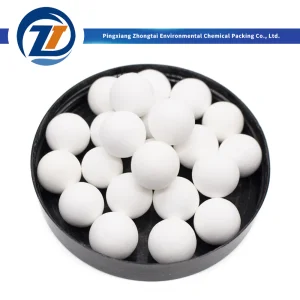
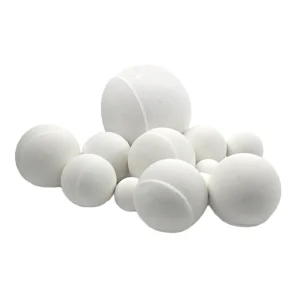
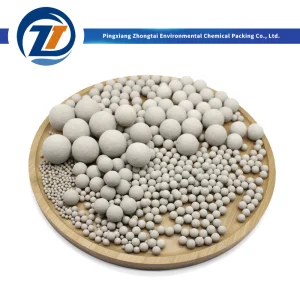
For standard refinery hydrotreaters and gas dryers operating under moderate temperatures, 17% to 23% $Al_2O_3$ inert ceramic balls are sufficient. However, for high-temperature steam reformers, secondary reformers, and ammonia synthesis units where silica leaching can poison downstream precious metal catalysts, high-purity ceramic media ($\ge 99\%\ Al_2O_3$) with silica content under $0.2\%$ must be specified.
Standard random packings in SS304/SS316L, Polypropylene, or Standard Ceramic are typically stocked in volume or can be produced within 7 to 14 working days for full container loads (20ft/40ft FCL). Custom metallurgy (such as Hastelloy or Titanium) or specialized mold geometries usually require 20 to 30 days for raw material procurement, tooling, production, and full QA/QC testing prior to container dispatch.
Liquid maldistribution is mitigated by maintaining an optimal ratio of column diameter to packing size ($D/d_p > 10$), utilizing initial high-precision liquid distributors (box or trough type) providing at least 42 to 100 drip points per square meter, and installing liquid redistributor rings at vertical intervals of 5 to 8 column diameters or a maximum bed height of 6 meters.
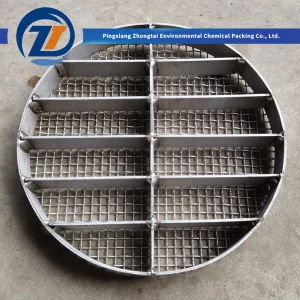
Yes. Premier Chinese manufacturers maintain in-house chemical engineering teams capable of taking process parameters (flow rates, gas/liquid density, viscosity, surface tension, operating pressure, and required theoretical stages) and providing full hydraulic rating calculations, recommended packing types, bed heights, and tower internal specifications (support plates, hold-down grids, and distributors).
Metal packings undergo rigid wall-thickness verification and crimp-strength testing. Plastic packings feature virgin resin compounding with anti-aging/UV stabilizers to prevent embrittlement. Ceramic packings undergo rigorous compressive strength tests (water absorption < 0.5%, acid resistance > 99.8% per ASTM C515). Export packaging includes reinforced internal corrugated lining, heavy-duty shrink wrapping, and steel banding on heat-treated pallets.
Direct factory sourcing for structured plates, catalytic substrates, ceramic spheres, and high-wear grinding media.