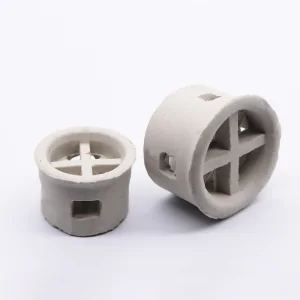
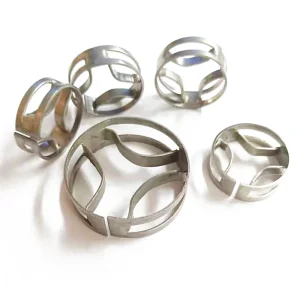
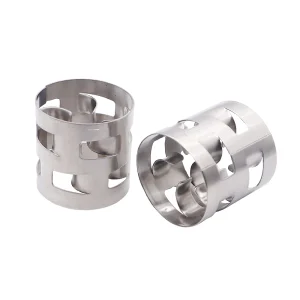
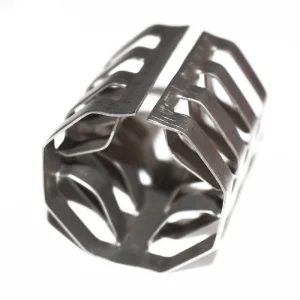
Explore factory-direct random tower packings, structured elements, and high-purity ceramic substrates manufactured under ISO 9001:2015 standards in Pingxiang, China.
Understanding how modern Intalox Saddle designs overcome the classic hydrodynamics limitations of conventional Raschig rings and early Berl saddles in mass transfer and heat exchange columns.
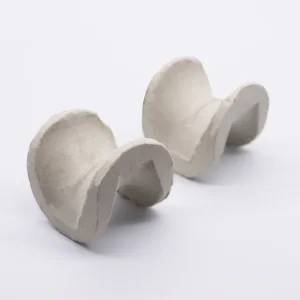
In the domain of chemical process engineering, column internals represent the fundamental operational core governing liquid-gas contact efficiency. Intalox Saddles—developed as an evolutionary leap beyond open cylinders and traditional Berl saddles—offer an asymmetric, open-arc geometry that prevents nested stacking inside packed beds. This distinct spatial configuration maximizes void fraction, lowers pressure drop per theoretical stage, and ensures uniform liquid redistribution across column cross-sections.
Traditional Berl saddles feature a symmetric parabolic contour. When dumped into industrial towers, individual pieces tend to interlock ("nest"), creating localized stagnant zones and severe wall-channeling. Intalox saddles break this structural symmetry with flared flanges and scalloped ribs, maintaining consistent bed porosity above 75% for ceramic media and over 90% for metal/plastic variants.
Choosing the correct substrate for Intalox Saddles requires analyzing fluid corrosivity, operating temperatures, thermal shock risk, and structural mass limits. Below is a comprehensive design benchmark matrix for chemical process engineers:
| Packing Material Grade | Specific Surface Area ($a$, $m^2/m^3$) | Void Fraction ($\varepsilon$, %) | Packing Factor ($F_p$, $m^{-1}$) | Max Operational Temp (°C) | Primary Corrosion Resistance |
|---|---|---|---|---|---|
| Ceramic Intalox Saddles (Acid-Proof) | 190 – 250 | | 72% – 78%160 – 220 | 1,100 °C | All organic & inorganic acids (except HF & hot concentrated caustic) | |
| Metal Intalox Saddles (SS304 / SS316L) | 220 – 310 | 92% – 96% | 95 – 140 | 400 °C – 800 °C | Chlorine-free organic solvents, nitric acid, petroleum fractions |
| Plastic Super Intalox (PP / PVDF / PTFE) | 150 – 230 | 88% – 94% | 110 – 170 | 90 °C – 180 °C | Severe wet chlorine, hydrofluoric acid solutions, alkaline scrubbing |
The calculation of dry pressure drop ($\Delta P_{dry}$) and wet pressure drop under liquid loading conditions relies on the Generalized Pressure Drop Correlation (GPDC). Intalox Saddles offer optimized values for the wall friction factor and lower packed bed resistance:
Where $F_p$ is the specific packing factor, $\rho_g$ and $\rho_L$ represent gas and liquid densities, $v_g$ represents gas velocity, and $\mu_L$ is liquid viscosity. By reducing $F_p$ compared to Raschig rings of equivalent diameter, Intalox saddles allow process plants to increase vapor velocity by up to 25% before reaching the hydrodynamic flooding threshold.
Pingxiang, Jiangxi Province, stands as China’s undisputed capital of industrial ceramics and chemical mass transfer media. As a pioneer manufacturer since 2003, Pingxiang Zhongtai Environmental Chemical Packing Co., Ltd. integrates raw material refinement, automated pressing, continuous tunnel kiln firing, and full batch QA/QC under a unified digital management system.
Situated directly above extensive reserves of specialized chemical-grade kaolin, refractory clays, and high-purity alumina, our manufacturing plants minimize raw material transport costs while ensuring raw composition stability ($\text{SiO}_2 + \text{Al}_2\text{O}_3 > 92\%$).
Our ultra-long continuous roller and tunnel kilns utilize digital multi-zone thermal control, firing ceramic Intalox saddles at stable temperatures between 1,280°C and 1,350°C to maximize mullite-phase crystal formation and zero open porosity.
Every batch of Intalox Saddles undergoes rigorous testing: Acid Resistance testing per ASTM C279 ($\ge 99.8\%$ weight retention in hot boiling $\text{H}_2\text{SO}_4$), Water Absorption per ASTM C373 ($< 0.5\%$), and point-crush strength evaluation.
How engineered Intalox Saddle random tower packings solve critical operational bottlenecks in global sulfuric acid plants, refinery revamp projects, and industrial gas scrubbers.
Challenge: Corrosive concentrated $\text{H}_2\text{SO}_4$ (93%–98%) operating at elevated temperatures rapidly degrades standard ceramic rings, while high gas velocities cause liquid entrainment.
Solution: Zhongtai’s High-Alumina Ceramic Intalox Saddles (25mm and 38mm) provide zero acid-leaching, exceptional mechanical crush resistance ($> 1,200 \text{ N/piece}$), and superior wetting capabilities that cut sulfur trioxide ($\text{SO}_3$) slip by up to 40%.
Challenge: Expanding column throughput in crude fractionators without installing larger vessel shells or causing column flooding.
Solution: Replacing legacy Raschig rings with Stainless Steel 316L Metal Intalox Saddles increases tower volumetric capacity by 20–30% while reducing HETP (Height Equivalent to a Theoretical Plate), leading to higher fractionate purity and reduced reboiler energy consumption.
Challenge: Wet scrubber towers treating $\text{Cl}_2$, $\text{HCl}$, $\text{SO}_2$, or $\text{NH}_3$ experience severe biological fouling and chemical corrosion under high liquid loading.
Solution: Polypropylene (PP) and PVDF Plastic Super Intalox Saddles provide an exceptionally open, smooth surface structure that resists scaling, minimizes bio-fouling, and drastically reduces circulation pump power demands.
A systematic reference guide for EPC project managers, procurement directors, and process engineers specifying Intalox Saddle packing orders.
To ensure zero breakage and smooth customs clearance across European, North American, and Southeast Asian ports, Zhongtai adheres to rigorous export logistics procedures:
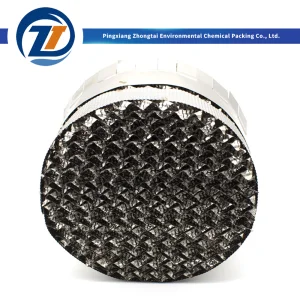
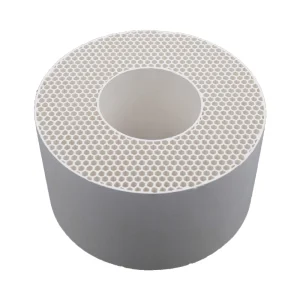
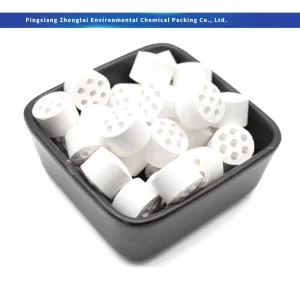
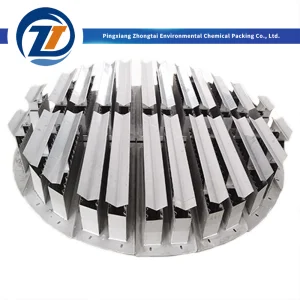
Explore our complete range of random packings, structured corrugated sheets, liquid distributors, and specialized proppants for severe industrial environments.
Direct answers from our senior process engineering team regarding selection, installation, thermal limits, and logistics for Intalox Saddles.