Direct factory supply of engineered mass transfer, catalyst bed protection, and molecular adsorption elements manufactured according to rigid ISO 9001 and ASTM testing criteria.
Unlike standard activated carbons that rely on non-specific surface adsorption, Carbon Molecular Sieves (CMS) function as kinetic gatekeepers for the high-purity fractionation of atmospheric gases.
The operational premise of pressure swing adsorption (PSA) nitrogen generation rests upon the minor differences in kinetic molecular diameters between molecular oxygen (O2, kinetic diameter: 0.346 nm / 3.46 Å) and molecular nitrogen (N2, kinetic diameter: 0.364 nm / 3.64 Å).
While thermodynamic equilibrium adsorption on conventional microporous surfaces would prefer nitrogen due to its quadrupolar moment, Carbon Molecular Sieves flip this relationship entirely via kinetic transport rate differential. The micropore mouths of high-performance CMS are tailored precisely between 0.30 nm and 0.38 nm.
Because oxygen is marginally smaller, its diffusion velocity into the internal pore network of the carbon skeleton is nearly four orders of magnitude faster than nitrogen ($D_{O_2} / D_{N_2} \approx 10^2 - 10^4$). Under operational pressure (typically 0.7 to 0.9 MPa), ambient compressed air flowing across a packed CMS bed deposits oxygen inside the carbon matrix, enabling ultrapure nitrogen gas (from 95% up to 99.9995%) to discharge continuously overhead.
Every batch produced at our Pingxiang factory undergoes rigorous automated lab profiling before dispatch:
| Adsorbent Mechanism | Pore Geometry & Chemistry | Target Gas Adsorbed | Effluent Gas Stream | Regeneration Dynamics | Primary Industrial Sector |
|---|---|---|---|---|---|
| Carbon Molecular Sieve (CMS) | Slit-shaped carbonaceous micropores (3.0 – 3.8 Å) | Oxygen (O2), CO2, Moisture | Purified Nitrogen (N2 95%–99.9995%) | Depressurization to 0 bar (g) ambient venting | Refineries, Electronics, MAP, Metallurgy |
| Zeolite Molecular Sieve (13X) | Aluminosilicate crystalline cage (10 Å faujasite) | Nitrogen (N2 via quadrupole attraction) | Oxygen Concentrator Gas (O2 93% ± 3%) | Vacuum pressure swing (VPSA / PSA) | Medical Oxygen, Steel Blast Furnaces, Ozone |
| Zeolite Molecular Sieve (4A) | Type A aluminosilicate lattice (4.0 Å aperture) | Water vapor, light hydrocarbons | Dry Gas (Dew point < -70°C) | Thermal swing adsorption (TSA, 250–320°C) | Natural Gas Dehydration, Insulating Glass |
| Zeolite Molecular Sieve (5A) | Calcium-exchanged Type A (5.0 Å aperture) | Normal paraffin hydrocarbons (n-alkanes) | Branched iso-alkanes / Hydrogen stream | Pressure/Thermal swing desorption | Petroleum Isomerization, Hydrogen VPSA |
The manufacturing infrastructure of Pingxiang Zhongtai couples abundant industrial precursors with ultra-precise rotary calcination kilns to generate narrow pore distributions with high batch reproducibility.
Synthesis initiates with selected anthracite coal blends or synthetic phenolic novolac resin. Raw feedstocks are pulverized below 20 microns, compounded with specialized organic binders and dispersants, and extrusion-molded into uniform 1.1 mm to 1.8 mm cylindrical pellets.
Pellets traverse inert atmosphere rotary kilns heated between 600°C and 900°C. Controlled devolatilization expels volatile components, forming an amorphous, disordered micro-carbon skeleton featuring an initial aperture network of 0.4 nm to 0.6 nm.
The core proprietary phase: precise quantities of vaporized hydrocarbon agents (e.g., benzene, toluene, or methane) are introduced at 700°C to 850°C. Pyrolytic carbon atoms selectively crack and deposit directly inside pore mouths, narrowing apertures down to the target 0.35 nm.
Selecting the optimal CMS grade depends upon the target nitrogen purity and system design airflow balance. Higher numbered designations correspond to higher nitrogen yield per unit mass of adsorbent at specified purities.
| Model Grade | Adsorption Pressure | Testing Cycle Time | Target Purity ($N_2$) | Nitrogen Output Yield | Air-to-Nitrogen Ratio |
|---|---|---|---|---|---|
| ZTAI-CMS 200 | 0.75 – 0.85 MPa | 2 × 60 seconds | 99.5% | ≥ 200 $Nm^3/h \cdot t$ | 2.8 – 3.0 |
| ZTAI-CMS 220 | 0.75 – 0.85 MPa | 2 × 60 seconds | 99.5% | ≥ 220 $Nm^3/h \cdot t$ | 2.6 – 2.8 |
| ZTAI-CMS 240 | 0.75 – 0.85 MPa | 2 × 60 seconds | 99.9% | ≥ 240 $Nm^3/h \cdot t$ | 3.1 – 3.3 |
| ZTAI-CMS 260 | 0.75 – 0.85 MPa | 2 × 60 seconds | 99.9% | ≥ 260 $Nm^3/h \cdot t$ | 2.9 – 3.1 |
| ZTAI-CMS 280 | 0.75 – 0.85 MPa | 2 × 50 seconds | 99.99% | ≥ 280 $Nm^3/h \cdot t$ | 3.8 – 4.1 |
| ZTAI-CMS 330 (Ultra) | 0.80 – 0.90 MPa | 2 × 45 seconds | 99.999% | ≥ 330 $Nm^3/h \cdot t$ | 4.5 – 5.0 |
Across chemical complexes, marine logistics, and microchip fabrication plants, on-site nitrogen generation replaces costly cryogenic liquid tanker deliveries with continuous, on-demand security of supply.
Microchip lithography, reflow soldering, and component wire-bonding require oxygen concentrations strictly below 5 ppm to avoid metal oxidation. Zhongtai CMS-330 provides 99.999% purity on-site, mitigating surface wetting defects and bridging failures in Surface Mount Technology (SMT) production lines.
In volatile hydrocarbons storage tanks, offshore LNG FPSO vessels, and flare header sweeps, nitrogen inerting depresses the oxygen concentration below the Limiting Oxygen Concentration (LOC). High-hardness CMS pellets resist attrition and bed vibration during high-pressure cyclic pulsations.
Modified Atmosphere Packaging (MAP) for meats, nuts, snacks, and bulk grain silos mandates food-grade inerting gas. Displacing oxygen down to 0.1% arrests fungal sporulation, insect proliferation, and oxidative fat rancidity, extending product shelf lives by 300% without chemical preservatives.
Fiber laser cutting of stainless steel, aluminum, and titanium alloys requires 99.99% dry, oil-free nitrogen up to 3.0 MPa as an assist gas. Pure nitrogen blows molten metal out of the kerf while preventing oxidation, yielding clean, dross-free edge faces ready for direct welding.
In modern EV battery gigafactories, electrolyte injection and pouch cell sealing must transpire inside dry rooms with dew points under -50°C. CMS PSA nitrogen serves as a moisture-free cover gas, preventing electrolyte hydrolysis into toxic, corrosive hydrofluoric acid (HF).
Powder milling, micronization, and vacuum transfer of explosive organic powders demand oxygen-deficient environments to curb static dust ignition. Furthermore, bubbling high-purity nitrogen through solvent reactors removes dissolved oxygen, ending unwanted oxidation of sensitive API structures.
A quantifiable financial and engineering analysis demonstrating how switching to in-house carbon molecular sieve PSA plants radically decreases long-term OPEX and insulates against supply chain disruptions.
When purchasing CMS adsorbents for new generator builds or bed repacking revamps, EPC project engineers evaluate several physical fluid dynamic variables to ensure proper sizing:
Industrial buyers frequently encounter compromised CMS batches from secondary traders characterized by:
1. Wide Pore Size Distribution: Inadequate CVD furnace control resulting in low N2 purity and high air consumption rates.
2. Low Impact Crush Strength: Pellets that pulverize into fine black dust within 3 to 6 months of cyclic valve switching, blocking downstream mufflers and valve ports.
3. Moisture Poisoning: Packaging in standard permeable polyethylene bags rather than hermetically vacuum-sealed steel drums, pre-loading micropores with ambient humidity during sea transit.
Pingxiang Zhongtai counters these risks through factory-direct batch traceability, automated crushing resistance checks on every 500 kg lot, and airtight export packaging.
The role of Carbon Molecular Sieves is expanding beyond traditional nitrogen generation into clean fuel refining, hydrogen economy separation, and decarbonization infrastructures.
Customization of CMS pore mouths to 0.33 nm to kinetically split CO2 (0.33 nm) from Methane (CH4, 0.38 nm) in anaerobic digester gas, transforming raw agricultural biogas into pipeline-spec biomethane.
Development of high-rigidity carbon matrices capable of operating at 3.5 MPa for single-stage separation of trace CO, CO2, and N2 from Steam Methane Reforming (SMR) and water electrolysis off-gases.
Deploying neural network PID controllers on electric continuous rotary furnaces to regulate carbon vapor cracking rates within ±0.8°C, narrowing batch aperture deviation to less than 0.01 Å.
Transitioning from fossil-derived coal pitches toward renewable agricultural lignin and waste coconut shell precursors to manufacture carbon-negative molecular sieves for sustainable industrial supply chains.
Improper loading of CMS into PSA twin towers is the single greatest cause of early bed failure. Pouring media directly from bags induces loose gravity settling, creating localized density voids. Under intense cyclic pressure changes (0 to 0.8 MPa every 60 seconds), loosely packed pellets shift, grind against one another, and disintegrate into fine carbon dust.
Utilize a rotating pneumatic distribution plate at the column top. Pellets fall individually like a snowstorm, interlocking tightly horizontally and vertically to achieve maximum packing density (>680 g/L).
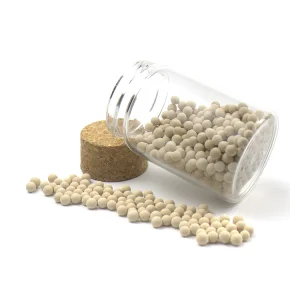
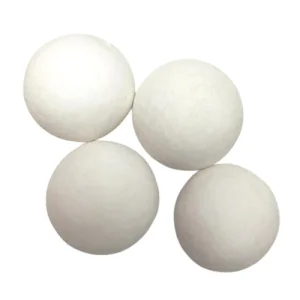
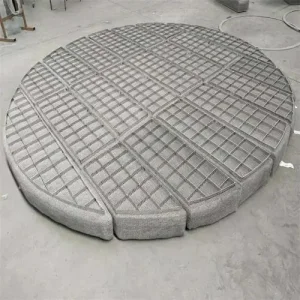
Top the carbon bed with stainless steel wire mesh (30 mesh), followed by a 100 mm layer of high-density 17–23% inert alumina ceramic balls and a mechanical spring-loaded hold-down plate to lock media firmly in position.
Ensure compressed feed air passes through refrigerated and desiccant dryers plus oil-coalescing micro-filters. Residual oil aerosols (<0.01 mg/m³) permanently poison CMS micropores within weeks if unfiltered.
Detailed technical answers addressing design calculations, bed lifespans, contamination diagnostics, and procurement specifications.
Explore additional high-performance column internals, structured packings, zeolite molecular sieves, and molten filtration media engineered for petrochemical and metallurgical plants.