
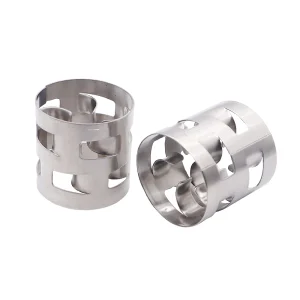
Engineered for high mass transfer efficiency, low hydraulic pressure drop, and superior mechanical resistance to thermal stress.
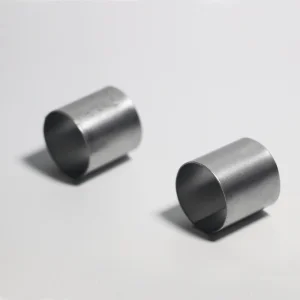
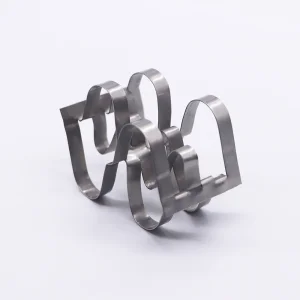
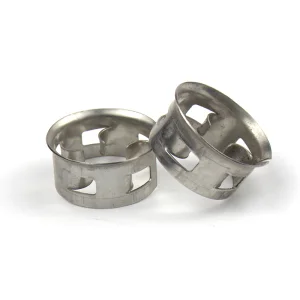
Strategic deployment of metallic tower internals across archipelago-specific operating conditions and emerging energy corridors.
The Republic of the Philippines presents a rapidly evolving industrial landscape marked by distinct geographic, climatic, and metallurgical challenges. As manufacturing centers expand beyond Metro Manila into the CALABARZON (Cavite, Laguna, Batangas, Rizal, Quezon) corridor, Central Luzon (Bataan, Pampanga), and Northern Mindanao, process engineers are upgrading aging fractionation, absorption, and stripping assets. The country’s industrial economy is heavily reliant on petrochemical refining, oleochemical extraction, fertilizer synthesis, geothermal power generation, and coastal thermal power facilities.
Operating in the Philippines requires overcoming critical environmental vulnerabilities. Process facilities situated along the coastal zones of Batangas Bay, Bataan Peninsula, and Iligan Bay operate in aggressive marine microclimates characterized by high ambient humidity (averaging 75% to 88% annually), severe sea-salt aerosol dispersion, and heavy typhoons. Metal tower packings deployed in acid gas scrubbers, natural gas sweetening columns, and solvent recovery plants must withstand not only process stream corrosivity but also rapid external atmospheric stress and severe operational swings.
Serving complex crude refining, olefin cracking, naphtha hydrotreating, and lube oil recovery. High-pressure columns require SS316L and Alloy 2205 structured and random packing to minimize HETP while preventing chloride-induced stress corrosion cracking (CSCC).
The Philippines is one of the world's premier producers of geothermal energy (Tiwi, Mak-Ban, Tongonan, Palinpinon). Scrubbing hydrogen sulfide (H₂S) and carbon dioxide from high-enthalpy geothermal steam lines necessitates titanium, Hastelloy C-276, and 316L packing media.
Refining crude coconut oil (CNO), fatty acids, methyl esters, and refined glycerine demands stainless steel tower internals that provide high thermal efficiency under deep vacuum to avoid product degradation and fouling in esterification and distillation towers.
A rigorous evaluation matrix designed for plant revamps, debottlenecking, and greenfield installations in Southeast Asia.
Achieving optimal mass transfer inside packed columns hinges on understanding the delicate equilibrium between specific surface area (m²/m³), void fraction (%), packing factor (Fp), and hydraulic resistance under high vapor velocities. In tray-to-pack conversions—a prevalent revamp strategy in Philippine facilities seeking up to 35% capacity boosts without shell replacement—metal random and structured packings offer significant thermodynamic advantages.
Compared to ceramic or polymer alternatives, metal tower packings feature ultra-thin wall constructions (down to 0.3mm for wire gauze or 0.8mm–1.5mm for stamped sheet rings). This yields voidages typically exceeding 95% to 98%, dramatically lowering the specific pressure drop per theoretical stage (ΔP/NTS). This physical characteristic is vital for vacuum applications such as fatty acid fractionation columns in Southern Luzon, where minimal bottom temperature must be preserved to prevent polymerization and thermal decomposition of sensitive organic molecules.
| Packing Type & Geometry | Available Alloys | Specific Surface Area (m²/m³) | Void Fraction (%) | Bulk Density (kg/m³) | Primary Industrial Use-Case |
|---|---|---|---|---|---|
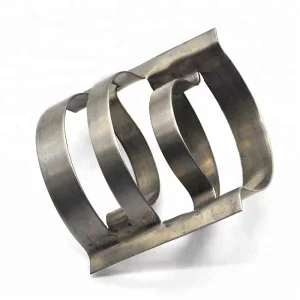
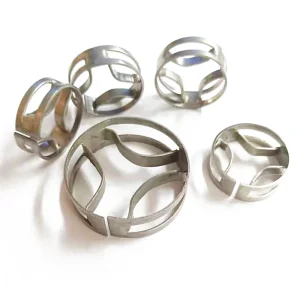
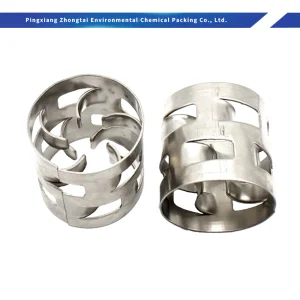
| Metal Pall Ring (50mm / 2") | SS304, SS316L, Carbon Steel | 110 – 128 | 96.5% | 330 – 350 | CO₂ absorption scrubbers, VOC abatement, refinery atmospheric towers |
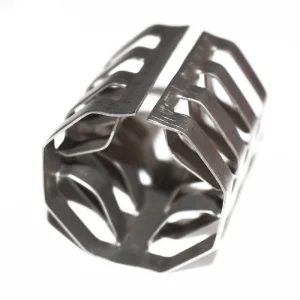
| Cascade Mini Ring (#2 / #3) | SS316L, 321, Duplex 2205 | 150 – 180 | 97.2% | 290 – 310 | Demethanizers, deethanizers, liquid-liquid extraction units |
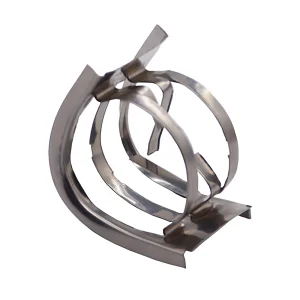
| Metal Intalox Saddle (#50) | SS316L, Hastelloy C-276, Monel | 130 – 160 | 97.8% | 280 – 320 | Vacuum distillation, sulfuric acid stripping, acid gas recovery |
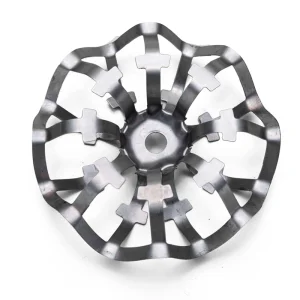
| Metal Super Raschig Ring (No. 1.5) | SS304, SS316L, Titanium Gr. 2 | 145 – 175 | 98.1% | 260 – 295 | High-throughput debottlenecking, olefin purification columns |
| Wire Gauze Structured Packing (500X/Y) | SS316L, 304, Hastelloy C-22 | 450 – 520 | 94.0% | 380 – 420 | High-purity essential oil extraction, pharma-grade glycerine, isomer separation |
Bridging international fabrication rigor with the statutory codes of the Philippine Department of Energy (DOE) and Department of Environment and Natural Resources (DENR).
Every shipment bound for the ports of Manila (MICT/South Harbor), Batangas, or Subic is accompanied by certified Mill Test Certificates (MTC), spectrographic melt analyses, and strict compliance documentation verifying exact alloy composition.
Industrial boilers and smelting operations, such as the PASAR copper smelter in Leyte, face strict emission thresholds for SO₂ and NOx. Our high-efficiency metal packing configurations ensure maximal removal efficiency in municipal and hazardous flue gas scrubbers.
To eliminate rust blooming and galvanic pitting during maritime transit across the South China Sea, all metallic internals undergo passivation, desiccant-infused vapor corrosion inhibitor (VCI) shrink-wrapping, and export-grade fumigated seaworthy crating.
Addressing decarbonization, blue hydrogen production, and circular economy requirements through advanced surface metallurgy.
The industrial decarbonization agenda within Southeast Asia is placing new performance mandates on traditional column internals. The transition toward point-source Carbon Capture, Utilization, and Storage (CCUS) projects across coal-fired power facilities in Sual, Pagbilao, and Mariveles requires amine treating columns with unprecedented gas throughput capacity and minuscule foaming tendencies. Conventional random packings often experience localized liquid maldistribution and hot spots when subjected to high-viscosity, solvent-degrading environments.
Our research and engineering initiatives focus on three transformative pillars: micro-textured surface modifications that promote uniform liquid film creation at ultra-low liquid fluxes (L < 0.5 m³/m²·h); hybrid metallurgical packings combining high-strength core alloys with nano-coatings that resist abrasive particulate erosion in mining effluent scrubbers; and computational mass transfer design tools that allow Philippine process operators to simulate flooding envelopes and revamp column performance with real-world fluid dynamics data before taking towers offline.
Enhanced wetting mechanics allow immediate boundary-layer refreshment, preventing stagnant liquid pockets and eliminating local corrosion cells in high-purity chemical distillation.
Experimental deployment of advanced austenitic and super duplex alloys engineered to survive extreme geothermal steam condensates containing acidic chloride-fluoride mixtures.
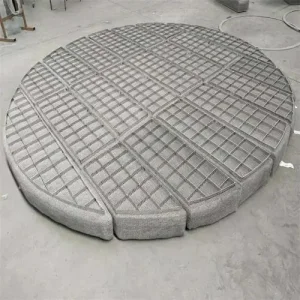
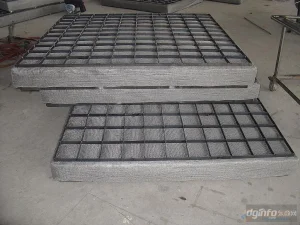
Seamless integration between random packing beds and custom-engineered liquid distributors, hold-down plates, and multi-beam support grids for zero-dead-zone fluid distribution.
Factory-direct supply of random rings, saddles, and precision structured corrugated packings for heavy industrial service across the Philippines.
In-depth responses covering metallurgy, importation logistics, hydraulic design, and site turnaround support.
Philippine chemical and petrochemical operations located close to marine waters (e.g., Batangas, Bataan, and Cebu) encounter elevated airborne chloride concentrations. When operating temperatures exceed 60°C, conventional SS304 is prone to stress corrosion cracking. In such scenarios, our engineering group specifies stabilized low-carbon grades such as SS316L, Duplex 2205 (EN 1.4462), or Super Duplex alloys. These metals feature higher pitting resistance equivalent numbers (PREN ≥ 35), providing robust defense against localized pitting and stress-induced cracking in hot, saline, and damp settings.
Shipments depart direct from major container ports (Shanghai or Ningbo) to Manila South Harbor or the Manila International Container Terminal (MICT) with typical maritime transit times of 4 to 7 days. Batangas and Subic Bay ports are served via direct or feeder routes in 6 to 9 days. We provide comprehensive export documentation to support Philippine Bureau of Customs (BOC) release, including ASEAN-China Free Trade Agreement Preferential Tariff Certificates (Form E), commercial invoices, fumigation certificates, packing lists, and certified EN 10204 3.1 Mill Test Reports.
In fatty acid, biodiesel, and coconut oil distillation plants across Mindanao, structured wire gauze or corrugated sheet packing (such as 250Y or 500X) is favored when operating under high vacuum where pressure drop across the entire column must remain strictly below 20–30 mbar. Structured packing provides an exceptionally low HETP (typically 250mm to 350mm). Conversely, for heavily fouling duties, crude oil desolventizing, or wash sections where solids or polymeric residues might accumulate, random packings like Metal Pall Rings or Cascade Mini Rings offer simpler maintenance, superior anti-fouling characteristics, and easier in-situ washing.
Yes. Our in-house chemical and mass transfer engineering team conducts full hydraulic rating studies. If you provide column dimensions, operating flow rates (vapor and liquid), density, viscosity, surface tension, and separation targets, we compute the operational flooding percentage, pressure drop per meter, effective interfacial surface area, and theoretical plate requirements. For tray conversions, we design and manufacture the full suite of internal column hardware, including support plates, hold-down screens, chimney trays, and high-precision trough or spray liquid distributors.
All raw stainless steel, nickel alloy, and titanium coils undergo incoming raw material verification, including optical emission spectrometry (OES) and X-ray fluorescence (XRF) Positive Material Identification (PMI). Stamping dies, forming equipment, and deburring systems dedicated to stainless steel are isolated from carbon steel handling lines to eliminate iron pick-up and subsequent galvanic corrosion. Finished products undergo degreasing, ultrasonic cleaning, and acid passivation to ensure an unblemished chromium-oxide protective barrier.