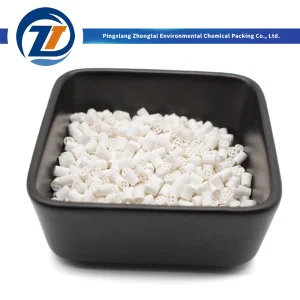
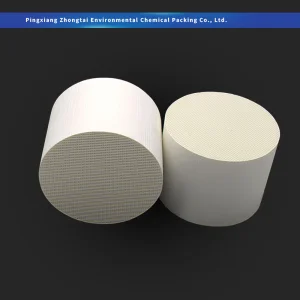
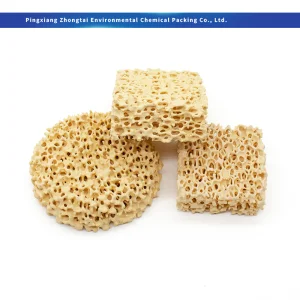
Direct factory-engineered mass transfer media, ceramic foam filters, and catalyst bed support solutions for industrial process towers.
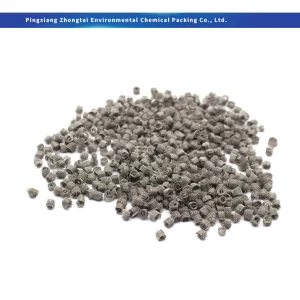
Synthetic Zeolite Type 13X (Sodium X faujasite structure) represents the pinnacle of commercial alkali metal aluminosilicate adsorbents. Defined by its open-framework crystal lattice with an effective pore aperture of approximately 10 Angstroms (1.0 nm), Zeolite 13X possesses a unit cell chemical formula of Na86[(AlO2)86(SiO2)106]·264H2O with a characteristic silica-to-alumina (SiO2/Al2O3) molar ratio of 2.0 to 2.5.
Unlike 3A, 4A, or 5A molecular sieves, Zeolite 13X features a super-cage cavity structure capable of adsorbing molecules with kinetic diameters up to 10 Å. This allows for the simultaneous entrapment of large hydrocarbons, aromatics, nitrogen compounds, and trace polar impurities, making it the industry standard for industrial gas purification.
Manufactured through precision hydrothermal synthesis, high-grade China 13X zeolites demonstrate static water adsorption values exceeding 26.0% by weight (at 25°C, 75% RH) and carbon dioxide (CO2) adsorption capacities of ≥ 18.0 cm³/g under standard pressure conditions.
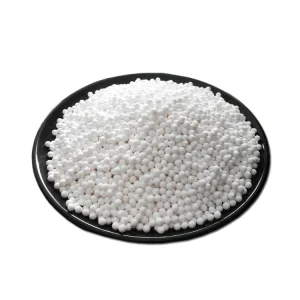
Severe thermal swings in Pressure Swing Adsorption (PSA) and Temperature Swing Adsorption (TSA) units require extreme crush strength. Modern Chinese manufacturing utilizes advanced clay binder systems and binderless techniques to deliver crush strengths up to ≥ 85 N/bead (3-5 mm size).
| Property Parameter | Zeolite 3A | Zeolite 4A | Zeolite 5A | Zeolite 13X (Standard) | Zeolite 13X-APG / HP |
|---|---|---|---|---|---|
| Nominal Pore Diameter | 3 Å (0.3 nm) | 4 Å (0.4 nm) | 5 Å (0.5 nm) | 10 Å (1.0 nm) | 10 Å (Optimized Lattice) |
| Cationic Counter-Ion | Potassium (K+) | Sodium (Na+) | Calcium (Ca2+) | Sodium (Na+) | Sodium / Modified Na-Li |
| Bulk Density (g/ml) | 0.60 – 0.68 | 0.62 – 0.70 | 0.62 – 0.69 | 0.62 – 0.68 | 0.64 – 0.70 |
| Static Water Adsorption (wt%) | ≥ 21.0% | ≥ 22.0% | ≥ 21.5% | ≥ 26.0% | ≥ 27.5% |
| CO2 Adsorption Capacity | Excluded | Low | Moderate | ≥ 18.0 cm³/g | ≥ 22.0 cm³/g |
| Primary Industrial Intent | Ethanol/Cracked Gas Drying | General Gas Drying | H2 Purification, n-Paraffin | ASU Pre-purification, Mercaptans | Cryogenic ASU, VPSA Oxygen |
Understanding the pricing drivers for China-manufactured Zeolite 13X requires a deep-dive look into raw material synthesis, chemical binder technologies, calcination energy costs, and quality control specifications.
The baseline cost of 13X synthetic powder is dictated by sodium silicate (water glass) and sodium aluminate quality. Using low-iron, high-purity silica sol prevents pore clogging and structural lattice defects, yielding superior adsorption isotherms while adding 8-12% to raw material cost.
Standard Zeolite 13X incorporates 15-20% inorganic clay binders (such as attapulgite, kaolin, or bentonite). Advanced Binderless Zeolite 13X undergoes secondary crystallization, converting the clay matrix into active zeolitic structure. Binderless grades carry a 30-45% price premium due to higher static capacity (+20%) and lower bed mass requirements.
Particle sizing directly impacts column pressure drop. Micro-spheres (0.4-0.8 mm) for medical oxygen concentrators require specialized high-frequency bead-forming equipment and narrow screening tolerances, commanding higher pricing than standard industrial 3.0-5.0 mm spherical beads or 1/16” extrudates.
Chinese manufacturers structure pricing based on technical specification tiers, packaging standards, and total order volume:
The global chemical engineering sector is shifting toward decarbonization, energy efficiency, and extended bed lifetimes. Chinese top-tier manufacturers are driving R&D breakthroughs across four core technological vectors:
Eliminating hazardous wastewater by recycling mother liquor during faujasite crystallization. Green synthesis cuts carbon emissions per ton of zeolite by up to 28% while improving crystalline purity.
By transforming inert clay binders into active Type X zeolitic crystals via caustic aging, binderless sieves increase active pore volume to nearly 100%, vastly reducing required vessel sizing.
Engineering framework defects and cation positions to lower TSA desorbing temperatures from 300°C down to 180°C–220°C, drastically cutting plant utility steam and electrical consumption.
Developing modified 13X variants capable of selective mercaptan and VOC capture in high-humidity stream conditions without immediate water-saturation deactivation.
Zeolite 13X is deployed globally across major process industries where trace contamination leads to operational downtime or severe equipment damage.
In cryogenic Air Separation Units (ASU), trace moisture and carbon dioxide must be removed down to sub-ppm levels (<0.1 ppm H2O, <1 ppm CO2) prior to entering the main heat exchanger box. Freezing CO2 or ice causes catastrophic blockage in aluminum plate-fin heat exchangers. Zeolite 13X-APG offers exceptionally high CO2 dynamic adsorption capacity even under low partial pressures.
Natural gas streams contain corrosive H2S and organic sulfur compounds such as methyl, ethyl, and propyl mercaptans (R-SH). Due to its ~10 Å pore aperture, Zeolite 13X easily accommodates bulky mercaptan molecules that cannot enter 4A or 5A sieves, protecting downstream pipeline assets and meeting pipeline sales specifications.
In Pressure Swing Adsorption (PSA) and Vacuum Pressure Swing Adsorption (VPSA) systems, molecular sieves selectively adsorb nitrogen from ambient air, concentrating oxygen up to 93%-95%. Specialized 13X-HP and Li-X variants provide rapid adsorption kinetics, high N2 working capacity, and low energy usage per Nm³ of generated O2.
Proton Exchange Membrane (PEM) fuel cells require ultra-pure hydrogen (>99.97%) free from trace CO, CO2, and light hydrocarbons. Zeolite 13X acts as a primary polishing bed in multi-bed PSA systems, removing residual hydrocarbons and carbon oxides to prevent catalyst poisoning.
Liquid hydrocarbon feeds (such as naphtha, butane, and propane) require deep dehydration and trace nitrogen/sulfur compound removal before entering catalytic isomerization reactors. Zeolite 13X extends expensive noble metal catalyst lifetimes by up to 300%.
Industrial printing, coating, and chemical manufacturing release volatile organic compounds (VOCs). Hydrophobic and modified 13X zeolite beds capture solvent vapors (toluene, xylene, ethyl acetate) for recovery or thermal oxidation, ensuring compliance with strict environmental emission limits.
China’s leadership in industrial chemical packing and molecular sieve manufacturing is rooted in geographic industrial clusters, vertically integrated supply chains, and automated digital process control.
Pingxiang City in Jiangxi Province stands as China’s recognized hub for industrial ceramics, mass transfer packing, and synthetic adsorbents. Raw kaolin, silicate resources, specialized kiln engineering firms, and testing laboratories are concentrated within a 50-kilometer radius, driving down supply chain friction and operational overhead.
Modern Industry 4.0 production facilities utilize computer-controlled hydrothermal reactors for precise crystalline growth control. Continuous rotary kilns equipped with multi-zone infrared thermal sensors ensure uniform calcination temperature profiles, eliminating batch-to-batch variations in crush strength and moisture activation.
Molecular sieves rapidly absorb atmospheric moisture if exposed during packing. Leading Chinese factories deploy continuous vacuum-sealed packaging systems, filling air-tight steel drums, heavy-duty plastic pails, or barrier-lined jumbo bags in nitrogen-blanketed cleanrooms.
International EPC contractors, refineries, and chemical plant operators require strict certification alignment before approving new molecular sieve vendor registrations.
Export-ready China manufacturers maintain certified quality and environmental management systems in full compliance with ISO 9001:2015 (Quality Management), ISO 14001:2015 (Environmental Standard), and ISO 45001:2018 (Occupational Health & Safety).
For European Union destinations, synthetic zeolites undergo full EU REACH registration, ensuring compliance with chemical safety limits. Material Safety Data Sheets (MSDS) and RoHS heavy metal test reports are routinely issued per manufacturing lot.
To eliminate procurement risk, shipments are routinely audited by third-party international testing agencies such as SGS, Intertek, or BV (Bureau Veritas) for critical metrics including crush strength, static water absorption, bulk density, and attrition loss.
Evaluating Zeolite 13X purely on an upfront $/kg or $/MT basis often leads to sub-optimal operational results. Process engineers and procurement executives must evaluate adsorbents through a Total Cost of Ownership (TCO) matrix.
TCO = CInitial Procurement + CFreight & Logistics + CBed Installation & Downtime + CRegeneration Energy (5-8 Yrs) - ValueExtended Lifetime
Selecting high-capacity, low-attrition Zeolite 13X reduces vessel mass requirements, lowers regeneration temperature duty, and extends replacement cycles from 3 years to 5-8 years, yielding up to a 40% lifecycle cost savings.
| Inspection Property | Test Standard Method | Target Technical Specification | Operational Risk if Non-Compliant |
|---|---|---|---|
| Particle Sizing & Uniformity | GB/T 6609 / ASTM D5158 | ≥ 98% within nominal range (e.g. 3.0-5.0mm) | Bed channeling, uneven gas distribution, pressure drop spikes |
| Bulk Density | ASTM D4180 | 0.64 – 0.68 g/mL | Incorrect bed volume calculation, mass loading shortfall |
| Crush Strength (Average) | ASTM D4179 / Single Bead Test | ≥ 35 N (1.6-2.5mm) / ≥ 85 N (3.0-5.0mm) | Bead crushing under bed static weight, dusting, pressure build-up |
| Attrition Loss Rate | Custom Tumbling / ASTM D4058 | ≤ 0.10% by weight | Downstream particulate contamination, valve seating erosion |
| Static Water Adsorption | HG/T 2521 / Desiccator Method | ≥ 26.0% (at 25°C, 75% RH) | Premature moisture breakthrough, freezing in cold boxes |
| Residual Package Moisture | Karl Fischer / LOI (575°C) | ≤ 1.5% as delivered | Reduced initial working capacity, immediate bed deactivation |
Direct technical answers to common questions asked by procurement directors, plant engineers, and international buyers when evaluating China Zeolite 13X suppliers.
Get bulk metric-ton pricing, custom sizing options, and full laboratory batch reports directly from Pingxiang's premier chemical packing and molecular sieve production base.
Contact Senior Technical EngineerComprehensive selection of high-alumina support media, molecular sieves, structured packing, and foundry filtration components.